
Predictive Modeling of Thermal Stratification: A Proxy for Algal Bloom Management in Lake Trevallyn
Thermal Stratification Prediction at Lake Trevallyn
This paper presents a machine learning-based approach to predict thermal stratification in Lake Trevallyn, Tasmania, as a proxy for toxic algal blooms. By utilizing a linear regression model with lagged environmental variables (air temperature, humidity, and river flow), the authors achieved effective one-day-ahead temperature predictions across the water column.
TL;DR
Researchers from CSIRO have developed a machine learning framework to predict thermal stratification in Lake Trevallyn, Tasmania. By identifying that environmental variables correlate better with absolute depth temperatures than with temperature differences, the team successfully utilized linear regression with time-lagged data to provide a one-day-ahead forecasting tool for conditions that trigger toxic algal blooms.
Motivation: The Silent Threat in the Water Column
Lake Trevallyn is more than just a scenic spot in Launceston; it is a critical source of drinking water and hydroelectric power. However, recent years have seen the emergence of toxic algal blooms, which not only degrade water taste and odor but pose significant health risks.
The biological "trigger" is Thermal Stratification—a phenomenon where water layers stop mixing, creating a warm, stationary surface layer ideal for algae growth. Predicting these events is the first step toward proactive water management.
The Methodological Pivot: Predicting Components, Not the Gap
Initially, the researchers faced a major hurdle: the direct correlation between weather variables (like wind or rain) and the temperature difference (stratification) was extremely weak (typically < 0.2). This low signal-to-noise ratio made direct machine learning prediction nearly impossible.
The Insight: Instead of predicting the "difference," the authors chose to predict the actual temperatures at two specific depths: the surface (0.5m) and the bottom (10m).
Data Synergy and Feature Engineering
The model incorporates data from multiple sources:
- BoM Station (Ti Tree Bend): Air temperature, humidity, wind speed.
- SILO Data: Solar radiation, air pressure, and rainfall.
- Hydrological Flow: Flow rates from the Meander and Liffey Rivers.
Through correlation analysis (Fig. 3), the team discovered that a lag of 4 days was the "sweet spot" for these variables to influence water temperature, accounting for the thermal inertia of the lake.
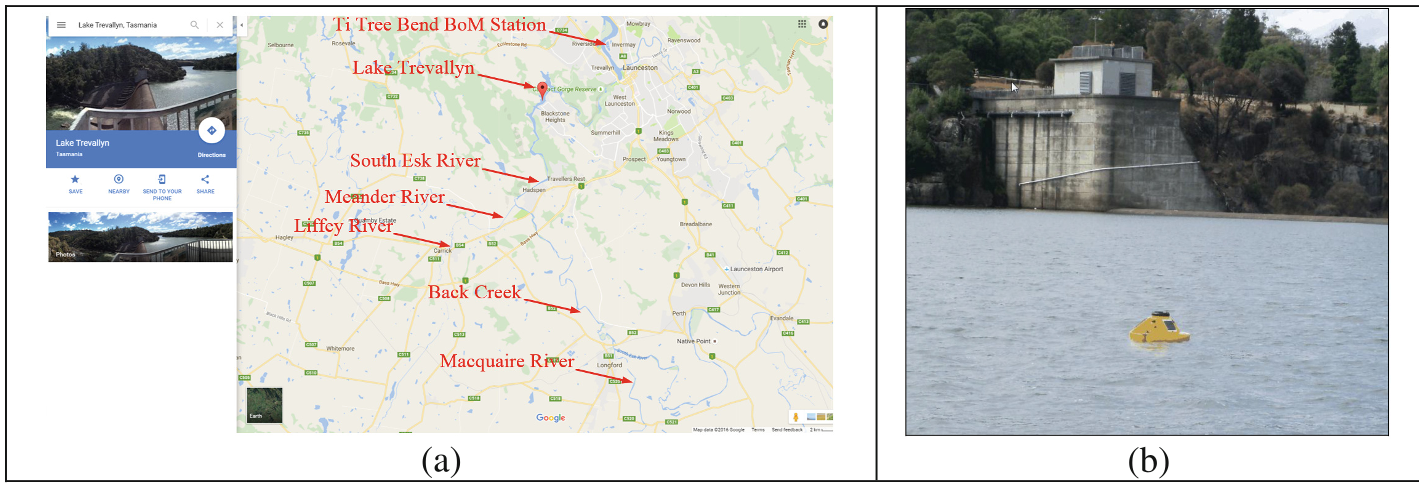 Fig 1. Geographical context of Lake Trevallyn and the placement of the sensor buoy used for data collection.
Results: Linear Simplicity Over Nonlinear Complexity
Interestingly, the study found that Support Vector Regression (SVR)—a more complex non-linear model—performed poorly compared to Linear Regression. This suggests that the relationship between environmental forcing and water temperature, once correctly lagged and selected, is predominantly linear.
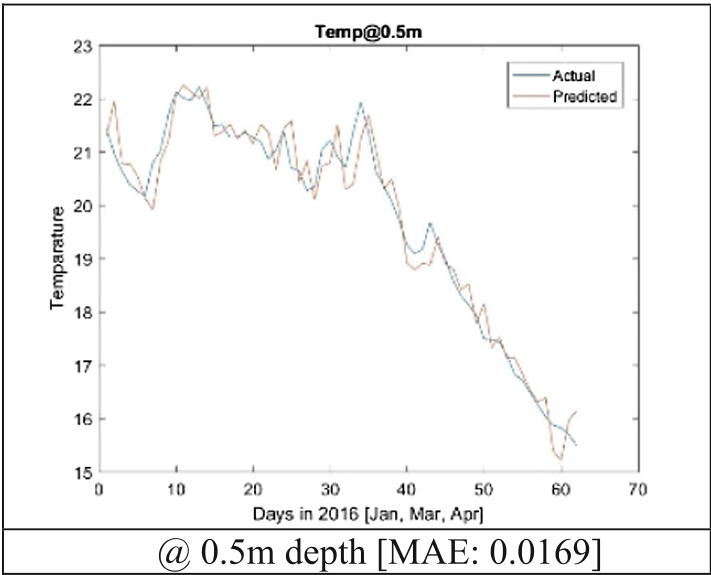 Fig 3. Analysis showing the correlation between influence variables and temperature across different lags. Defining the 0.5 threshold was key to feature selection.
The model was trained on 2014-2015 data and validated on 2016 data. The results showed a high degree of fidelity in tracking the temperature at both 0.5m and 10m depths, effectively capturing the widening gap that signifies stratification.
Critical Analysis & Future Outlook
While this work provides a robust baseline for short-term prediction, it is a "preliminary" step. The reliance on linear models suggests that the current feature set is well-posed, but extending the prediction horizon to weeks or months—which would be necessary for long-term infrastructure planning—will likely require more sophisticated temporal models like LSTMs (Long Short-Term Memory networks) to account for seasonal trends and long-term climate oscillations.
Key Takeaway for Industry: When dealing with environmental sensors, the "Physics of the Problem" (like thermal inertia) should dictate the "Architecture of the Model" (like lag periods). Simple models often win when the features are engineered with domain expertise.