
The Birth of the Social Brain: How Theta Networks Reconfigure During Infancy
The emergence of a theta social brain network during infancy
This longitudinal study of 854 infants maps the development of functional brain networks using EEG during the first year of life. It identifies a distinct reconfiguration of theta-band networks from parieto-occipital to frontoparietal structures, which correlates with the emergence of social selectivity.
Executive Summary
TL;DR: High-density EEG tracking of over 800 infants reveals that the "Social Brain" isn't born—it's networked. Between 5 and 10 months of age, the brain's theta-band oscillations shift from local posterior processing to a sophisticated frontoparietal network that specifically "tunes in" to social stimuli like human faces and songs.
Academic Context: This work serves as a pivotal validation of the Interactive Specialization (IS) framework. It moves past the "modular" view of brain development (where areas turn on like lightbulbs) toward a "connectionist" view where the orchestration of communication between distant regions is the true catalyst for cognitive milestones.
Problem & Motivation: Beyond Isolated Brain Regions
Human social behavior undergoes a sea change during the first year. A newborn's reflexive gaze evolves into complex joint attention and vocal play by 12 months. Traditionally, researchers looked at where the brain was active (e.g., the Fusiform Face Area). However, the authors argue that social capability arises not from a single "spot," but from optimized communication between areas.
The challenge? Capturing this in infants is notoriously difficult due to "fussiness" (data loss) and the limitations of traditional fMRI in moving babies. By using EEG and the Phase Lag Index (PLI), this study provides a robust look at how the "wiring" (functional connectivity) changes in real-time.
Methodology: High-Volume Longitudinal Tracking
The study followed 854 infants at two critical junctures: 5 months and 10 months.
- Stimuli: Naturalistic social videos (women singing nursery rhymes) vs. non-social videos (moving toys).
- Connectivity Metric: PLI was used to measure synchronicity. Unlike simple power analysis, PLI filters out the "background noise" of volume conduction, focusing on real phase-locked communication between distant sensors.
- Statistical Rigor: Linear Mixed Models (LMM) allowed the team to include participants even if they missed one session, maximizing the power of their massive dataset.
 The study utilized a specific grouping of electrodes to visualize "smoothed" connectivity across Frontal, Central, Parietal, and Occipital regions.
Methodology Detail: The Core Reconfiguration
The primary finding was a "Handover" of network dominance. In early infancy (4-5 months), the theta network is largely localized in the occipito-parietal (back of the head) regions—likely reflecting primary sensory processing of visual movement.
By 10 months, a "Frontoparietal Triangle" emerges. The prefrontal cortex begins communicating intensely with bilateral parietal areas.
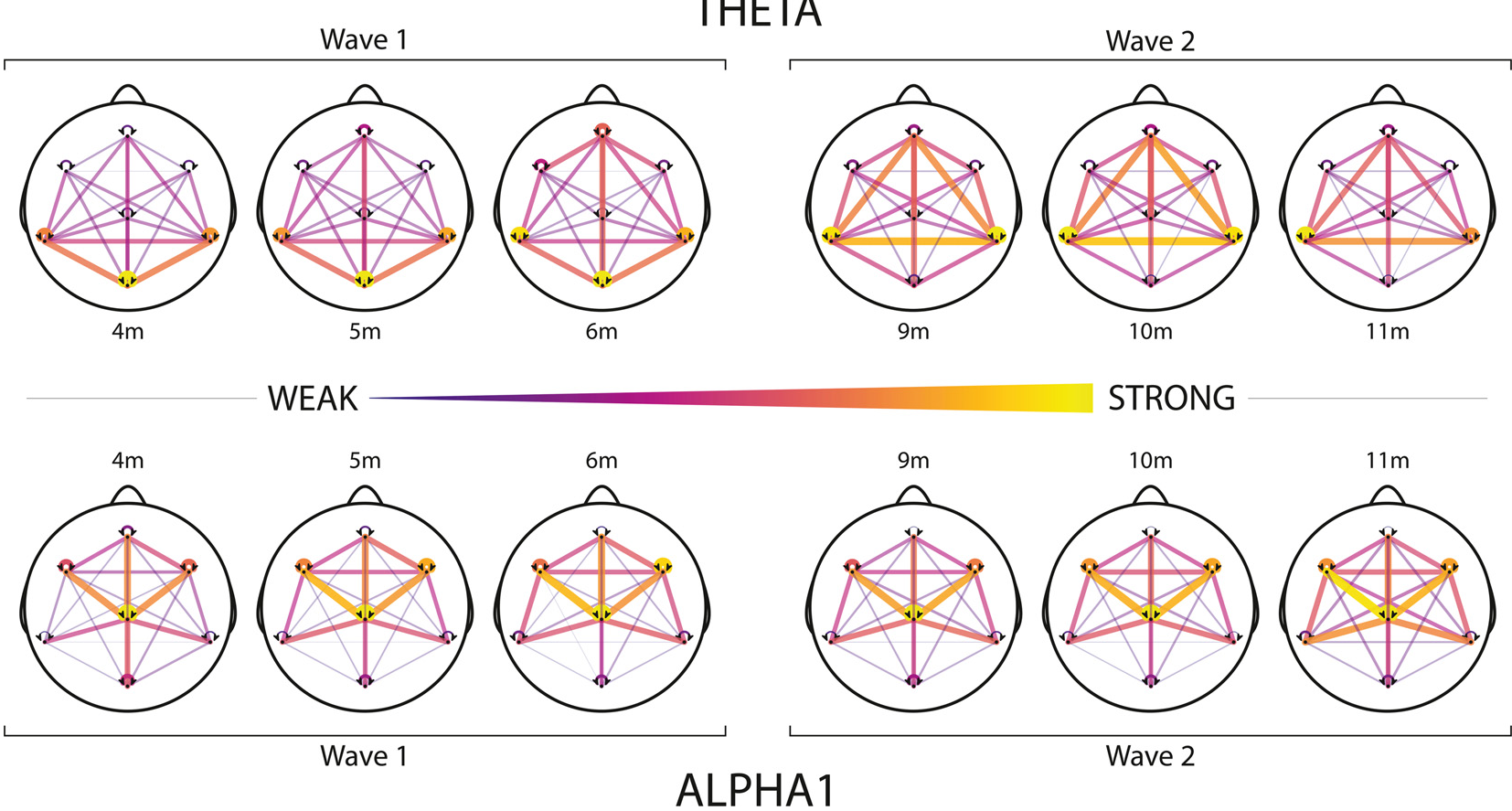 Note the shift from the 4-month-old's posterior focus to the 10-month-old's robust triangle of connectivity between the frontal and left/right parietal areas.
Experiments & Results: Social Selectivity
Is this new network actually "social"? The data says yes.
- Theta Band: Showed a significant Interaction Effect between Age and Stimulus Type. While 5-month-olds processed social and non-social videos with similar network strength, 10-month-olds showed a massive spike in global synchronicity for social content (r = 0.52).
- Alpha Band: Though alpha connectivity increased with age (likely due to general myelination), it showed zero selectivity for social vs. non-social stimuli.
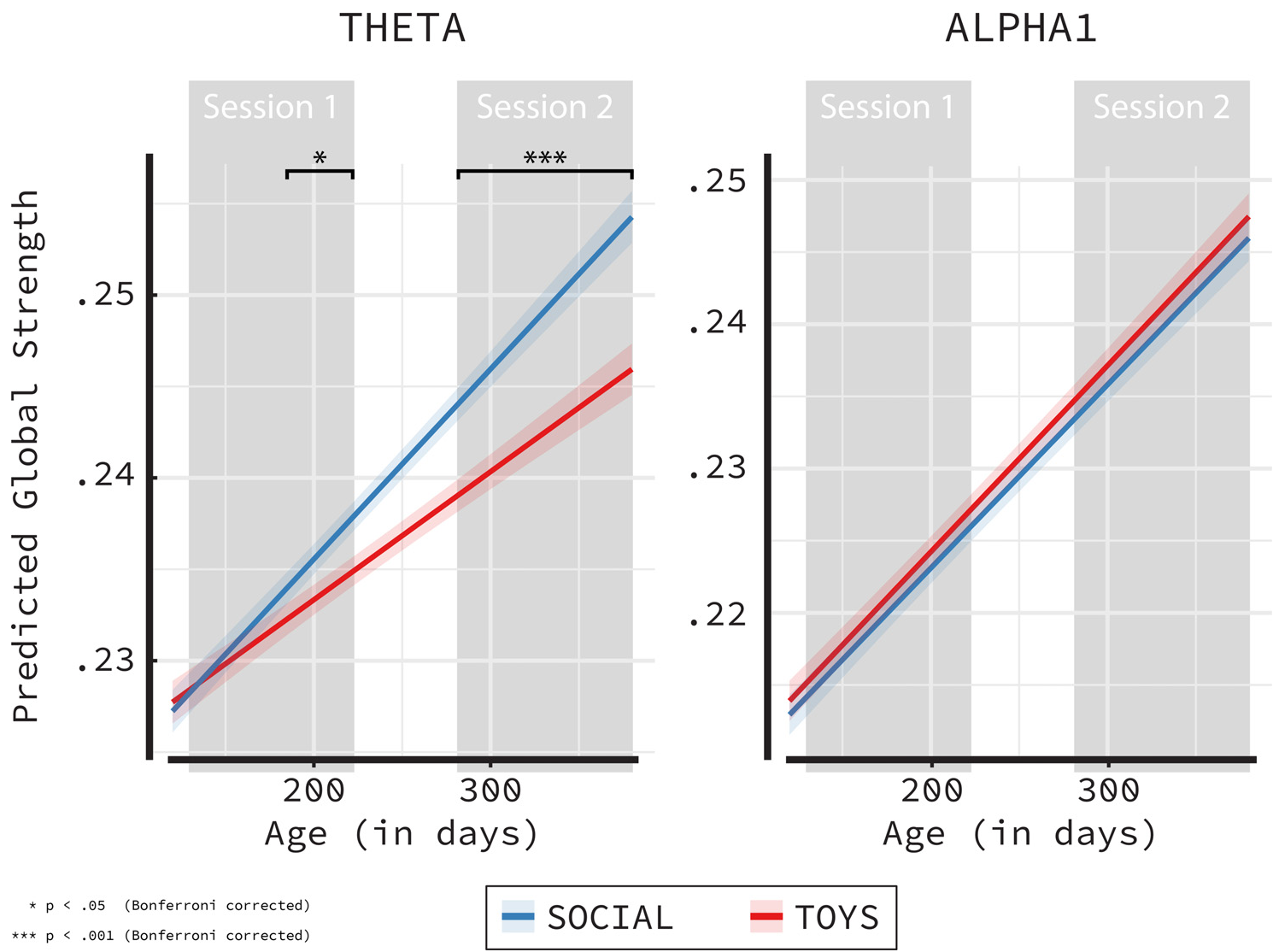 The divergence at 10 months shows the theta network specifically "activating" for social experiences, a hallmark of the maturing social brain.
Depth Insight: Why Theta?
In the academic hierarchy of brain rhythms, Theta (3-6 Hz) is often linked to memory, emotional processing, and infant-directed speech. The study suggests that the reorganization of theta connectivity provides the "scaffold" for social learning. As the frontoparietal theta network comes online, infants gain the ability to integrate information from different senses and focus their attention on social agents.
Critical Analysis & Conclusion
Takeaway
The "Social Brain" is a network-level phenomenon. Its emergence is marked by a structural shift towards frontoparietal integration in the theta frequency band, specifically between 6 and 9 months of age.
Limitations
- The 3-Month Gap: Because the study sampled at 5 and 10 months, we don't know if this reconfiguration is a gradual "slide" or a sudden "jump" at 8 months.
- Screen vs. Reality: The stimuli were videos. Social interaction in the real world is "live" and reciprocal, which might engage the Alpha band differently (e.g., through mu-rhythm desynchronization).
Future Outlook
This normative map of social network development provides a baseline for clinical research. In the future, "low theta-connectivity" at 10 months might serve as an early-warning signal for ASD, allowing for interventions years before behavioral symptoms become obvious.