
Thinking Without Words: How Abstract-CoT Smashes the Efficiency Barrier of Reasoning Models
Thinking Without Words: Efficient Latent Reasoning with Abstract Chain-of-Thought
Abstract Chain-of-Thought (Abstract-CoT) is a novel post-training mechanism that enables Large Language Models to perform discrete latent reasoning using a reserved vocabulary of "abstract tokens." By replacing lengthy natural language rationales with short, non-verbal sequences, it achieves comparable performance to standard CoT while being up to 11.6x more token-efficient.
TL;DR
Reasoning models like OpenAI's o1 or DeepSeek-R1 have proven that "thinking" leads to better answers, but at a massive cost: they generate thousands of "hidden" words that bloat latency. Abstract Chain-of-Thought (Abstract-CoT) proposes a radical shift: what if a model could think using a private, ultra-short code of "abstract tokens" instead of human language? The result is a reasoning engine that is 12x faster in its thinking phase while maintaining SFT+RL level accuracy.
The Problem: The High Tax of Human-Readable Thought
In the current LLM paradigm, "Chain-of-Thought" (CoT) is synonymous with "Verbalization." To solve a math problem, the model writes out every step in English. While effective, this is:
- Expensive: Every token generated costs time and money.
- Redundant: The model doesn't need to explain its logic to itself in English; it only does so because it was trained on human text.
- Untrustworthy: Research shows models often "hallucinate" their explanations, providing a logic that doesn't actually match how they reached the answer.
Methodology: Building a Private Language for Models
The researchers from IBM Research AI didn't want to just "shorten" text; they wanted to create a latent scratchpad.
1. The Reserved Vocabulary
They added a set of special tokens (e.g., <TOKEN_A>, <TOKEN_B>) to the model's dictionary. Initially, these mean nothing to the model.
2. The Policy Iteration Warm-Up
To give these tokens meaning, they used a Bottleneck Attention Mask. During training, the model sees the question and a "teacher" English explanation. However, the mask is structured so that the final answer cannot see the English explanation—it can only see the abstract tokens.
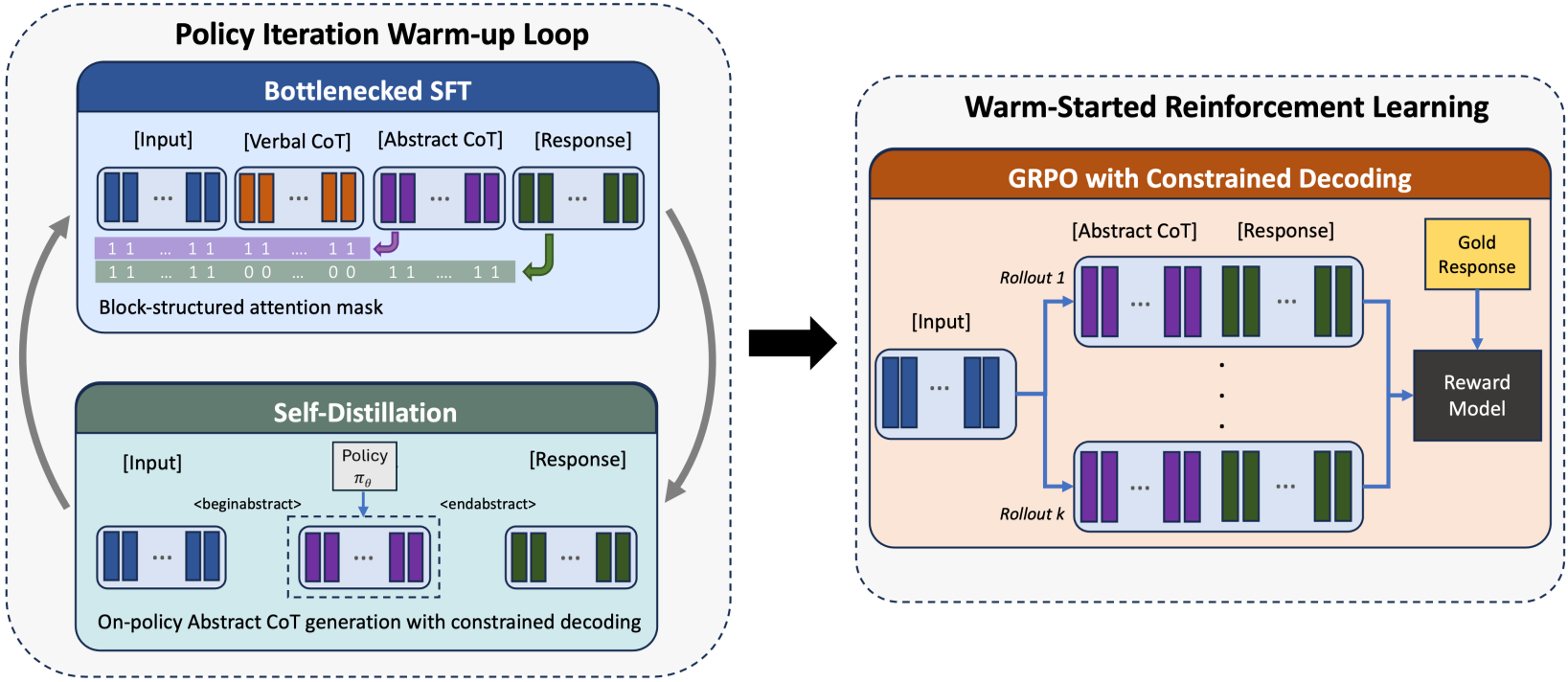 Figure 1: The training pipeline. Notice the Information Bottleneck where the answer depends only on the abstract sequence.
This forces the model to "compress" the logic of the English explanation into the abstract tokens. Once the tokens are "warmed up," the model is trained via self-distillation to generate these tokens directly from the prompt.
3. Warm-Started RL (GRPO)
Finally, they used Group Relative Policy Optimization (GRPO)—the same algorithm used by DeepSeek—to award points when the abstract tokens led to the correct answer. The model learns to "navigate" its own private language to maximize accuracy.
Experiments: Speed Meets Intelligence
The results across MATH-500, AlpacaEval, and HotpotQA show that Abstract-CoT effectively closes the gap with traditional "Long-Form" reasoning.
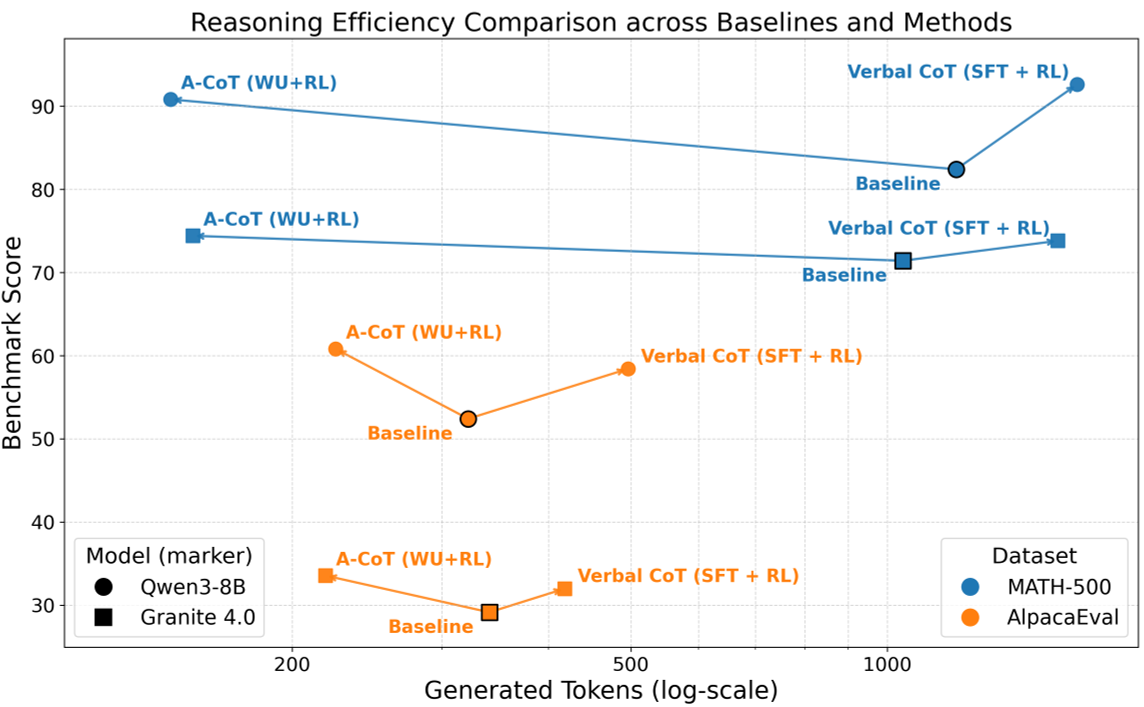 Figure 2: Performance vs. Token Count. Abstract-CoT (WU+RL) achieves SFT+RL accuracy with a fraction of the token budget.
- Token Efficiency: On MATH-500, the model used roughly 144 tokens to think, compared to 1,671 tokens for the verbal version—an 11.6x compression.
- Emergent Language: Analysis of the abstract tokens revealed they follow a Power Law (Zipf's Law). This suggests the model isn't just using tokens randomly; it is developing a "language" where certain tokens represent high-frequency reasoning subroutines.
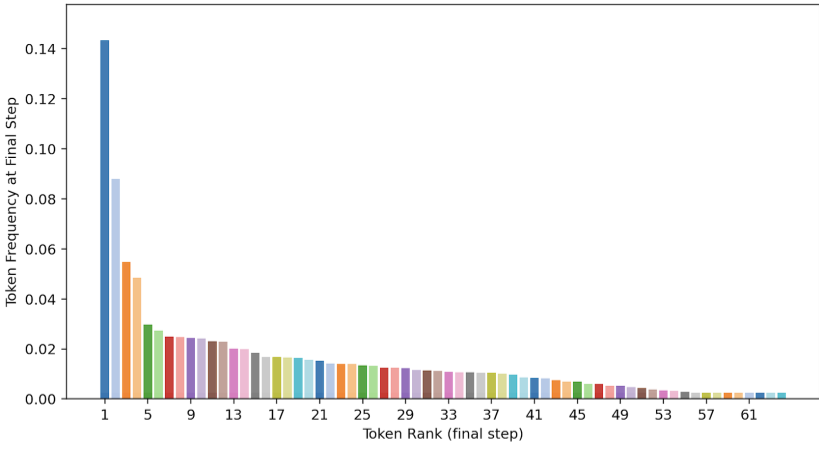 Figure 3: The emergence of a power-law distribution in the abstract vocabulary over 1M RL episodes.
Critical Insight: The End of Interpretable Reasoning?
Abstract-CoT presents a fascinating trade-off. We lose interpretability (we can't read the <TOKEN_A> <TOKEN_Z> sequence), but we gain tremendous efficiency.
For consumer-facing AI that needs to "show its work," verbal CoT remains king. However, for agentic workflows, backend API calls, and robotics, where the logic is just a means to an end, Abstract-CoT demonstrates that a model's private "thoughts" are far more efficient than the "speech" we force upon them.
Conclusion and Future Work
The paper proves that filler-token reasoning doesn't require massive pre-training; it can be "unlocked" during the post-training phase. Future research will likely focus on budget-adaptive reasoning—allowing the model to decide if a problem needs 10 abstract tokens or 100—further pushing the boundaries of inference-time scaling.