
Thousands of Small, Constant Rallies: Decoding WhatsApp Partisanship
Thousands of Small, Constant Rallies: A Large-Scale Analysis of Partisan WhatsApp Groups
This paper presents a large-scale analysis of partisan WhatsApp groups during the 2018 Brazilian presidential election. Utilizing a novel recursive data collection method, the authors analyzed over 2.8 million messages from 232 public groups to contrast the behaviors of right-wing and left-wing users.
TL;DR
While public social media like Twitter and Facebook are often the focus of election integrity research, the real action in the 2018 Brazilian election happened in the "dark social" corners of WhatsApp. This paper uncovers a massive network of partisan groups, revealing that the political right didn't just have more users—they had a more interconnected, multimedia-heavy infrastructure that fundamentally outpaced the left in digital mobilization.
Contextual Positioning
This work serves as a SOTA (State-of-The-Art) data collection benchmark. By moving beyond simple keyword searches on Google and into recursive "invite mining" within the app itself, the authors captured a dataset 3.5x larger than previous attempts, providing the most granular look at how WhatsApp acts as a political weapon.
The Problem: The Transparency Gap in Encrypted Spaces
Traditional social network analysis (SNA) thrives on open APIs. WhatsApp is a black box. Because of end-to-end encryption, researchers can only observe activity by being "in the room." Previous studies were too small to be representative or too broad (mixing cat groups with politics). The challenge was: how do we find the thousands of private "digital rallies" without a central directory?
Methodology: The Recursive Invite Loop
The breakthrough in this paper is the Step 4: Invite Mining. Instead of just searching for groups on the web, the researchers built a loop:
- Join a group found via Google/Twitter.
- Scrape that group's chat log for new
chat.whatsapp.comlinks shared by users. - Automate the joining of those new groups.
This mirrored the way real voters discover groups, allowing the researchers to follow the "interconnected nature" of the partisan ecosystem.

Key Insights: Right-Wing vs. Left-Wing Ecosystems
The study highlights a stark structural asymmetry between the two sides:
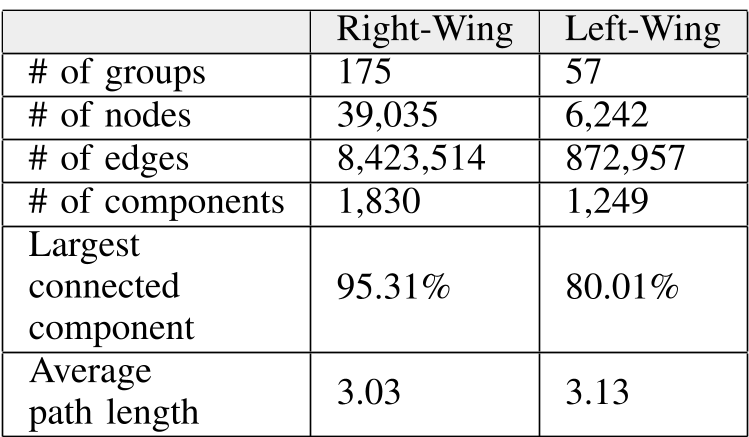
- Network Density: Right-wingers are much more "tightly connected." Their Average Path Length (APL) is shorter despite having more nodes. This suggests a highly efficient ecosystem for information diffusion.
- The Multimedia Blitz: Right-wing messages were 46.55% multimedia (images/video), compared to only 30% for the left. In the attention economy, the right's content was inherently more "viral."
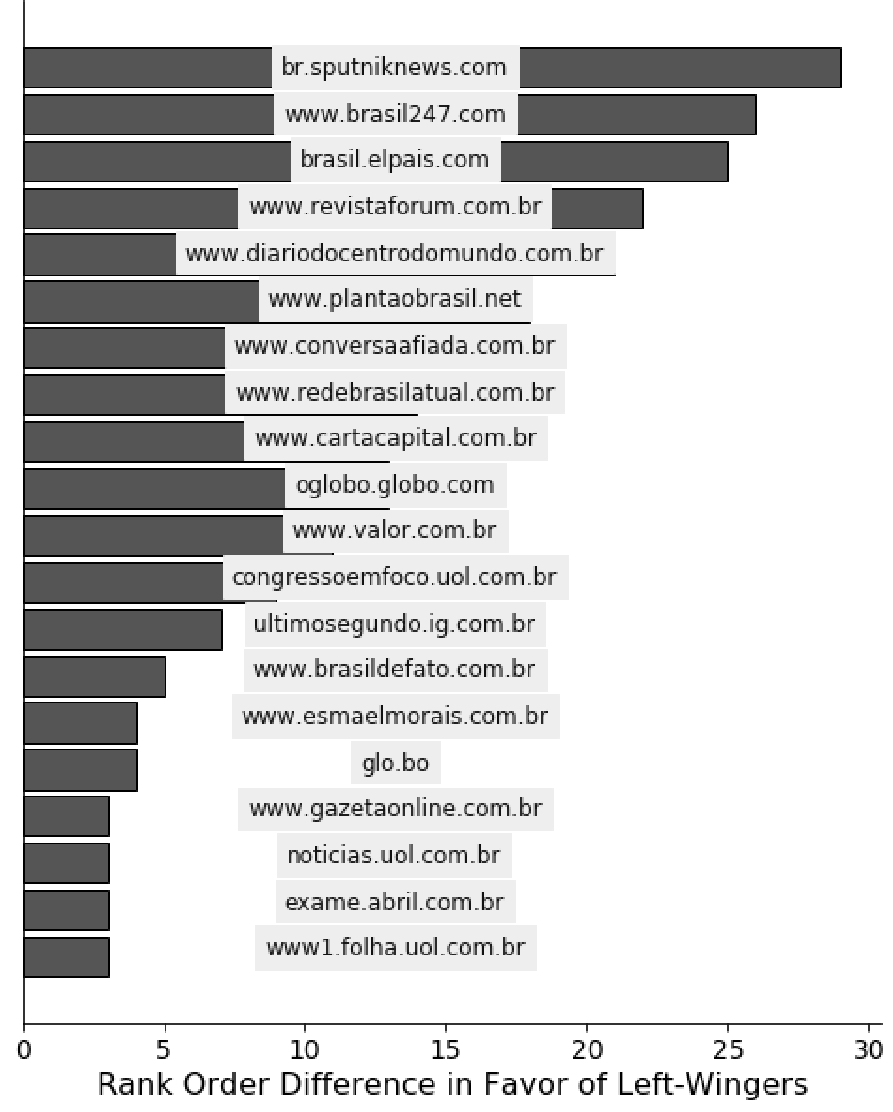
- YouTube as an Engine: Over 56% of external links in right-wing groups led to YouTube, indicating that WhatsApp serves as the distribution arm for a secondary ecosystem of right-wing video creators.
Geographical Anomalies
One of the most intriguing findings was the "International" (Int) and "Administrative" (DF) overrepresentation. The authors hypothesize that the high volume of international numbers in these groups might not just be voters abroad—they could be ghost accounts used to bypass WhatsApp's spam filters, suggesting a level of professionalized coordination.
Critical Analysis & Conclusion
The study concludes that WhatsApp isn't just a messaging app in Brazil; it's a parallel internet. The right-wing's success was built on a foundation of multimedia engagement and hyper-connectivity.
Takeaway for Future Research: To understand modern elections, we must look at the "interconnected nature" of small groups. The "rally" has moved from the town square to the encrypted chat.
Limitations: The study relies on public group invites. Truly private, invite-only groups (the "darkest" of dark social) remain inaccessible, potentially hiding even more coordinated strategies.