
IMMRA: Balancing Accuracy and Speed via Velocity Attenuation in Social Networks
Three-hop velocity attenuation propagation model for influence maximization in social networks
The paper introduces IMMRA, a novel influence maximization algorithm for social networks that utilizes a "Three-hop Velocity Attenuation Propagation Model." By accounting for both temporal and spatial (distance) decay in information spread, the method achieves competitive influence accuracy compared to the standard Greedy algorithm while dramatically reducing computational overhead.
TL;DR
The IMMRA (Influence Maximization based on Rate Attenuation) algorithm tackles the long-standing efficiency bottleneck of the Greedy algorithm. By introducing a Three-hop Velocity Attenuation Model, it mimics the natural decay of information in the real world—where news travels slower and weaker as it gets further from the source. It achieves a performance profile that matches the accuracy of Monte Carlo-based Greedy methods while being orders of magnitude faster.
Problem & Motivation: The "Distance-Time" Decay Oversight
In the study of Influence Maximization (IM), we typically ask: Which k nodes should we pick to start a viral trend?
Standard models like Independent Cascade (IC) treat every "activation" attempt with static probabilities, but real-world information dissemination has a "pulse." The further a message travels (distance) and the longer it takes to reach someone (time), the less likely it is to cause action.
Existing Greedy algorithms are too slow for real-time applications because they simulate thousands of random "what-if" scenarios (Monte Carlo). Heuristics are faster but often lose the "physics" of information flow. The authors identified a crucial middle ground: The Three-Hop Rule. Sociological research suggests that influence beyond three steps in a network is negligible.
Methodology: The Physics of Information Velocity
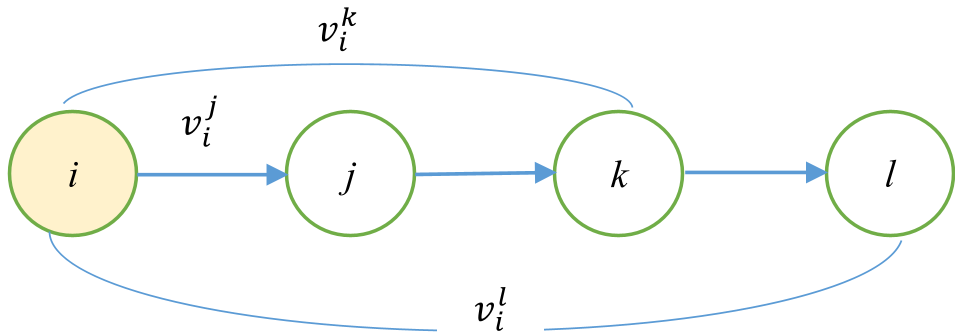
The core innovation is the Propagation Velocity (). Most models assume influence is binary (active/inactive); the authors treat it like a moving wave that loses energy.
1. The Attenuation Formula
They define velocity using two decay factors:
- Distance Factor (): (Inverse square law).
- Time Factor (): (Exponential decay).
The resulting objective function calculates the influence of a node not just by counting neighbors, but by weighting them: where represents the node degree and represents the calculated velocity reaching that hop.
2. The IMMRA Algorithm
The algorithm effectively prunes the search space by only looking three steps ahead. This changes the complexity from (where is 10,000 simulations) to , making the computation linear and localized.
Experiments & Results: Greedy Accuracy at Heuristic Speeds
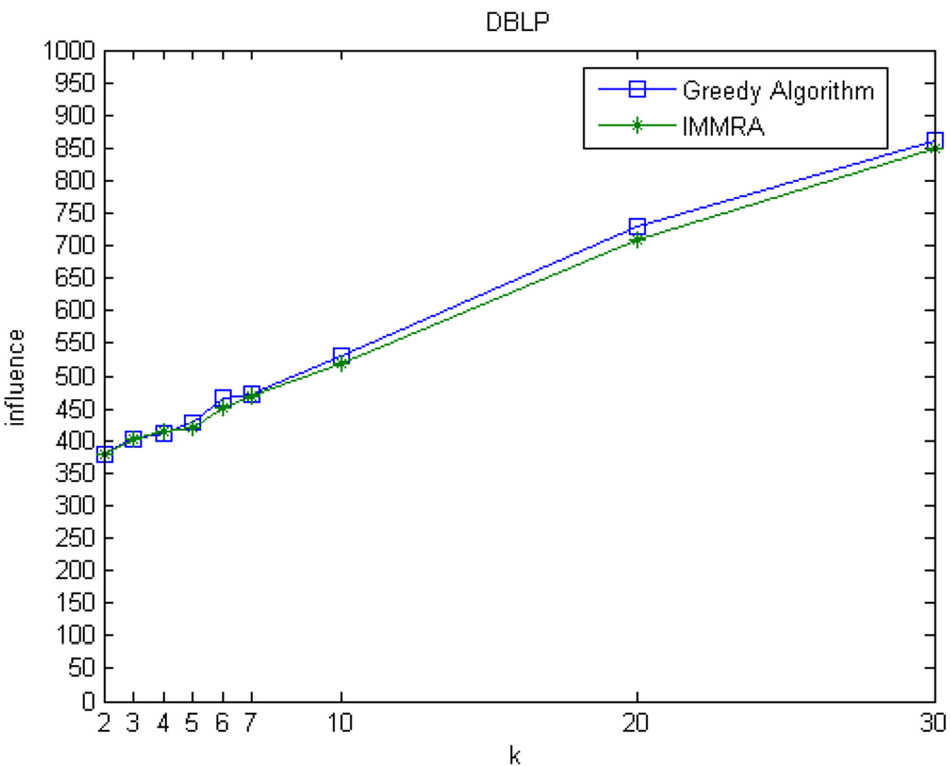
The authors tested IMMRA against the gold-standard Greedy algorithm on two real-world datasets: DBLP and Facebook.
Accuracy Comparison
As shown in the influence spread graphs, the "Star" line (IMMRA) almost overlaps with the "Square" line (Greedy). This proves that the three-hop constraint doesn't sacrifice performance, as the velocity-weighted sum effectively captures the "potential" of a node to influence the network.
Efficiency Gains
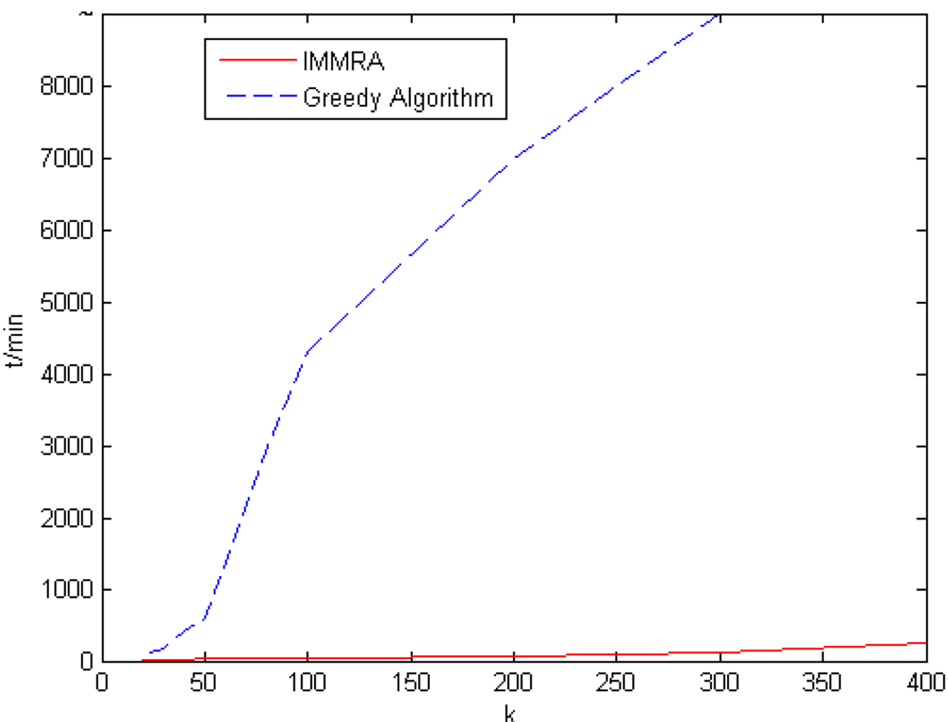
The real victory is in the runtime. While the Greedy algorithm's time consumption grows exponentially and becomes unmeasurable as increases, IMMRA maintains a nearly flat, manageable growth curve.
Critical Insight: The Value of "Localism"
This paper serves as a reminder that in complex network analysis, more information is not always better. By acknowledging that influence is a "local" phenomenon that dies out after three hops, we can ignore 90% of the network noise during seed selection.
Takeaway for Industry: When building recommendation engines or viral marketing tools, focus your computational budget on the "influence neighborhood" (3-hops) rather than attempting to model the entire global graph. This provides a pragmatic path to scaling IM algorithms to millions of nodes.
Limitations: The model relies on a network-specific parameter . Future work could explore how to dynamically learn for different content types (e.g., breaking news vs. long-term marketing).