
3LP: Beyond Profile Hiding—Securing Your Privacy via the Social Graph
3LP: Three Layers of Protection for Individual Privacy in Facebook
The paper introduces 3LP (Three Layers of Protection), a novel privacy-enhancing framework designed to mitigate attribute inference risks in Online Social Networks (OSNs) like Facebook. It combines attribute suppression with friendship link manipulation (hiding and adding friends) to protect users from sophisticated attackers who exploit Social Attribute Networks (SAN).
TL;DR
Even if you hide your profile information on Facebook, your friends' data can give you away. This paper introduces 3LP (Three Layers of Protection), a framework that protects users from "Attribute Inference Attacks" by not only suggesting which profile details to hide but also strategically recommending which friends to mask or add to break the mathematical patterns attackers use to "guess" your secrets.
The Hidden Risk: Your Friends are Snitching
The central problem in modern OSN privacy is Attribute Inference. You might keep your political views or emotional state (e.g., "feeling lonely") private, but an attacker can build a classifier based on your social circle. Because of homophily (the tendency to associate with similar people), the metadata of your friends acts as a high-confidence proxy for your own.
Existing tools like PrivAdv only look at your attributes. They tell you to hide your "Hometown" or "High School." But this paper proves that even after total attribute suppression, 43% of users remain vulnerable because their friendship links are still visible.
Methodology: The 3LP Framework
The authors propose a three-layered defense based on a Social Attribute Network (SAN) model. The strength of a connection between a user and a sensitive attribute value is calculated using a metric that considers common friends and their respective "influence" (based on their total connection count).
The Three Layers
- Layer 1: Attribute Suppression: The "standard" defense. Identifies which public attributes (like "Religion" or "Work") are strong predictors of the sensitive class and suggests hiding them.
- Layer 2: Hiding Friends: If Layer 1 fails, 3LP identifies friends who share the sensitive attribute. By hiding the link to the friend with the lowest degree (highest influence), the user can drop below the attacker's detection threshold with minimal changes.
- Layer 3: Adding Friends: The most counter-intuitive step. If hiding isn't enough, the system suggests adding new friends who do not share the sensitive attribute. This injects "noise" into the attacker's dataset, making their predictions unreliable.
 Equation 1: The metric used to calculate the influence of friendship links on attribute inference.
Experimental Evidence
The authors tested 3LP on two primary datasets:
- Facebook Dataset (): 616 female users, focusing on "loneliness" as the sensitive attribute.
- Synthetic Dataset: 1000 records focusing on "Political Orientation" and "Sexual Orientation."
| Method | Protection Rate () | Protection Rate () |
|---|---|---|
| PrivAdv (Baseline) | 56.62% | 58.3% |
| 3LP (Layer 1+2) | 64.52% | 100% |
| 3LP (Full) | 100% | 100% |
The effectiveness of the multi-layered approach is clear. In the Facebook dataset, while suppression left 27 users at risk, Layer 2 (hiding) and Layer 3 (adding) closed the gap entirely.
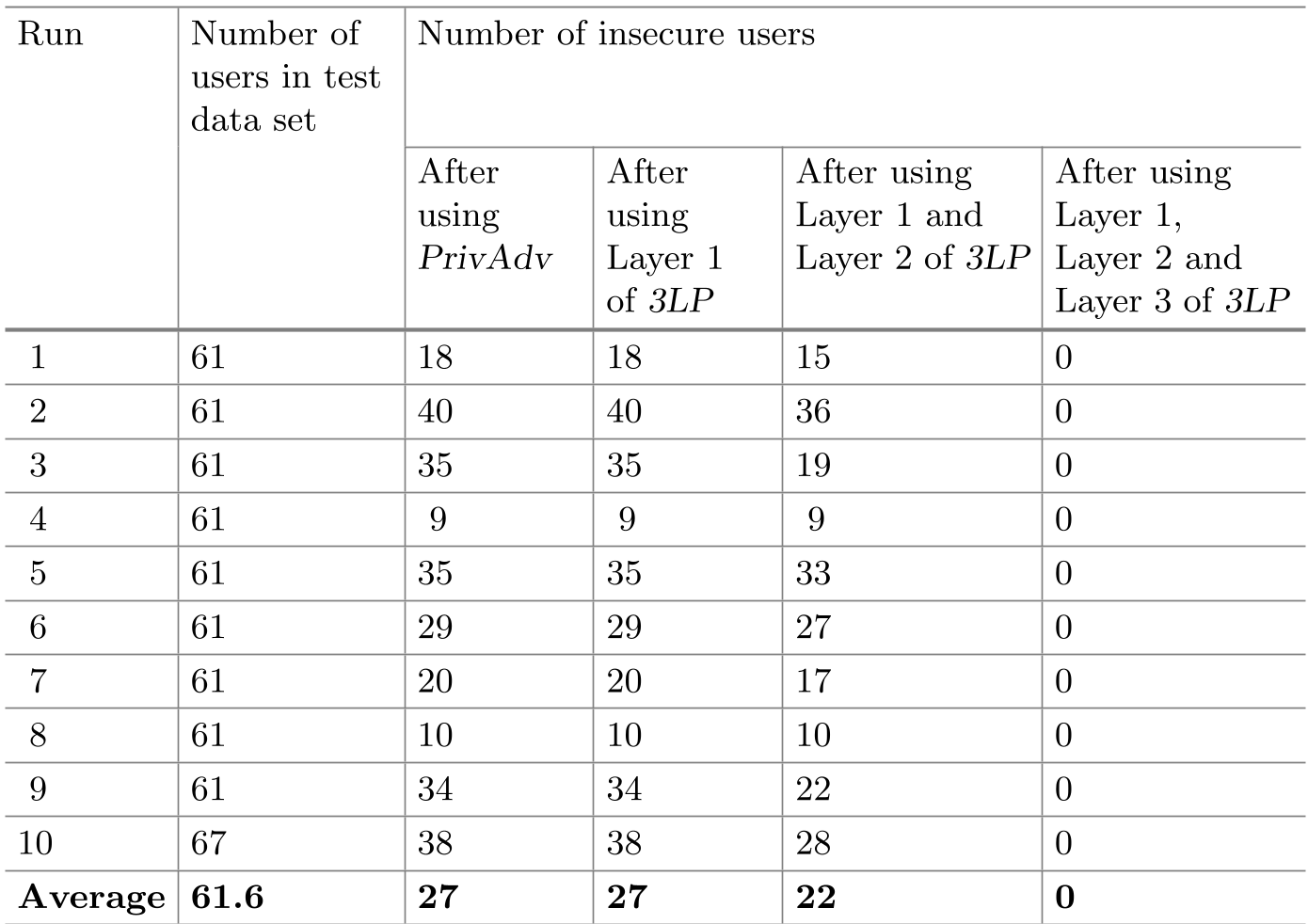 Table: 3LP progressively eliminates insecure users across 10 experimental runs.
Implementation Realities: Can we actually use this?
A common critique of such methods is the "social cost." Users don't want to unfriend real people or add strangers just for an algorithm. However, the study found that the "burden" is surprisingly low:
- On average, users only needed to hide 1 friend and add 2 friends to achieve full privacy.
- The authors suggest that Facebook itself could implement "Privacy-Preserving Edge Masking," where the platform hides certain connections from third-party data auditors or APIs without actually breaking the social link for the user.
Critical Analysis & Conclusion
Takeaway: Your privacy is a function of your network, not just your profile. 3LP proves that we can mathematically "rebalance" a social graph to ensure privacy with very few modifications.
Limitations: The "Add Friend" strategy (Layer 3) carries social risks, such as exposing users to strangers or malicious actors. Furthermore, if everyone in a network uses 3LP simultaneously, the global graph structure changes, which might require a more dynamic, game-theoretic approach to privacy.
Future Outlook: As Graph Neural Networks become the standard for recommendation and ad-targeting, methods like 3LP will be essential for "Graph Sanitization" before data is shared with third-party researchers.