
Deciphering the Global Social Web: A Three-Level Framework for Multi-cultural Networking
A Three-Level Approach to the Study of Multi-cultural Social Networking
This paper proposes a comprehensive three-level framework (Individual, Interaction, and Consequence) to analyze multi-cultural social networking behavior. By comparing British and Chinese users on platforms like Facebook and Windows Live Space, it identifies how cultural backgrounds dictate self-presentation, social interaction patterns, and the subsequent accumulation of social capital.
TL;DR
Social networking is not a monolithic experience. This research breaks down multi-cultural online behavior into Individual perception, Interaction patterns, and Capital consequences. By comparing British and Chinese users, the study reveals how cultural DNA—from communication styles to "Self-Construal"—determines who we trust, how we post, and what social benefits we actually reap from our digital connections.
Motivation: Beyond One-Size-Fits-All Social Media
While social networking sites (SNS) like Facebook and LinkedIn are global, our usage of them is deeply provincial. Most existing research treats "users" as a homogeneous group or focuses purely on technical metrics. The authors argue that to understand the true nature of the "Global Village," we must look at the interplay between cultural background and three distinct levels of social activity:
- The Individual: How do we present ourselves and perceive strangers?
- The Interaction: How do we decide whom to message or whose updates to "lurk" on?
- The Consequence: What do we actually gain (social capital) from these digital ties?
Methodology: A Tri-Level Deep Dive
The authors conducted three distinct studies to map this ecosystem:
1. The Individual Level: The Perception Gap
Using a mix of British and Chinese "Personae," the researchers tested how users judge personality based on Verbal (blog content) and Non-verbal (profile photos) cues.
- The Insight: Chinese users are "verbal-heavy," prioritizing the nuances of language and politeness. British users are more "visual-centric," basing competence judgments on non-verbal presentation.
2. The Consequence Level: Measuring Social Capital
The study adapted Williams’ Social Capital scales to see if "Cross-cultural" interactions actually pay off.
- Bridging Capital: Weak ties that provide new info and diverse views.
- Bonding Capital: Strong ties providing emotional and substantive support.
3. The Interaction Level: The Reinforcement Loop
Through interviews, the authors identified three primary behaviors: Observing (lurking), Communicating (1-to-1), and Grouping (many-to-many).
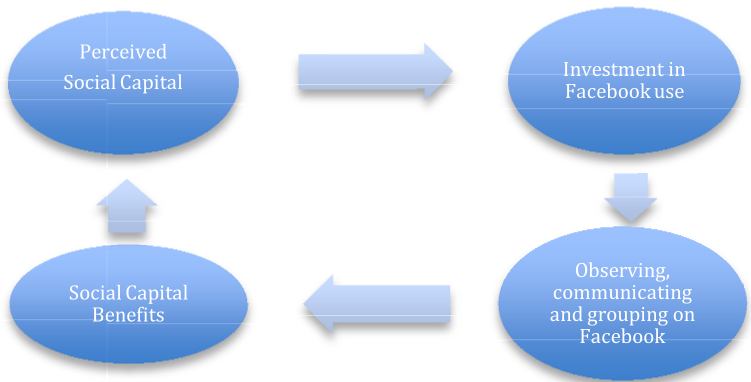 Figure 1: The feedback loop where social capital benefits drive future engagement.
Key Findings: Cultural Divergence in the Digital Space
Verbal vs. Non-Verbal Dominance
The study found that Incongruence (e.g., a Chinese face with a British-style, direct blog) creates unique perceptions. Interestingly, Chinese participants judged those with "British-style" blogs as having higher competence, suggesting a subconscious association between direct low-context communication and professional efficiency.
The "Bonding" Deficit
A major quantitative finding was that British users perceive significantly less "Bonding Social Capital" from cross-cultural interactions than Chinese users. While both groups gain "Bridging" capital (new information), Chinese users are more effective at turning online multi-cultural ties into "substantive support" and "access to resources."
Relationship Strength vs. Interaction Type
- British Users: Tend to Observe (lurk) primarily on strong ties and Group with everyone.
- Chinese Users: Tend to Group primarily with strong ties and Observe everyone.
- Driving Force: For British users, the primary motivator for grouping with weak ties is "Enlarging the circle" (Bridging). For Chinese users, "Social support" (Bonding) remains a dominant motivator even across cultural lines.
Critical Analysis & Conclusion
The "Reinforcement Loop"
The most significant takeaway is the Reinforcement Loop. Social capital is not just a byproduct; it is the fuel. As users experience tangible benefits (like getting help from a friend abroad), they become more confident in the platform, which drives more intensive interaction.
Limitations & Future Outlook
The study primarily utilizes a British/Chinese binary, which, while representative of the Low/High Context cultural divide, doesn't account for "Digital Native" subcultures that might transcend nationality. Furthermore, as AI-driven translation and cultural mediation become standard in SNS, the cues users rely on (verbal/non-verbal) may become increasingly blurred.
Final Takeaway
For developers and sociologists, the message is clear: Functionality does not dictate behavior; culture does. A feature designed for "Grouping" will be used for bonding in the East and bridging in the West. Designers must build "cultural flexibility" into the architecture of global social platforms.