
Modular SHM: Normalizing Environment for Smarter Wind Turbine Calibration
Three-Tier Modular Structural Health Monitoring Framework Using Environmental and Operational Condition Clustering for Data Normalization: Validation on an Operational Wind Turbine System This paper offers a modular three-tier framework for statistical pattern classification of feature vectors for SHM of operational wind turbines. A key feature of the work is the normalization of sensor data through the use of unsupervised clustering using EOC parameters
This paper introduces a modular three-tier framework for Structural Health Monitoring (SHM) of operational wind turbines, centered on unsupervised Affinity Propagation (AP) clustering for data normalization. The framework integrates EOC-based normalization, feature extraction using Vector Autoregression (VAR) residues, and statistical hypothesis testing to achieve high-accuracy damage detection under varying environmental conditions.
TL;DR
Researchers have developed a Three-Tier Modular Framework that solves the "Environmental Noise" problem in Structural Health Monitoring (SHM). By using Affinity Propagation (AP) to group sensor data into similar environmental conditions before analysis, the system achieved over 80% accuracy in detecting structural damage on an operational 3-kW wind turbine.
The "Masking" Problem in SHM
Monitoring a wind turbine isn't just about listening for "cracks." Turbines operate in chaotic environments. A change in vibration might be caused by a loosening bolt (damage), but it’s more likely caused by a shift in wind speed or ambient temperature (EOCs).
Prior works often struggled because environmental variations "mask" the structural signature of damage. The authors argue that without Data Normalization, SHM is essentially trying to find a needle in a haystack while the haystack is constantly being reshuffled by the wind.
Methodology: The Three-Tier Architecture
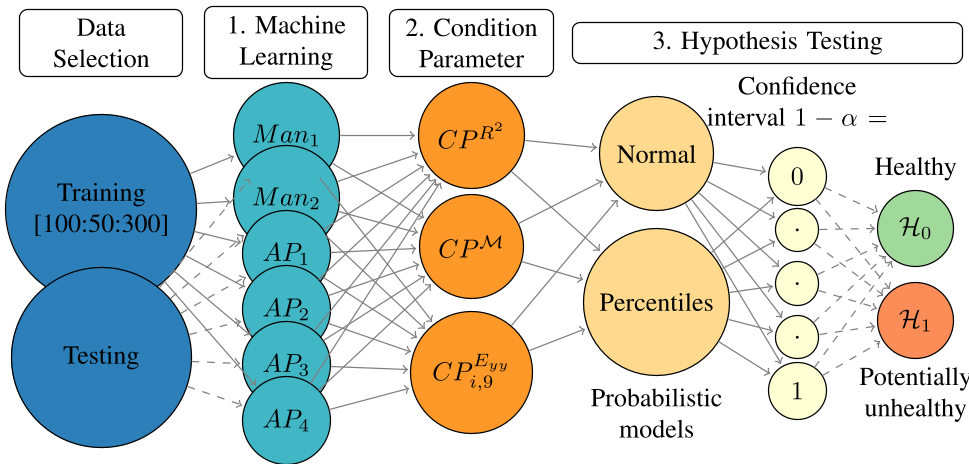
The proposed framework breaks the complexity into three distinct, swappable modules:
- Tier 1: Data Normalization (Machine Learning) Instead of simple manual binning, the authors use Affinity Propagation (AP). This unsupervised algorithm passes messages between data points to find natural "exemplars" (clusters) of similar EOCs (Wind Speed, Direction, Temperature).
- Tier 2: Feature Extraction (Condition Parameters) Once the data is normalized, the system calculates Condition Parameters (CPs). They primarily use residues from Vector Autoregressive (VAR) models—essentially checking how much the current vibration deviates from a mathematical model trained on healthy data.
- Tier 3: Hypothesis Testing Finally, the system uses statistical distributions (Gaussian or Percentile) to determine if a new data point is an outlier (damaged) or just a variation of the healthy state.
Real-World Validation: The Los Alamos Experiment
The team tested this on a 3-kW Whisper 500 turbine. To simulate damage, they replaced a fixed bolt at the base with a stiff spring, introducing a subtle, non-linear lateral movement.
Key Experimental Findings:
- The Power of Clustering: The "Manual1" setup (treating all data as one big cluster) failed completely. Damage detection only became viable once AP clustering was applied.
- Gaussian vs. Percentile: Assuming a normal (Gaussian) distribution for the data within clusters consistently outperformed using raw percentiles, especially in the 70-80% detection range.
- The AUC Benchmark: Using Receiver Operating Characteristic (ROC) curves, the best configurations reached an AUC of 0.844, indicating high diagnostic accuracy.
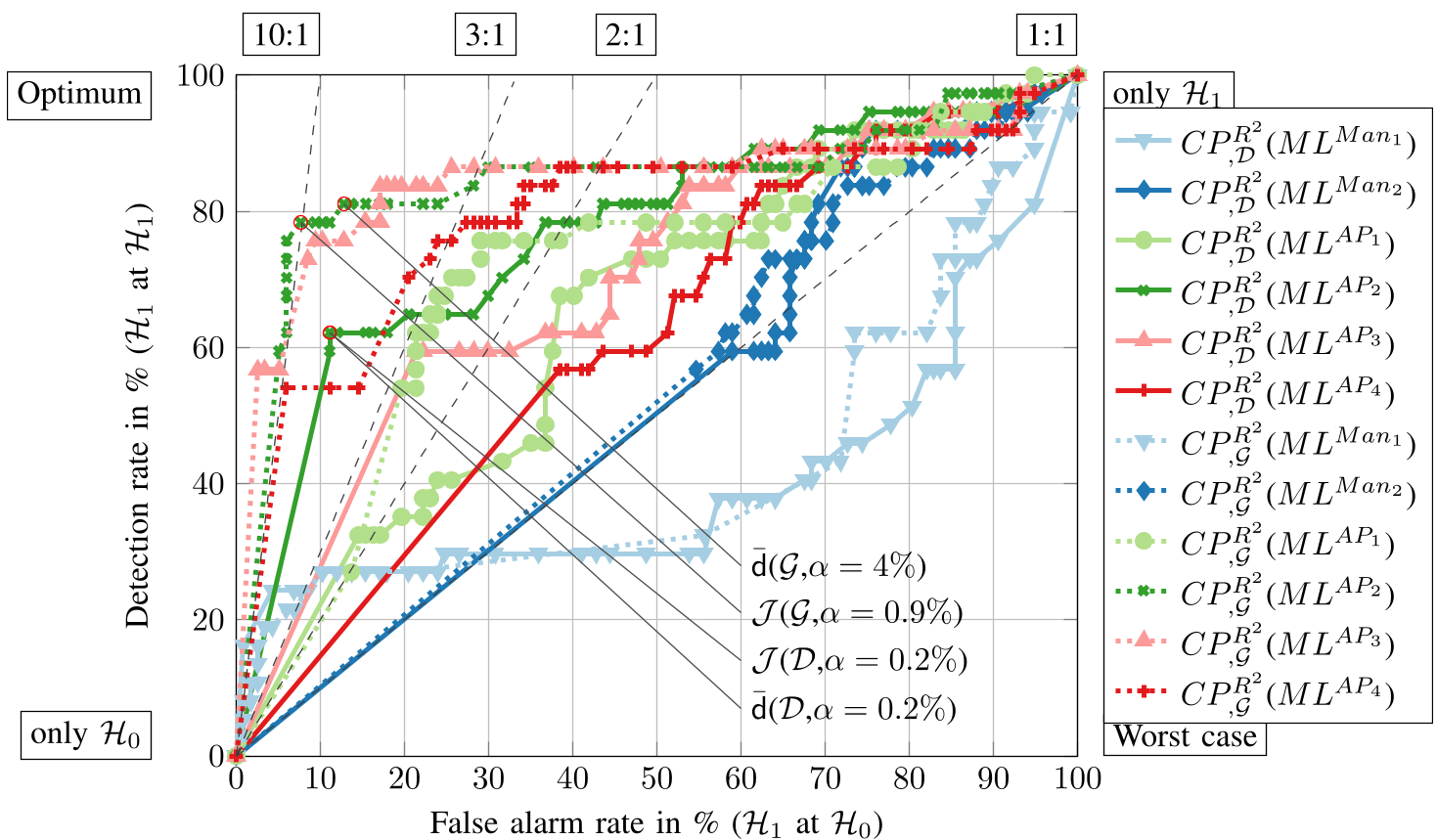 The image above shows that AP-based clustering (colored lines) stays much closer to the optimal upper-left corner than the manual baseline.
Critical Insight: Why This Matters
The genius of this work isn't just the math—it's the modularity. By decoupling the Normalization from the Detection, engineers can swap out the machine learning algorithm in Tier 1 as sensor technology improves (e.g., moving from AP to Deep Neural Networks) without redesigning the entire physical monitoring logic.
Limitations & Future Work
The study noted that damage detection remains difficult when wind direction causes the tower to "lean" into its support, effectively hiding the loose bolt. Future iterations could benefit from AdaBoost (Adaptive Boosting) to weight different sensor channels differently based on their real-time reliability.
Conclusion
This modular approach proves that we don't need "perfectly quiet" environments to monitor structures. We just need a framework smart enough to categorize the noise before looking for the signals of decay.