
T3 Architecture: Reclaiming Privacy through a Three-Tiered Social Graph
10430_Towards a Three-tiered Social Graph in Decentralized Online Social Networks.
This paper introduces the T3 Architecture, a decentralized framework for Mobile Social Networks (MSNs) that organizes the social graph into three distinct tiers: Friend, Context, and Location. It leverages a global directory for connectivity and decentralized local directories to enable privacy-preserving, context-aware services without a central provider.
TL;DR
The T3 Architecture challenges the dominance of centralized social media silos by proposing a decentralized, mobile-first framework. It breaks the traditional social graph into three layers—Friend, Context, and Location—and utilizes a hybrid directory system to enable rich social interactions and recommendations without sacrificing user privacy or data sovereignty.
Background: The Social Silo Problem
Modern Online Social Networks (OSNs) act as "walled gardens." They provide convenience at the cost of total surveillance. The core issue is the Centralized Social Graph: because a single entity owns the map of all human connections, they own the users' digital identities.
The transition to Mobile Social Networks (MSNs) has exacerbated this. Our smartphones transmit constant streams of location and sensor data. In a centralized model, this is a privacy nightmare; however, Beierle et al. argue that the smartphone’s processing power actually makes it the perfect tool for a decentralized revolution.
Methodology: The Three-Tiered Vision
The researchers categorize social interactions into three tiers based on their duration and source:
- Friend-Tier (Long-term): Explicitly reported relations (connections you proactively make).
- Context-Tier (Medium-term): Inferred relations based on shared contexts, such as being in the same university class or belonging to the same gym.
- Location-Tier (Short-term): Ephemeral, spontaneous groups formed when being at the same place, like a park or a concert.
The T3 System Components
To support these tiers, the T3 architecture introduces three functional layers:
- Global Directory: Functions like a DNS for people, mapping User IDs to current IP addresses/protocols for direct communication.
- Decentralized Directories: Localized services (e.g., a Wi-Fi hotspot in a mall) that allow users to optionally share limited context for local search and discovery.
- Smartphones: The primary data handlers that store the social graph and process sensitive sensor data locally.
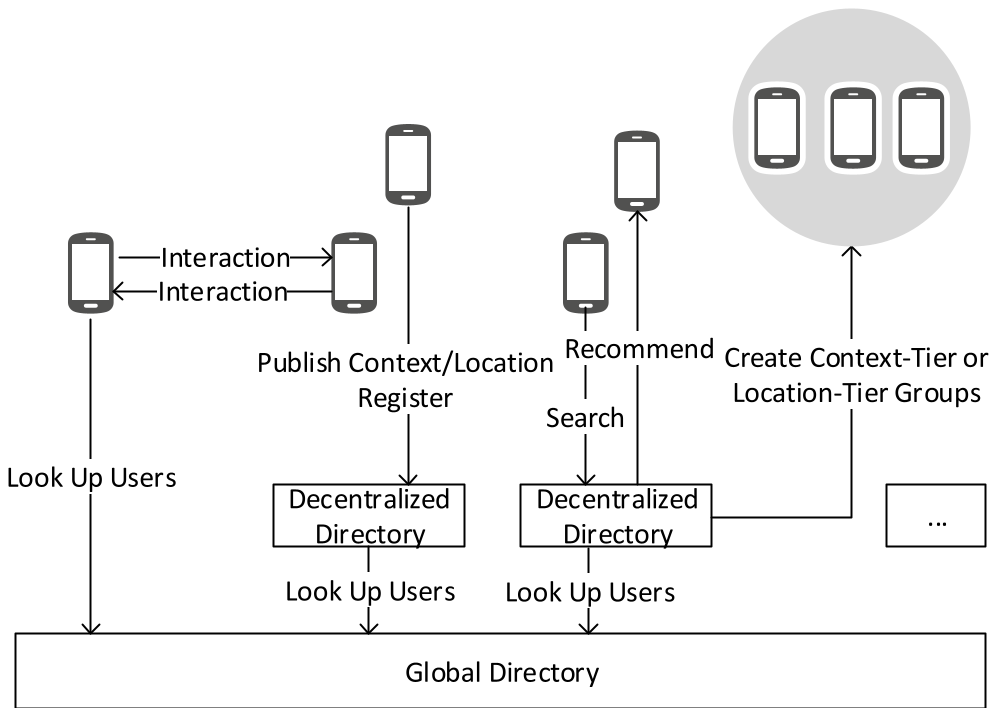 Figure 1: The T3 Architecture showing the interaction between Smartphones, Global Directories, and Decentralized Directories.
Why Decoupling Works
The "magic" of T3 lies in the decoupling of Contact from Discovery. In Facebook, to find a friend or get a recommendation, you must give the platform your data. In T3:
- You use the Global Directory only to find how to talk to someone.
- You use Decentralized Directories to find who to talk to in a specific setting (e.g., finding a jogging partner in the park).
This prevents any single provider from building a comprehensive profile of your entire life. If you trust your gym, you give their local directory your fitness index. When you leave, that connection can be severed.
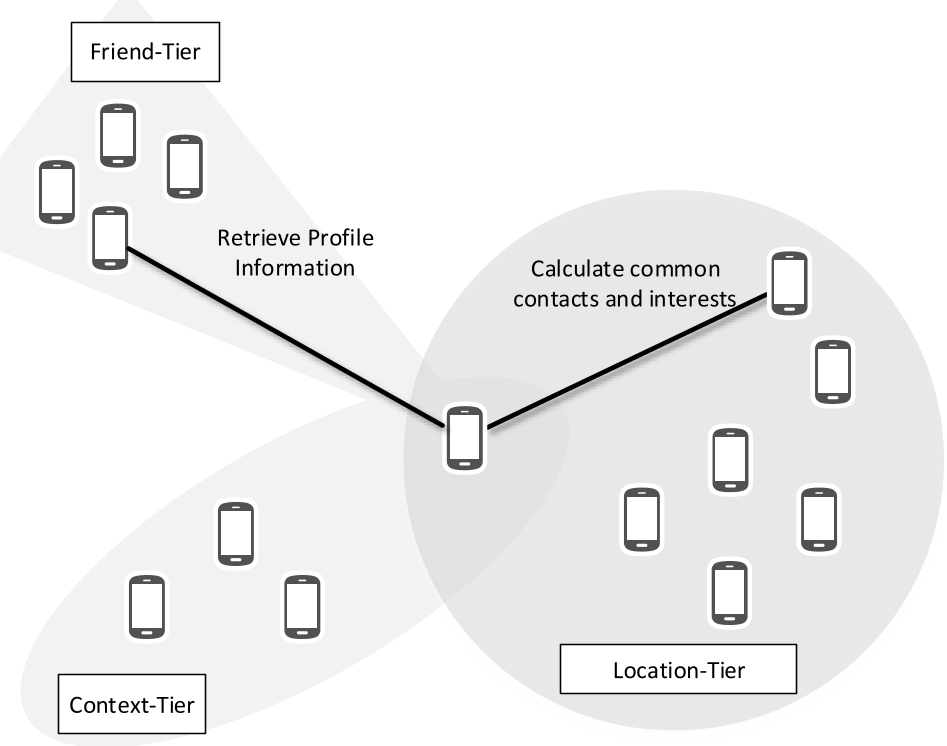 Figure 2: Recommendation functionality handled via a Decentralized Directory without a central cloud authority.
Critical Insight: The Smartphone as an "Extension of Man"
The authors build upon McLuhan’s theory, viewing the smartphone not just as a tool, but as a digital extension of the user's social presence. By moving the "Social Graph" storage to the device itself, T3 ensures that mobility and privacy are no longer a zero-sum game.
Limitations and Future Work
While the T3 architecture provides a robust conceptual framework, several challenges remain:
- Identity Provisioning: How do we prevent ID spoofing in a global directory without a central authority?
- Availability: If a user is offline, their profile might be unreachable since it is stored on their device.
- Incentivization: Why would a gym or a city provide a decentralized directory? New economic models for "Local Social Infrastructure" are needed.
Conclusion
The T3 Architecture represents a vital shift toward a more democratic internet. By acknowledging that not all social ties are equal (Friends vs. Temporary Location-based groups), it provides a technical path toward social apps that are both highly personalized and deeply private.