
Scaling Trust: Threshold-Based Heuristics for Social Network Inference
Threshold-Based Heuristics for Trust Inference in a Social Network
The paper introduces two threshold-based heuristics, H1 and H2, designed for efficient trust inference in sparse social networks. By pruning the path search space using node influence metrics, the proposed methods significantly reduce computational complexity while maintaining high recommendation accuracy in Trust-Aware Recommender Systems (TARS).
TL;DR
Trust is the currency of social recommender systems, but calculating it across a sparse web of users is a computational nightmare. This paper introduces two threshold-based heuristics (H1 and H2) that leverage node reputation to prune the search space of trust paths. The result? A massive speedup in trust inference (up to 93% time reduction) while maintaining the accuracy of the recommendations.
The Scalability Wall in Trust Inference
In modern E-commerce, trust is crucial for solving the Cold Start problem—where we know little about a new user but can infer their preferences based on who they trust. Trust propagation follows a transitive logic: if Alice trusts Bob, and Bob trusts Carol, Alice might trust Carol.
However, the "All Path" enumeration approach—which searches for every possible connection between users up to a certain length—suffers from exponential complexity. As social networks grow, finding these paths becomes a bottleneck that prevents real-time updates.
Methodology: Pruning with Purpose
The authors suggest that we don't need to look at every path. Instead, we should prioritize paths that pass through influential nodes. They define a cut-off threshold () at each step of the propagation.
The Core Insight
If a neighbor's reputation (vertex weight ) is below a certain average threshold of the current neighborhood, we stop propagating trust through that branch. The authors propose three ways to calculate this reputation:
- Indegree: Simple popularity (how many people trust this user?).
- Degree-of-Trustworthiness: A normalized influence metric.
- Degree-of-TrustNPurchase: A novel metric combining social ties with actual purchase behavior (categorizing items into Heavily Rated, Average, and Cold Start).
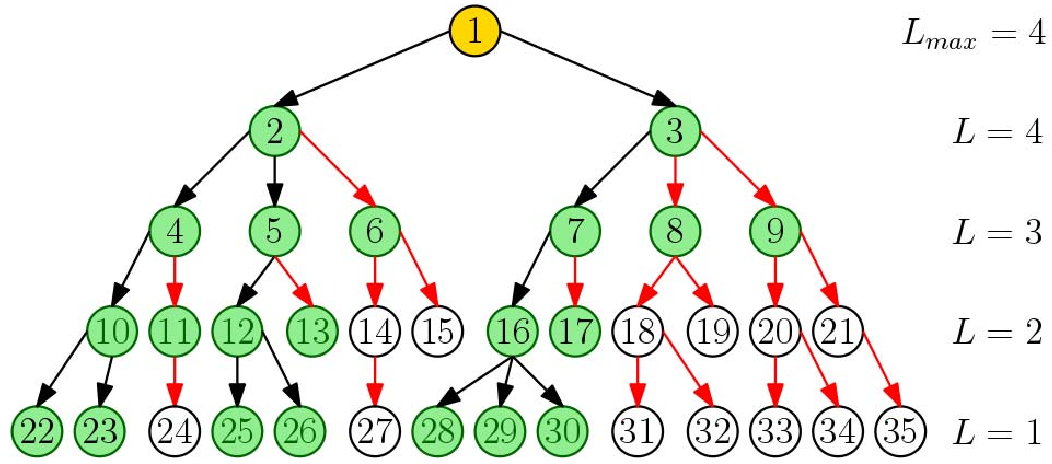 Figure 1: The heuristic greedily selects higher-weighted nodes (green) for propagation while pruning less influential ones (red arrows).
Two Heuristic Flavors
- H1 (Heuristic 1): Maximizes speed. It builds a subset of users, potentially leading to a sparser inferred network but much faster results.
- H2 (Heuristic 2): Focuses on density. It uses a
checkPath()function to ensure that no potential edges are lost, achieving the same density as the "All Path" method but still faster due to reduced exploration.
Experimental Performance
The researchers tested their methods on FilmTrust and Epinions datasets.
1. Massive Time Savings
On the FilmTrust dataset with , the exhaustive "All Path" method took 3296 seconds. The H1-Th- heuristic completed the same task in only 214 seconds—a nearly 15x speedup.
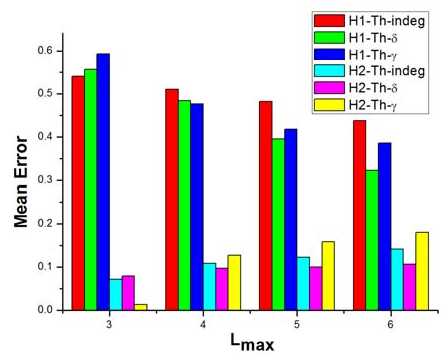 Figure 2: Analysis of Path Count (log scale) and Density as propagation length increases. Note the exponential growth inhibited by the heuristics.
2. Preserving Accuracy
The "million-dollar question" is whether pruning paths hurts recommendation quality. The results in Table IV prove otherwise:
- MAE & RMSE: The error metrics for H1 and H2 are almost identical to the "All Path" benchmark.
- Coverage: In the Epinions dataset, the coverage remained high (around 90-93%), meaning the system could still provide recommendations for the vast majority of users.
 Table 1: Comparison of MAE, RMSE, and Coverage across different heuristics and datasets.
Critical Analysis & Conclusion
This paper successfully bridges the gap between graph-theoretic trust models and practical scalability. By treating trust propagation like a guided search rather than a brute-force traversal, the authors have made path-based trust inference viable for larger datasets.
Limitations: The heuristic assumes that reputation (Indegree/Purchase history) is a reliable proxy for trust "flow." In some adversarial environments, popular nodes might actually be malicious "hubs," which this heuristic might inadvertently favor.
Future Outlook: Integrating Distrust (negative ties) into this heuristic search would be the next logical step. As social platforms become more polarized, the ability to prune "distrust paths" efficiently will be just as important as finding trust paths.