
Thunder Crystal: Transforming Idle Home Bandwidth into a Global Content Powerhouse
Thunder crystal: a novel crowdsourcing-based content distribution platform
Thunder Crystal is a novel crowdsourcing-based content distribution platform that incentivizes private users (agents) to contribute their idle upload bandwidth and storage in exchange for cash rebates. Developed by researchers from Shenzhen University and NUS, it functions as a distributed mini-CDN, achieving a massive 10–20x amplification of content distribution capacity compared to traditional central server delivery.
TL;DR
Thunder Crystal is a pioneering crowdsourcing platform that offloads heavy video distribution tasks to regular users. By rewarding users with "Crystals" (convertible to cash) for sharing their storage and upload bandwidth, the system creates a massive network of "mini-CDN" nodes. It successfully amplifies server capacity by up to 20x while maintaining the high availability of traditional CDNs at a fraction of the cost.
Background: The Cost of Content
As 4K and Ultra-HD video becomes the standard, Internet Content Providers (ICPs) face a financial nightmare: bandwidth bills. Traditional CDNs (Content Delivery Networks) are stable but expensive. P2P (Peer-to-Peer) solutions are cheap but notoriously unreliable and can ruin the experience of the very users who share their data.
The researchers behind Thunder Crystal asked a fundamental question: Can we combine the professional management of a CDN with the economic scale of P2P by treating users as partners rather than just peers?
The Problem: Fraud, Copyright, and Volatility
Prior hybrid systems faced three major hurdles:
- Content Abuse: If a user has a full movie 100% locally, they can distribute it illegally.
- Fake Downloads: Users might "cheat" by downloading their own hosted content to rack up rewards.
- Stability: Normal users turn off their computers. P2P networks collapse when "seeders" go offline.
Methodology: The "Mini-CDN" Architecture
Thunder Crystal solves these by treating agent devices (mostly Smart Routers/APs) as professionally managed edge servers.
1. Security via Fragmentation
To prevent copyright infringement and fraud, the system uses a multi-tier indexing strategy. Files are split into Chunks (300MB) for encryption and then stored as Segments (512MB).
- Insight: No single agent ever holds a "viewable" unencrypted file. They only hold encrypted "blocks" that are useless without the Thunder Server's coordination.
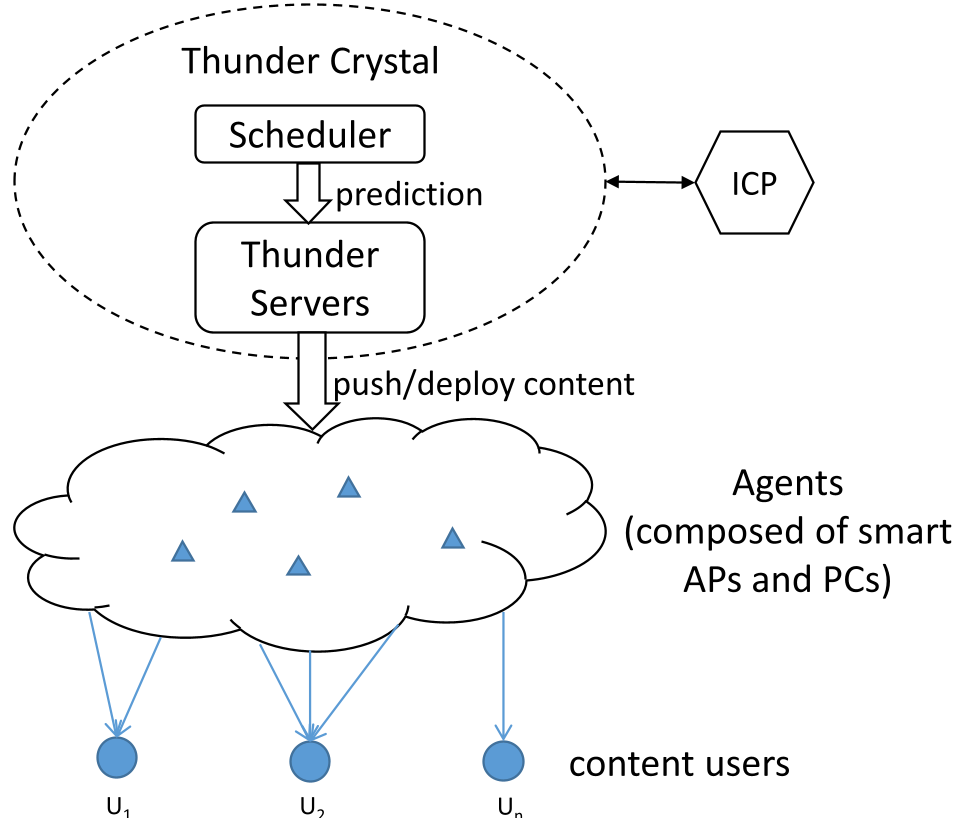
2. Smart Pushing Strategy
The system doesn't wait for users to request files. It proactively pushes content based on a mathematical model of popularity: Where is the number of requests from the previous day. This ensures that the most "viral" content is already sitting on thousands of home routers before the peak evening hours hit.
Performance: 20x Impact
The study analyzed 11,000+ devices in China, categorized into "Thin Agents" (home users) and "Fat Agents" (power users with multiple devices).
Key Findings:
- Incentives Work: Unlike P2P users who leave once their download is done, Thunder Crystal agents stay online 24/7 to maximize earnings.
- Efficiency: The system utilization stays consistent even as network traffic fluctuates.
- Capacity: The total traffic served to users is 10 to 20 times greater than the traffic pushed out by the central servers.
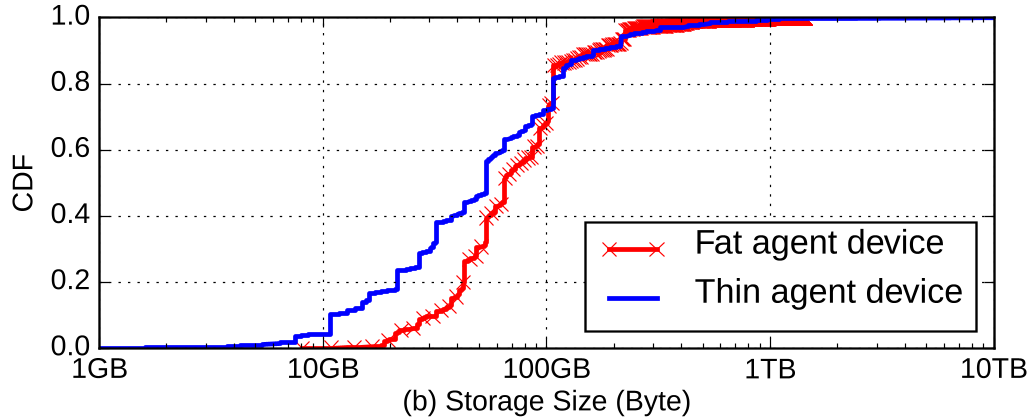 Figure: CDF of resource contribution showing that agents allocate significant storage (10GB-100GB) for the platform.
Critical Insight: The "Fat Agent" Storage Gap
An interesting observation in the paper is the correlation between storage and upload success. The researchers found a 0.515 correlation between used storage and upload traffic.
- The Analysis: "Fat Agents" (those with more bandwidth) often don't provide enough storage. To maximize efficiency, high-bandwidth users must be encouraged to plug in larger hard drives to host a wider variety of content chunks.
Conclusion & Future Outlook
Thunder Crystal proves that the "sharing economy" (similar to Uber or Airbnb) is viable for the backbone of the internet. By turning a liability (idle home routers) into an asset (a distributed CDN), they have created a blueprint for future low-cost content distribution.
Limitations: The current strategy treats all agents randomly during the push phase. Future iterations could optimize based on ISP locality to reduce "cross-province" traffic costs for the ISPs themselves.
Final Takeaway: When the incentive is right, private infrastructure can outperform dedicated corporate hardware in both scale and cost-efficiency.