
Thwarting Pollution Attacks: Securing the Future of Mobile Social Networks
Thwarting pollution attacks in network coding for delay tolerant mobile social networks
This paper introduces a robust security framework for Delay Tolerant Mobile Social Networks (DTMSNs) to mitigate pollution attacks in Network Coding (NC). It combines cryptographic hash dissemination with subspace error-correction to ensure message recovery despite adversarial packet injections, validated through a sophisticated fluid-approximation performance model.
TL;DR
In the decentralized world of Delay Tolerant Mobile Social Networks (DTMSNs), data doesn't travel via a straight line; it "hops" through social encounters. While Network Coding (NC) makes this process efficient, it creates a massive security hole: a single "polluted" packet can corrupt every other packet it meets. This paper presents a mathematically grounded framework that combines homomorphic hashes and subspace error correction to keep data clean, even when the network is crawling with adversaries.
The "Butterfly Effect" of Network Pollution
In a standard DTN, nodes act as relays. Traditional routing just copies packets. Network Coding, however, allows nodes to "mix" (linearly combine) packets. While this solves the "coupon collector problem" (needing specific packets), it introduces a vulnerability: if an adversary injects a fake packet, any node that mixes it with legitimate data generates a new, corrupted packet. The pollution spreads exponentially.
The challenge is twofold:
- Mobile Dynamics: We can't use fixed firewalls or constant connections to a central server.
- Byzantine Adversaries: Malicious nodes might have full knowledge of the protocol and try to overwhelm the destination's decoding capacity.
Methodology: The Dual Defensive Shield
The authors don't just try to "block" the adversary; they use a two-pronged strategy to manage the adversary's capability.
1. Homomorphic Hash & Public Key Dissemination
To prevent relays from unknowingly spreading garbage, the source broadcasts a Public Hash (). This hash is "homomorphic," meaning if you combine two valid packets, the resulting packet still satisfies the hash.
- The Problem: How do you trust the hash itself?
- The Solution: A symmetric-key pre-distribution scheme (Eschenauer-Gligor) is used among a subset of nodes to authenticate the hash sender, creating a "clean" backbone of Secure Nodes.
2. Subspace Error Correction
Even if some polluted packets get through, the destination can still recover the data using Subspace Coding. Instead of sending individual vectors, the source sends a vector space . The destination recovers the information if the dimension of the "clean" space received is sufficiently larger than the "polluted" space generated by the adversary.
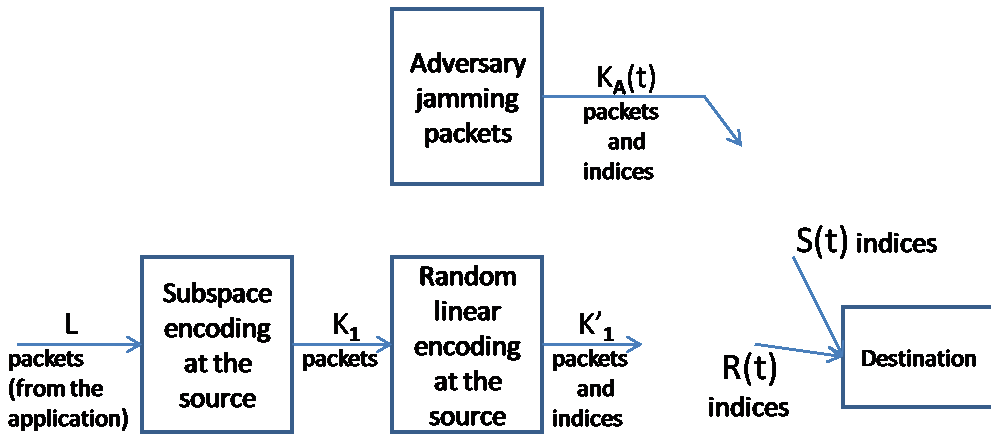 Figure 1: The encoding workflow, showing the transition from information packets to a robust vector subspace.
Performance Modeling with Fluid Approximations
The core academic contribution is a Fluid Model—a set of Ordinary Differential Equations (ODEs) that predicts how information (and pollution) spreads through a social community.
The model tracks:
- : The number of nodes in community carrying legitimate indices.
- : The fraction of "contaminated" nodes.
By solving these equations, network designers can decide exactly how many secure nodes () are needed and how much redundancy () to add to the file before sending it, ensuring a specific probability of success before the deadline .
Experimental Results
The authors validated their model using a trace of 1,000 nodes. They simulated a Byzantine attack where an adversary constantly injects fake packets.
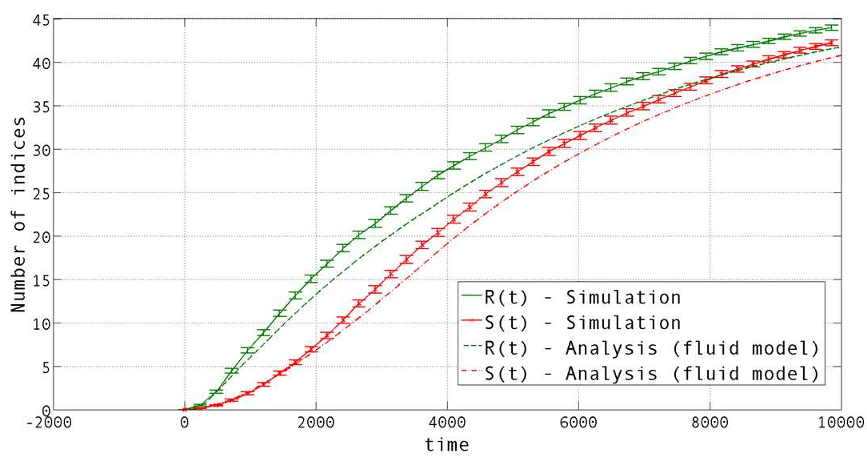 Figure 2: The average number of source degrees of freedom (R(t)) versus adversarial degrees of freedom (S(t)). The tight fit between the solid lines (model) and the marks (simulation) proves the model's accuracy.
The results demonstrate that even with a high volume of malicious traffic, restricting the adversary's access to only non-secure relays (approx. 20% of the network in their test) allows the destination to successfully decode the original file.
Critical Insight & Conclusion
This work shifts the security paradigm for mobile networks from prevention to resilience. By acknowledging that some pollution is inevitable in opportunistic environments, the authors provide the mathematical tools to "outcompute" the adversary.
Limitations: The model assumes social meeting patterns are somewhat persistent (Poisson distributed). In highly volatile or purely random movement scenarios, the fluid approximation might require more frequent parameter updates.
Future Outlook: This framework is a precursor to securing decentralized "Edge AI" and "Federated Learning" environments, where individual nodes might contribute poisoned gradients to a global model. Subspace-based validation could be the next frontier in securing decentralized intelligence.