
TI-SC: Bridging Community Structure and Scoring Criteria for Scalable Influence Maximization
TI-SC: top-k influential nodes selection based on community detection and scoring criteria in social networks
This paper introduces TI-SC, a community-based Influence Maximization (IM) algorithm designed for large-scale social networks. It integrates Louvain community detection with a novel scoring criterion and community merging to achieve near-optimal seed selection under the Independent Cascade (IC) model.
TL;DR
Influence Maximization (IM) is the art of finding a small "seed set" of nodes that triggers the largest possible information cascade in a social network. While the Greedy approach is the gold standard for accuracy, its complexity is a nightmare for modern datasets. TI-SC (Top-k Influential nodes selection based on Community detection and Scoring criteria) solves this by partitioning the network and using a "social trust" inspired scoring model to pick seeds while aggressively pruning the search space.
The Problem: The "Rich-Club" and the Computational Wall
State-of-the-art IM algorithms face two massive hurdles:
- The Rich-Club Phenomenon: In dense networks, highly influential nodes tend to be connected to each other. Traditional heuristics often pick these nodes together, resulting in massive influence overlap. You end up "preaching to the choir"—wasting resources by targeting people who would have been influenced anyway.
- Computational Overhead: Many algorithms waste time evaluating "unsuitable" communities—small, isolated clusters where information cannot spread far.
Methodology: Human Intuition Meets Graph Theory
The TI-SC algorithm operates through a sophisticated 4-phase pipeline:
1. Strategic Partitioning and Merging
TI-SC starts with the Louvain algorithm to detect communities. However, not all communities are distinct. If the "core nodes" (identified via k-core decomposition) of two communities are linked, TI-SC merges them. This ensures that the diffusion structure is modeled accurately before seed selection starts.
2. A Real-World Scoring Criterion
The authors introduce a scoring mechanism based on how humans trust information. If node is to be evaluated, its score is derived from its 1-hop and 2-hop neighbors.
- Physical Intuition: People near a source have higher "knowledge" and thus their "scores" (influence weight) carry more weight.
- The Equation: The score for a node is calculated locally within its community, reducing the need for global graph traversals.
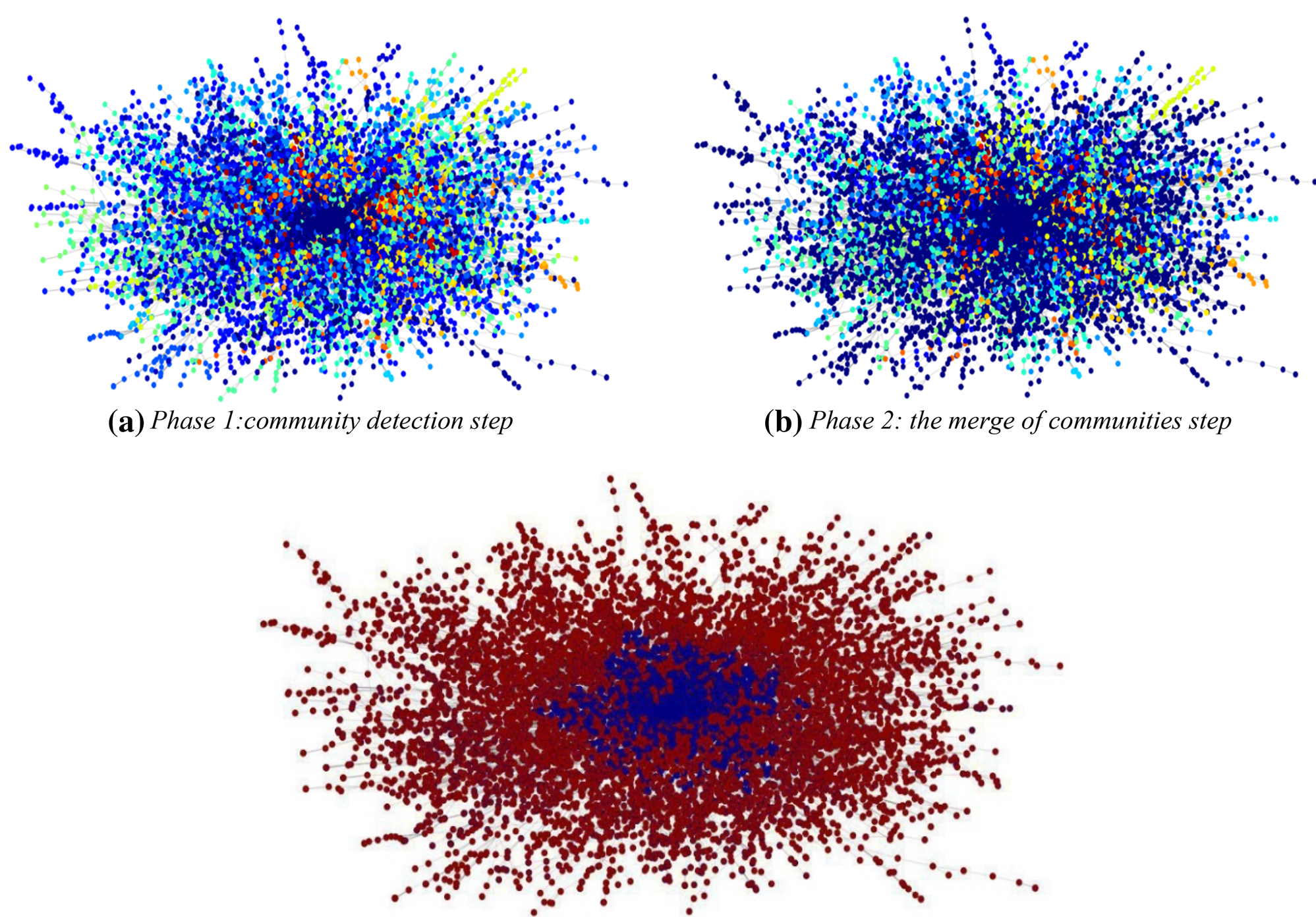 Fig 1. The filtering process: Red nodes belong to communities with low expansion potential and are pruned to save computation.
3. Dynamic Updating (Anti-Overlap)
Crucially, once a seed is selected, TI-SC updates the scores of its neighbors. By artificially lowering the scores of nodes near a newly selected seed, the algorithm "pushes" the selection of the next seed toward a different part of the network, effectively solving the Rich-Club overlap problem.
Experiments: Efficiency at Scale
The authors tested TI-SC against benchmarks like Collective Influence (CI) and DegreeDiscount on datasets ranging from small Email networks to 1M-edge DBLP graphs.
Key Performance metrics:
- Diffusion Accuracy: On the Ego-Facebook dataset, TI-SC achieved an influence spread of 382.8, outperforming PHG (375.1) and DegreeDiscount (367.8).
- Time Complexity: While the original Greedy algorithm is unusable for DBLP, TI-SC's complexity is effectively , where is the number of edges.
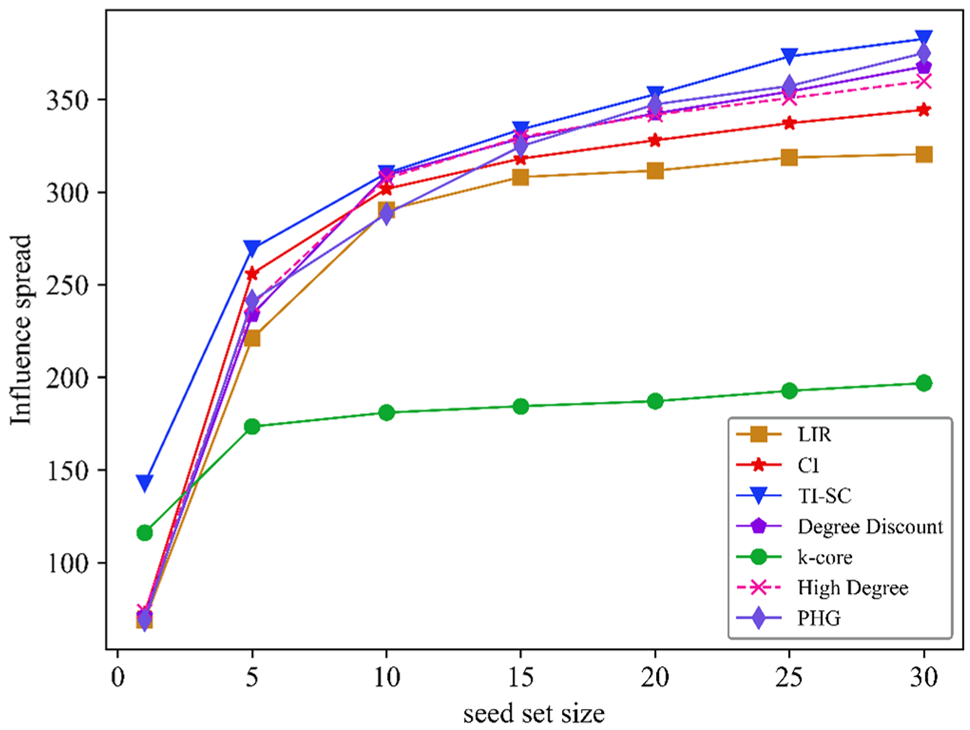 Fig 2. Influence spread across different seed set sizes (k). TI-SC (solid black line) consistently maintains the lead.
Deep Insight: Why TI-SC Matters
The real brilliance of TI-SC isn't just in the community detection—it's in the factor control. By calculating a ratio () of nodes to edges within a community, the algorithm can predict whether a community is a "dead end" for information spread. This heuristic allows it to skip redundant Monte Carlo simulations, which are the main bottleneck in IM research.
Limitations & Future Work
While TI-SC excels in "Rich-Club" networks, its advantage narrows in networks with very low connectivity where community structures are less pronounced. Future adaptations could look into Dynamic Social Networks where the community structure shifts over time.
Conclusion
TI-SC represents a significant step towards practical Viral Marketing and Information Warfare defense. By combining the macro-scale view (Communities) with micro-scale trust metrics (Scoring), it provides a blueprint for running complex optimization tasks on graphs with millions of users without needing a supercomputing cluster.