
DualGen Bridge AI: Building a Digital Gateway to Tibet’s Tourism with LLMs
Research on Tibetan Tourism Viewpoints information generation system based on LLM
The paper introduces the DualGen Bridge AI (DBA) system, a specialized framework designed to improve tourism information generation for Tibet using Large Language Models (LLMs). By combining a dual-model architecture for keyword extraction and content generation with a custom multi-structured evaluation framework, the system achieves SOTA performance in regional tourism services, notably with ChatGLM3-6B reaching an overall score of 80.84.
TL;DR
Researchers have developed the DualGen Bridge AI (DBA) system, a specialized dual-model framework optimized for the unique challenges of Tibetan tourism. By integrating high-precision keyword extraction with spatial algorithms (Haversine) and fine-tuned LLMs, the system bridges the gap between scattered regional data and tourist needs, achieving an 80.84% performance score on a custom multi-structure evaluation metric.
Background: The "Information Gap" in the Land of Snows
Tibet's unique religious ethos and "labyrinthine" topography make it a difficult terrain for standard smart tourism. Prior work often fails because:
- Data Scarcity: General LLMs (like GPT-4) lack the granular cultural and geographical data specific to Tibetan tourist sites.
- Structural Rigidity: Traditional evaluation metrics like BLEU or METEOR focus on natural language smoothness but fail to judge the accuracy of structured data (like POI names and coordinates).
Methodology: The Three Pillars of DualGen Bridge AI
The DBA system operates through a structured pipeline that ensures user intent is translated into accurate geographical recommendations.
1. Keyword Extraction (The Input Layer)
The system uses a fine-tuned Mistral-7B-Instruct-v0.2 to strip away conversational "noise" and extract specific location entities. Through Supervised Fine-Tuning (SFT) and LoRA, the researchers boosted extraction accuracy from 0.06 to 1.00.
2. The Bridge Model (The Computational Core)
Instead of letting the LLM "hallucinate" distances, the system employs a Bridge Model. It uses the Haversine formula to calculate spherical distances between the user's current location and a curated dataset of 398 Tibetan viewpoints.
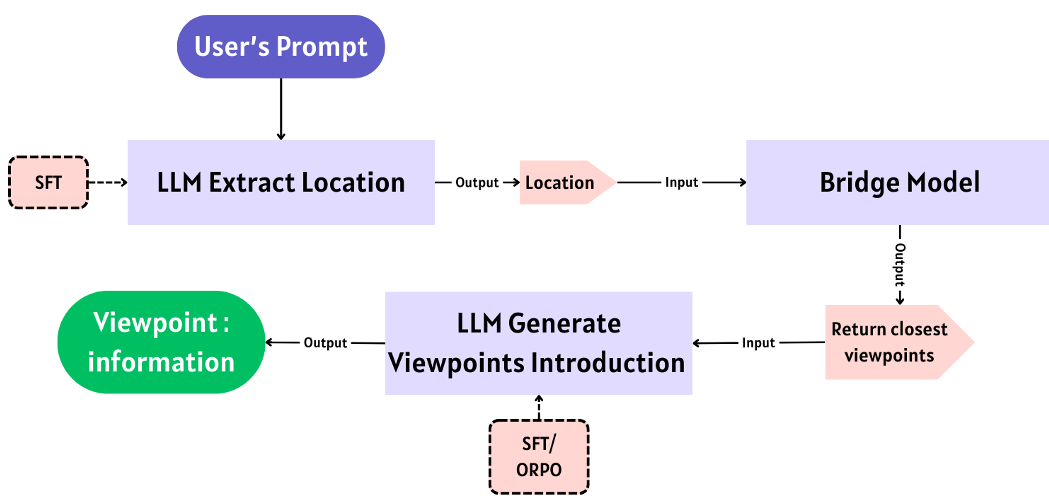 Fig 1: The DBA system workflow, illustrating the synergy between LLM extraction and algorithmic distance calculation.
3. POI Information Generation (The Output Layer)
After the Bridge model identifies the nearest five sites, a second LLM (specifically ChatGLM3-6B) generates detailed historical and geographical introductions.
Advanced Fine-Tuning: SFT vs. ORPO
The study provides a deep dive into optimization techniques:
- SFT+LoRA: Used to teach the model's basic task adherence.
- ORPO (Odds Ratio Preference Optimization): Used to refine the style of generation by penalizing "rejected" responses while amplifying "chosen" ones, without the need for a separate reference model.
Performance & Evaluation results
The researchers introduced a Multi-Structure Evaluation Standard. This composite score mathematically combines BLEU and Rouge scores (for structured text) with BERTScore-based fluency and relevance (for unstructured text).
| Model | Method | Accuracy Rate (Keyword Extraction) |
|---|---|---|
| Mistral-7B | Zero-Shot | 0.060 |
| Mistral-7B | SFT | 1.000 |
| Qwen1.5-7B | SFT | 0.980 |
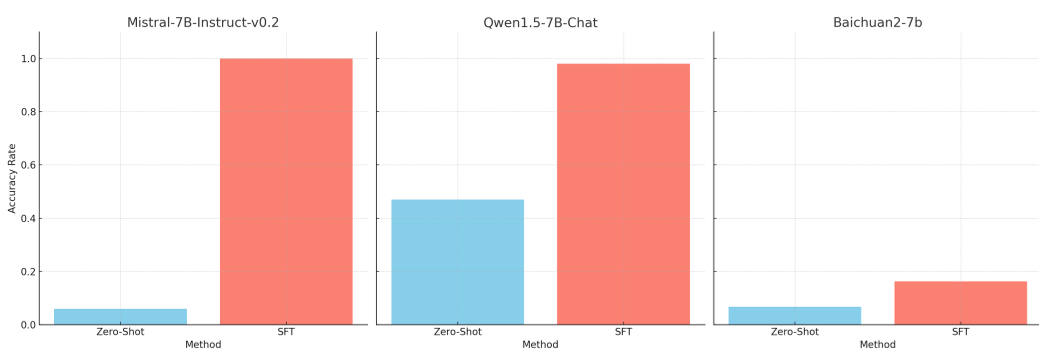 Fig 2: The dramatic leap in performance from Zero-Shot to SFT across different base models.
In the final generation task, ChatGLM3-6B with BF16 precision emerged as the winner, proving that architectural fit and precision selection (Brain Floating Point 16) significantly impact regional task performance.
Critical Insight: Why This Matters
The value of this research lies in its hybridity. It acknowledges that while LLMs are great "reasoners," they are often poor "calculators" for niche geography. By "bridging" the LLM with a hard-coded geometric formula (Haversine), the system provides a robust blueprint for other regional smart-service industries.
Limitations & Future Work
While successful, the system current relies on textual data. The authors suggest that moving toward Multi-modal LLMs (integrating photos of Tibetan landmarks) will be the next frontier in minimizing the information gap for tourists.
Conclusion
The DualGen Bridge AI demonstrates that the future of smart tourism isn't just about bigger models, but about smarter architectural bridges that connect general AI capabilities with specific, localized domain knowledge.