
TIDE: Every Layer Knows the Token Beneath the Context
TIDE: Every Layer Knows the Token Beneath the Context
This paper introduces TIDE (Token Identity Delivered Everywhere), a novel Transformer architecture that injects context-free token identity signals into every layer. Developed by researchers at Apple, TIDE achieves significant language modeling improvements by augmenting standard models with an ensemble of "EmbeddingMemory" blocks, outperforming LLaMA-style baselines across tasks like Wikitext and ARC with scales up to 3B parameters.
TL;DR
In standard Transformers, the model "forgets" exactly which token it is processing after the first layer, relying instead on a contextualized "haze" of hidden states. TIDE (Token Identity Delivered Everywhere) fixes this by piping static token identity through every single layer. This simple architectural change solves the "Rare Token Problem" (gradient starvation) and "Contextual Collapse," leading to faster convergence and significant accuracy gains for long-tail data.
The Blind Spot of Modern LLMs
Why do small models struggle with rare words or homophones? The authors point to two fatal flaws in the "single-injection" design used by almost every current LLM (from Llama to GPT-4):
- The Rare Token Problem: Following Zipf’s Law, the top 1% of tokens dominate 80% of the corpus. Because embeddings only get updated when their specific token appears, rare tokens are chronically under-trained. Their representations remain noisy and low-norm.
- Contextual Collapse: Imagine the words "1847" and "1849." In many contexts, they are syntactically identical. Because FFNs have a "Lipschitz constant" (a limit on how much they can change their output for a given change in input), if the attention layers haven't perfectly distinguished these tokens, the FFN effectively treats them as identical. The model "collapses" them into the same representation.
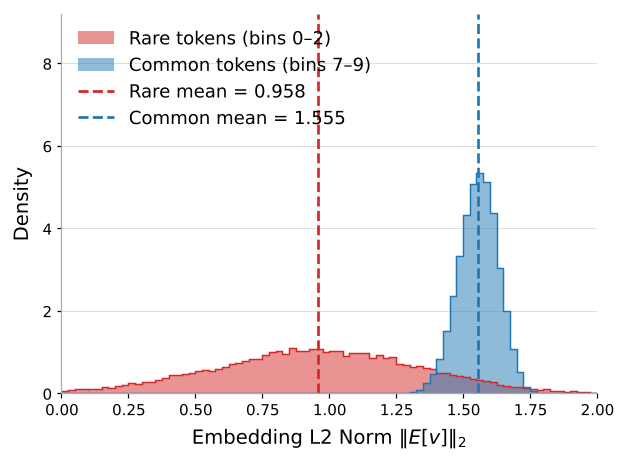 Figure 1: Rare tokens exhibit lower L2-norms and noise-dominated distributions compared to common tokens.
Methodology: Re-Introducing the Identity
TIDE doesn't just look at the embedding once. It introduces EmbeddingMemory: an ensemble of independent MemoryBlocks.
- Global Memory: Token indices are mapped to context-free semantic vectors.
- Depth-Conditioned Routing: Every Transformer layer has a lightweight "router" that looks at the current hidden state and decides which MemoryBlock to pull from.
- The Null Bank: If a layer doesn't need identity information (e.g., if the context is already sufficiently clear), the router can send the signal to a "Null Bank" (zero vector), ensuring TIDE is a safe architectural superset of the standard Transformer.
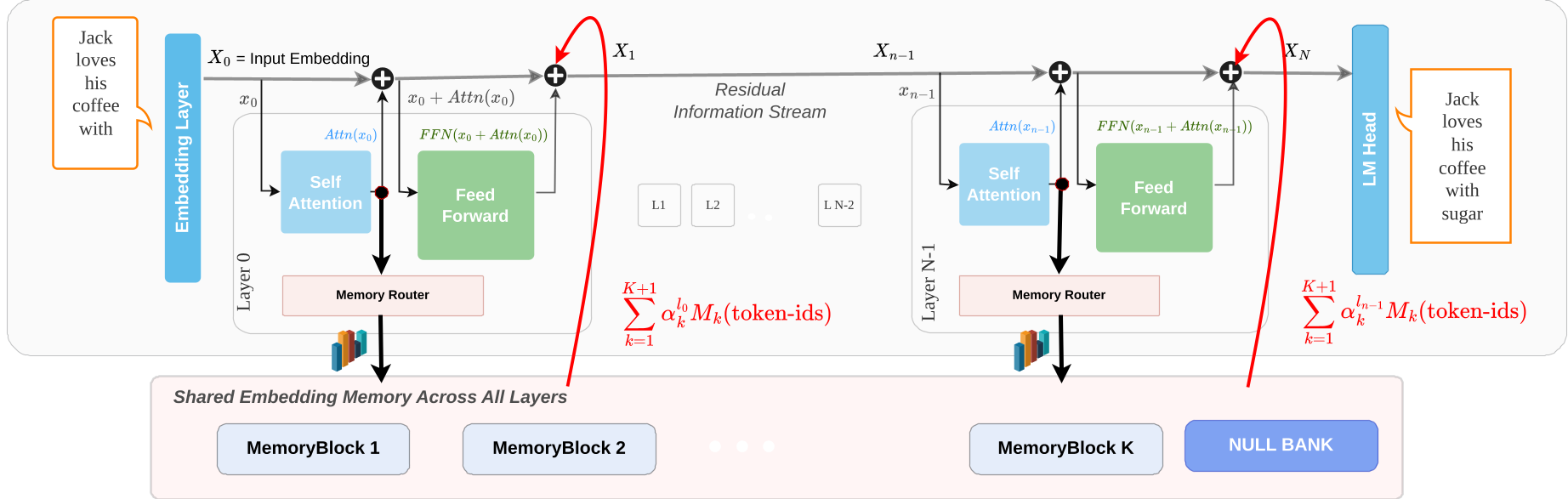 Figure 2: The TIDE architecture augments standard blocks with a parallel, persistent token-identity pathway.
Theoretical Advantage: K-Pathway Gradient Amplification
The most elegant part of TIDE is its effect on training. Normally, a token gets one gradient update per occurrence. In TIDE, because the token identity is used by every layer and pulled from K blocks, the rare token receives a K-fold amplification of gradient signal. Essentially, we are squeezing more "learning" out of every single time a rare word appears in the training data.
Experimental Results: Better, Faster, Stronger
TIDE-1B was tested against a standard LLaMA-style baseline. The results are striking:
- Convergence Speed: TIDE matches the performance of a baseline trained on 200B tokens using only 100B tokens.
- Rare Token Accuracy: Per-decile loss reduction was nearly 5x higher for rare tokens than for common ones.
- Downstream Power: Across eight benchmarks (ARC, PIQA, etc.), TIDE improved the average score by +2.3% at the 1B scale and +1.1% at the 3B scale.
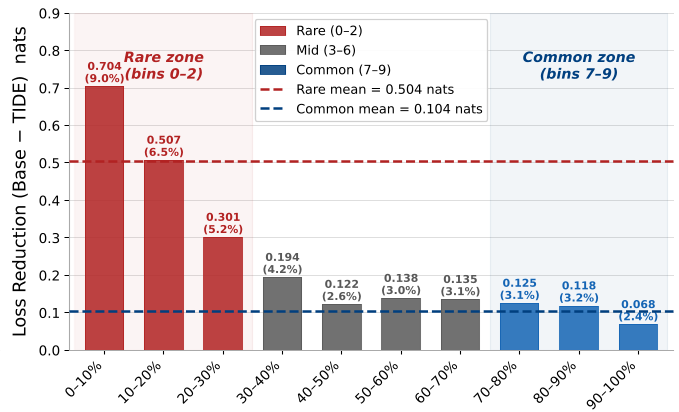 Figure 3: TIDE's gains are concentrated in the rarest tokens (Bin 0), where standard models struggle most.
Deployment & Efficiency
One might worry about the memory cost of these extra embedding tables. However, the authors show that because these tables are static and context-free, they can be 4-bit quantized and even offloaded to SSD with negligible impact on decoding speed (speed drops only ~1ms per token, which is a tiny price for the accuracy gain).
Conclusion: Stop Throwing Away Identity
TIDE is a powerful reminder that "Context is King," but it shouldn't be the only ruler. By anchoring every layer in the actual identity of the token being processed, models become significantly more robust to the long tail of human language. This work suggests that the next generation of LLMs should stop discarding their input indices and start using "identity memory" to build a deeper, more stable understanding of the world.