
Ties That Bind: How Network Topology Reshapes Homophily on Twitter
Tie Formation on Twitter: Homophily and Structure of Egocentric Networks
This paper investigates the relationship between homophily (similarity-driven association) and tie formation on Twitter by analyzing 29.5 million tweets. It introduces the "Ego Ratio" to categorize users into three topological structures—Generators, Mediators, and Receptors—and maps how different attributes like demographics, activity patterns, and content interests drive link formation across these groups.
TL;DR
Is "birds of a feather flock together" a universal truth on social media? This study analyzes 29.5 million tweets to prove that while similarity (homophily) drives connections, the type of similarity matters differently depending on who you are. By categorizing users as Generators, Mediators, or Receptors based on their follower/following ratio, the research reveals that bots crave "broadcasting" similarity, while average users seek "sentiment" and "location" alignment.
Context: Beyond the Simple Follow
For decades, sociologists have used Homophily to explain why we form ties. In the physical world, we gravitate toward people with similar ages, races, or jobs. However, Twitter isn't a level playing field. A news bot following thousands of people is fundamentally different from a celebrity followed by millions, yet most studies treat their "tie formation" (the act of following) as the same. This paper argues that internal motivations for following someone are encoded in the structure of one's egocentric network.
The "Ego Ratio" Framework
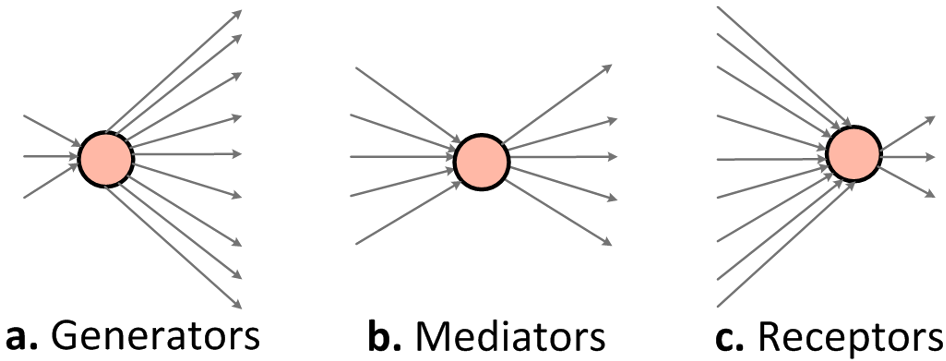
The core innovation of this work is the classification of users based on their Ego Ratio (Followers / Friends):
- Generators (Low Ratio): High out-degree. Often automated bots or niche businesses trying to gain visibility by following many users.
- Mediators (Ratio 1): The "average" users. Their incoming and outgoing ties are balanced, representing standard social reciprocity.
- Receptors (High Ratio): The "Elites" or celebrities. They receive immense attention but follow very few people.
Methodology: Quantifying Similarity
The author tracks "new ties" across two temporal snapshots (3 months apart) and measures similarity across three clusters:
- Demographics: Determining gender and ethnicity via Census Bureau genealogy data and political leanings via profile keywords.
- Activity: Measuring how often users retweet (broadcasting) vs. reply (interactiveness).
- Content: Using Toolkits like OpenCalais to match topical interests (e.g., Technology vs. Politics).
To handle complexity, the author uses Kullback-Leibler (KL) Divergence to measure the distance between two users' attribute distributions. Low divergence = High homophily.
Key Insights: What Drives the Follow?
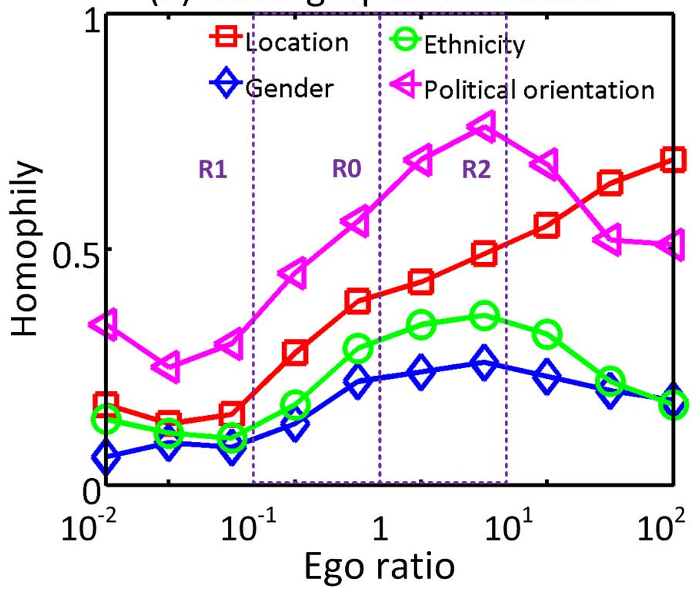
The study’s findings, visualized through homophily trends over varying Ego Ratios, challenge several assumptions:
1. The Universal Power of Interest
Topical Interest exhibited consistently high homophily regardless of the user type. Whether you are a bot or a celebrity, you follow people who talk about the same things you do.
2. The Identity Surprise
Surprisingly, Gender and Ethnicity showed remarkably low homophily in tie formation. On Twitter, identity markers are less predictive of who you follow than how you behave or what you talk about.
3. Structural Motivations
- Mediators are driven by Location and Sentiment. They use Twitter to connect with real-world contacts or people who share their emotional "vibe."
- Generators are obsessed with Broadcasting Behavior. A bot that retweets frequently is highly likely to follow another account that also retweets frequently—a "behavioral echo."
- Receptors (Celebrities) form "niche elites." They exhibit high homophily in Location and Interactiveness, essentially forming a digital "green room" with other elites in the same geographic hubs.
Critical Analysis & Takeaways
This paper provides a critical "structural lens" for Social Computing. It suggests that:
- Algorithmic Bias: If recommendation engines only look at topical homophily, they might successfully connect bots to bots, but fail to satisfy the "location/sentiment" needs of typical human Mediators.
- Limitations: The study acknowledges that correlation is not causation. We don't know if a user followed someone because of homophily, or if they became similar after following.
Conclusion: Twitter is not one network, but a collection of different "ego-species" participating for different reasons. Understanding that a "follow" from a Generator is driven by different homophilous forces than a "follow" from a Mediator is essential for anyone building or regulating social platforms.