
TH-ASVMC: Elevating Security in Mobile Healthcare via Tiger Hashing and Ensemble Learning
Tiger hash based AdaBoost machine learning classifier for secured multicasting in mobile healthcare system
The paper introduces TH-ASVMC, a novel framework for secure multicast routing in mobile healthcare systems (MANETs). It combines Tiger Hash functions for data integrity with an AdaBoost-ensemble SVM classifier for authenticating nodes, achieving superior reliability and reduced communication overhead compared to standard machine learning approaches.
TL;DR
The paper "Tiger hash based AdaBoost machine learning classifier" addresses the vulnerability of mobile healthcare systems (MANETs) to malicious nodes. By integrating the Tiger Hash function for data integrity and an AdaBoost-SVM ensemble for node authentication, the authors significantly enhance multicast routing security. The results are impressive: a ~24% increase in reliability and a ~34% reduction in communication overhead.
Background: The Healthcare MANET Dilemma
In mobile healthcare, sensors on patients transmit critical data across a network of mobile nodes. Because these networks (MANETs) lack a centralized authority, they are easy targets for "packet dropping" attacks or data tampering. Previous attempts used fuzzy trust models or single-layer classifiers, but these often struggled with scalability—either being too slow or failing to catch sophisticated unauthentic nodes.
Problem & Motivation: Why Existing Methods Fail
- Integrity Gaps: Standard protocols like SLMRP focus on quality of service but ignore whether the data was modified mid-transit.
- Classification Weakness: Single SVM or fuzzy models often have a high "false-positive" rate in node authentication, incorrectly labeling malicious nodes as authentic.
- The Overhead Trap: Heavy encryption techniques consume too much energy and time, which is fatal for real-time patient monitoring.
Methodology: The TH-ASVMC Architecture
The proposed TH-ASVMC (Tiger Hashing based AdaBoost with SVM Classifier) operates in three distinct phases:
1. Data Integrity via Tiger Hashing
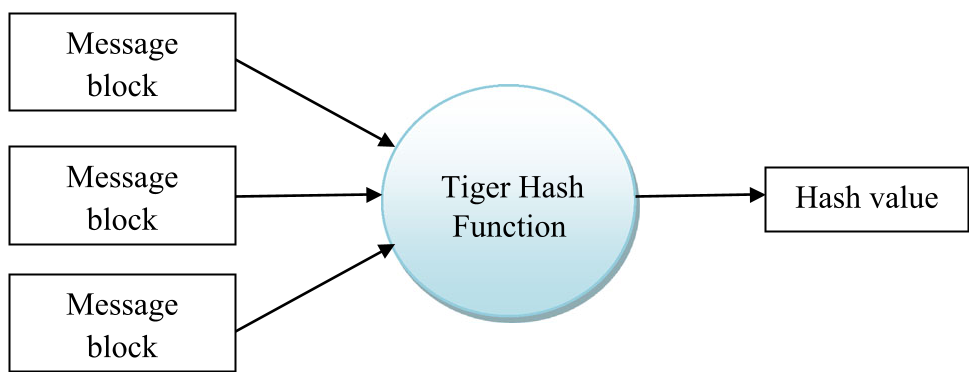
Instead of heavy encryption, the system uses the Tiger Hash function. It takes patient data and produces a 192-bit hash value.
- Why Tiger? It is optimized for 64-bit processors, making it faster than many contemporary hashes while remaining collision-resistant.
- Visual Logic: The process ensures that if an attacker modifies even one bit of the medical data, the hash comparison at the destination will fail.
2. Node Authentication via AdaBoost-SVM
This is the "brain" of the system. The model calculates a Trust Value for every node based on:
- DPFR (Data Packet Forward Rate): How many packets the node successfully passes.
- DPDR (Data Packet Drop Rate): How many packets the node suspiciously loses.
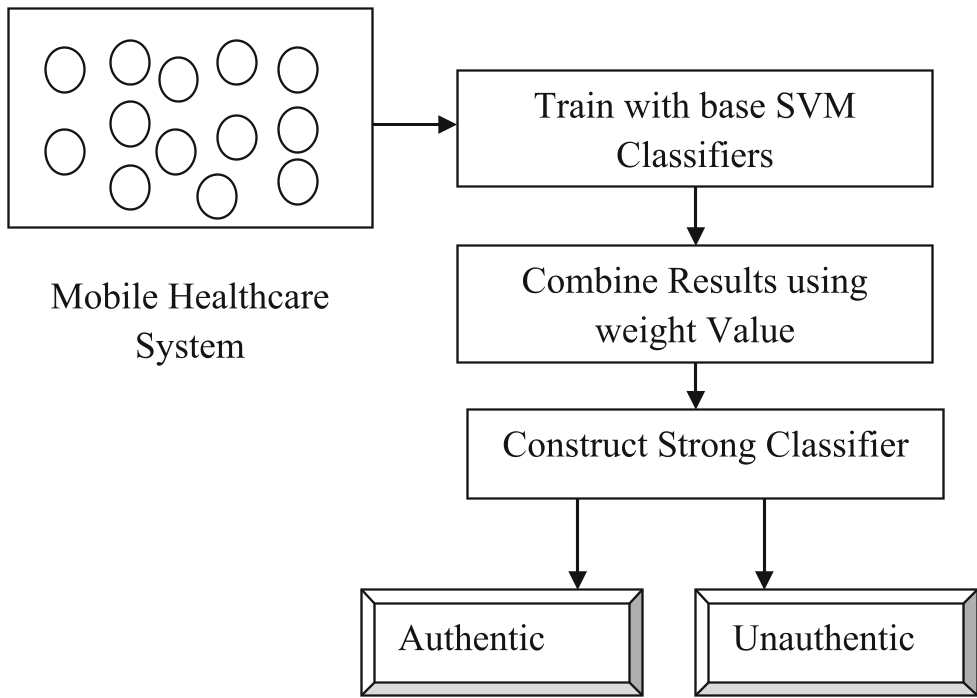
Individual SVMs act as "weak classifiers." The AdaBoost algorithm then combines these into a "strong classifier" by assigning weights to their predictions. This ensemble approach minimizes error rates and ensures that malicious nodes (unauthentic) are effectively quarantined.
3. Route Discovery
Once nodes are classified, the system utilizes a modified route discovery (RREQ/RREP) that exclusively selects authentic nodes with the minimum distance to the destination.
Experiments & Results
The authors tested the system in NS-2 with 500 nodes.
Reliability and Integrity
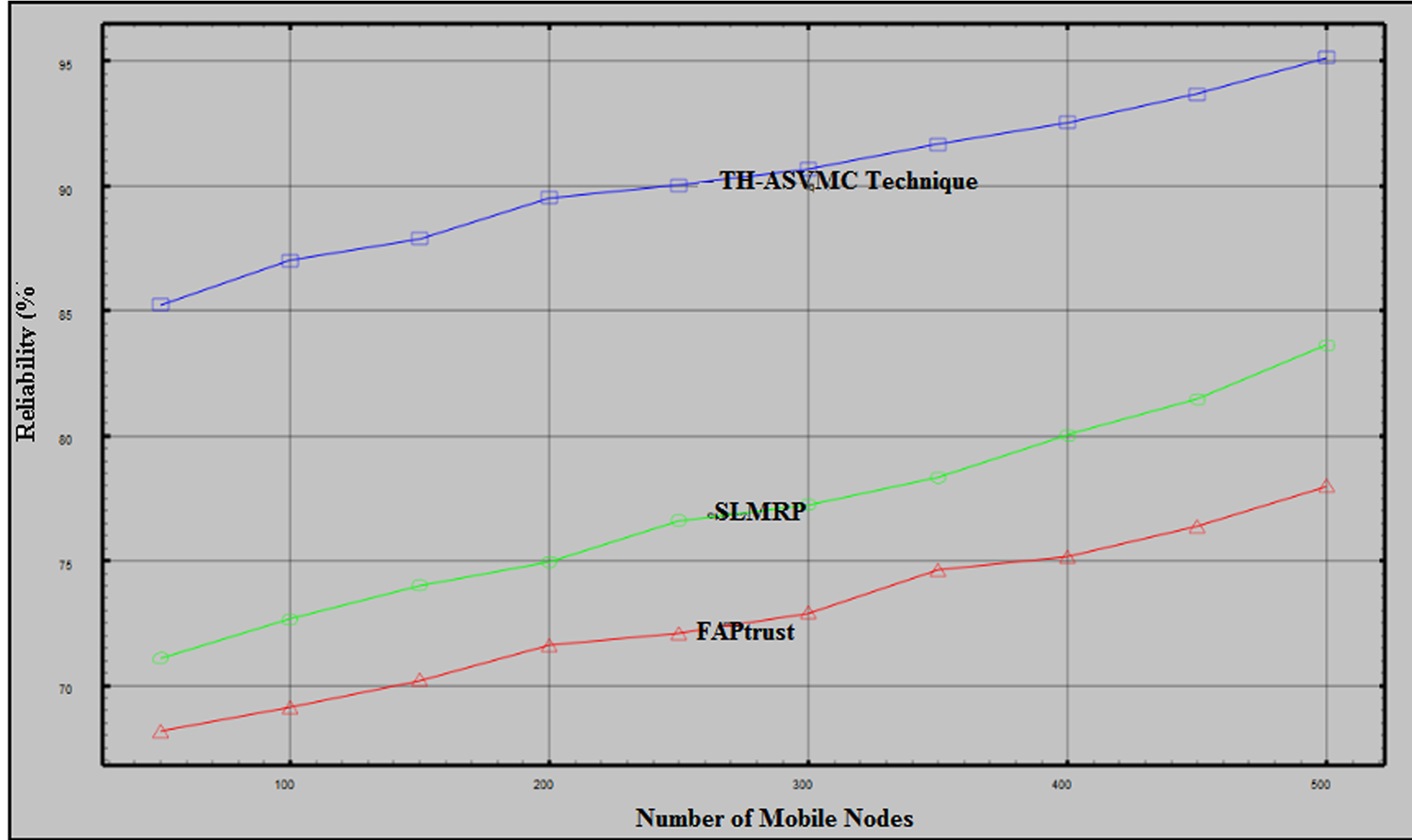
TH-ASVMC achieved a reliability rate of 95.14%, outperforming the fuzzy-based FAPtrust (77.98%) and the prediction-based SLMRP (83.62%). The Data Integrity Rate reached 96.59%, proving the Tiger Hash successfully blocked tampering attempts.
Scalability and Efficiency
As the number of data packets increased, TH-ASVMC maintained a lower communication overhead (59ms for 100 packets) compared to FAPtrust (80ms). This efficiency is critical for energy-constrained medical sensors.
Critical Analysis & Conclusion
Takeaway
The core insight of this paper is that trust is a dynamic metric. By using a machine learning ensemble (AdaBoost-SVM) to continuously evaluate node behavior, the network can self-heal and route around threats without the heavy computational tax of traditional cryptography.
Limitations & Future Work
- Mobility Patterns: While the Random Waypoint model was used, more complex "human-centric" mobility models would better reflect a hospital environment.
- Attack Variety: The paper focuses heavily on packet-drop behaviors. Future research could explore how this model handles "Sybil attacks" or "Blackhole attacks" specifically.
Conclusion: TH-ASVMC provides a robust blueprint for the next generation of secure, reliable, and energy-efficient mobile healthcare networks.