
Tikkoun Sofrim: Personalizing the Human-in-the-Loop Pipeline for Medieval Transcriptions
Tikkoun Sofrim: A WebApp for Personalization and Adaptation of Crowdsourcing Transcriptions
Tikkoun Sofrim is a specialized crowdsourcing web application designed to correct and retrain AI-based Handwritten Text Recognition (HTR) for medieval Hebrew manuscripts. By integrating the Kraken HTR engine with a personalized user-modeling framework, the system facilitates the creation of high-quality scholarly digital editions.
TL;DR
Tikkoun Sofrim is an innovative web application that bridges the gap between raw AI output and scholarly-grade transcriptions. By applying user modeling and adaptation strategies to the crowdsourcing process, it optimizes how volunteers correct Automated Transcription (AT) of medieval Hebrew texts, turning a tedious task into a personalized and engaging research contribution.
Background: The Limits of "Pure" Crowdsourcing
Crowdsourcing in the Digital Humanities has traditionally relied on the "wisdom of the crowd" in a generic sense. However, ancient manuscripts—specifically the Tanhuma/Yelamdenu Midrashim—present unique orthographic and structural challenges that a generalist crowd might struggle to solve. The authors identify a key gap: most platforms ignore the psychological and technical variations between volunteers. Without adaptation, volunteer fatigue leads to high churn and inconsistent data quality.
Methodology: The Workflow of Adaptation
The Tikkoun Sofrim architecture is not just a text editor; it is a sophisticated feedback loop. The system utilizes the Kraken HTR engine for initial page segmentation and transcription, then passes the results to a Task Assigner that considers the user's specific history and profile.
1. The Three-Stage Lifecycle
The authors break down the user experience into three distinct phases for personalization:
- Pre-Transcription: Users are screened using a short TIPI (Ten-Item Personality Inventory). Based on traits like Conscientiousness or Openness, the system serves specific motivational "nudges"—ranging from altruistic appeals to competitive social comparisons.
- Transcription: The UI itself adapts. Tutorial materials are dynamically swapped to match the specific manuscript a user is working on. Even the keyboard shortcuts for special characters (common in medieval Hebrew) change to reflect the character set of a particular witness.
- Post-Transcription: To encourage long-term retention, the system employs gamification (badges and leaderboards) and feedback mechanisms that validate the user's contribution against the project's overall progress.
 Figure 1: Conceptual overview of the Tikkoun Sofrim ecosystem.
Experiments and Interface
The core of the demo is the transcription interface, which presents a "line-by-line" correction task. This minimizes cognitive load by showing the original manuscript snippet directly above the AI-generated text.
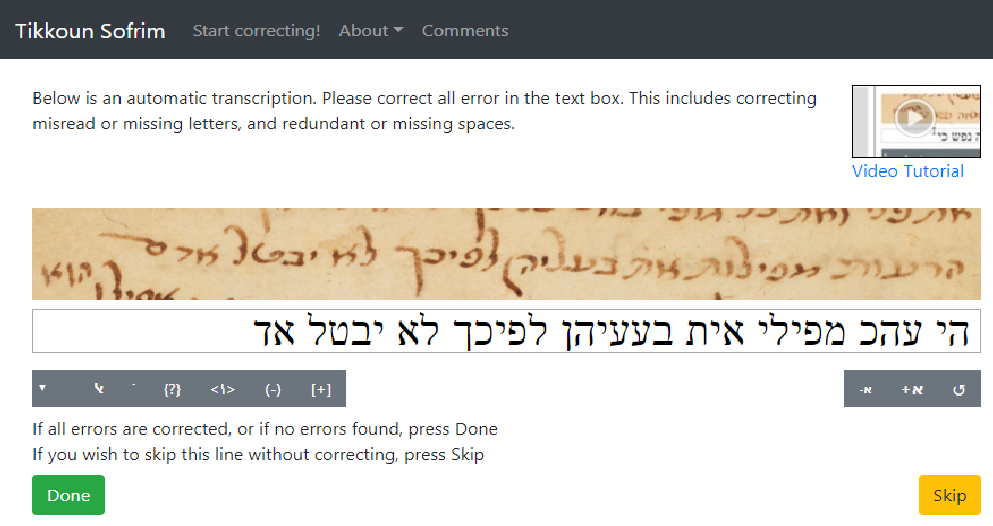 Figure 2: The transcription interface where users validate and correct HTR output.
By focusing on Midrash Tanhuma, a set of texts that were never formally canonized and exist in diverse manuscript forms, the project demonstrates that adaptive systems can handle "messy" data that standard HTR models typically fail on.
Critical Analysis & Conclusion
Tikkoun Sofrim moves the needle from "passive crowdsourcing" to "active citizen science."
Key Insights:
- Nudging Matters: Applying psychology-based nudges (TIPI-based) before a user even starts can significantly impact their commitment levels.
- Contextual UI: Adapting editing keys per manuscript is a small UX change with a high impact on the speed of specialized transcriptions.
Limitations & Future Work: While the current prototype focuses on personality scores, the authors admit that a deeper analysis of user ability (expertise-based task routing) is the next frontier. As AI models like Kraken improve, the role of the crowd will shift from "bulk transcription" to "expert validation" of the most difficult linguistic edge cases.
Conclusion: Tikkoun Sofrim provides a blueprint for how Digital Humanities projects can leverage AI without losing human nuance, ensuring that the labor of volunteers is utilized where it is most effective.