
TA-FSD: Leveraging Temporal Locality for Efficient First Story Detection in Twitter
Time-Aware First Story Detection in Twitter Stream
The paper introduces Time-aware First Story Detection (TA-FSD), a novel online clustering framework for identifying the earliest tweet of a new event in Twitter streams. It utilizes a ranking function based on temporal decay and popularity trends to restrict comparisons to the most relevant top-K event candidates, significantly outperforming P-LSH and Nugget-based baselines.
TL;DR
Social media moves fast. Conventional event detection algorithms struggle because they treat a tweet from last month with the same importance as one from ten minutes ago. Time-aware First Story Detection (TA-FSD) changes this by introducing a temporal ranking mechanism that focuses only on "hot" and "recent" events. This reduces unnecessary comparisons and slashes the error rate () by nearly 45% compared to prior state-of-the-art methods like P-LSH.
The Problem: The "History Trap" in Stream Processing
Most First Story Detection (FSD) systems rely on online clustering:
- A tweet arrives.
- It is compared against every existing event cluster.
- If no match is found, it is labeled a "First Story."
The Catch? As the stream continues, the number of clusters grows indefinitely. Comparing a new tweet about the "2026 World Cup" against a cluster from the "2012 Election" is a waste of compute and a source of noise. In the Twitter ecosystem, most events follow a sharp trajectory: a rapid rise for 1-2 days followed by a steep decline. Existing methods fail to exploit this "Temporal Locality."
Methodology: Ranking via Time and Heat
TA-FSD moves away from exhaustive comparison. Instead, it maintains an Event Profile (Nugget) for each cluster and ranks them using a two-part scoring function:
1. The Time Factor (Decay)
The importance of an event shouldn't just vanish; it should decay. The authors tested five decay functions (Gaussian, Triangle, Hamming, Circle, Window).
- Insight: Gaussian decay proved most effective, modeling the natural "fading out" of social interest.
2. The Hot Spot Factor (Trend)
An event is relevant if it's currently being discussed frequently. The heat is calculated as the ratio of current tweet volume to the average volume over a window .
3. The Architecture
By combining these, the system only compares new tweets against the Top-K ranked events.
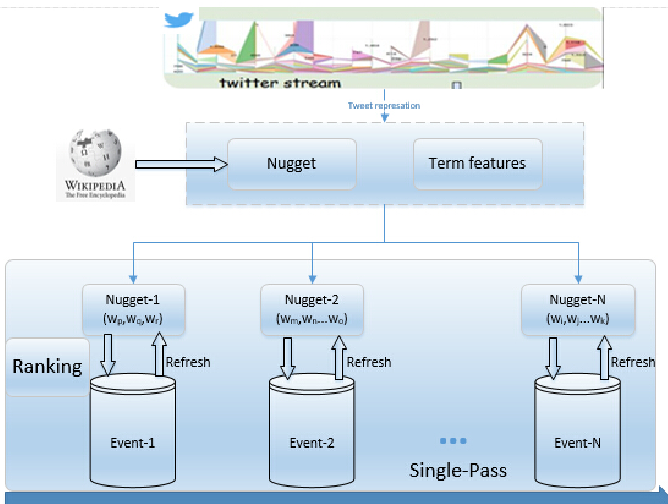 Fig 1: The TA-FSD System Architecture, showing the ranking and truncation flow.
Experimental Performance: Efficiency Meets Accuracy
The authors compared TA-FSD against baseline methods including P-LSH (Locality Sensitive Hashing) and the standard Nugget-FSD.
Scalability
As shown in Fig 3, TA-FSD maintains a nearly constant comparison count even as the total number of tweets grows to 80,000+. While LSH-based methods see an increase in hash collisions (and thus comparisons), TA-FSD's truncation keeps the workload predictable.
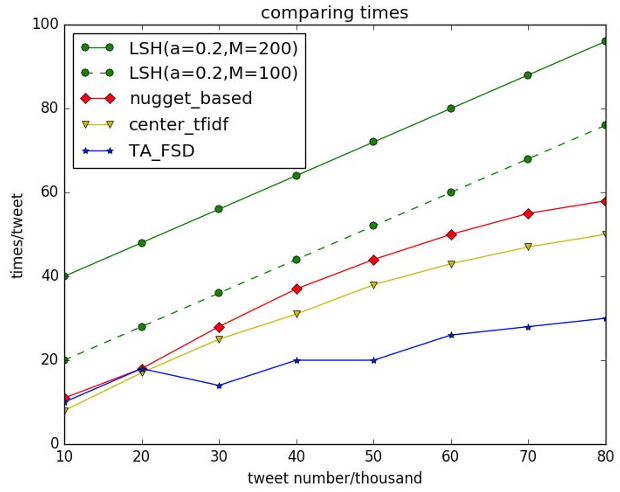 Fig 2: Comparison of the number of operations required per 10k tweets. TA-FSD (bottom line) is the most efficient.
Detection Quality
In terms of (the cost of misses and false alarms), TA-FSD outperformed all baselines across two major datasets (Edinburgh Corpus and Event2012).
| System | Event2012 |
|---|---|
| P-LSH | 0.679 |
| Nugget-FSD | 0.595 |
| TA-FSD | 0.398 |
Critical Insight & Future Outlook
The success of TA-FSD lies in its Inductive Bias: the assumption that most Twitter events are short-lived. By setting and hours, the authors found the "sweet spot" for social media monitoring.
Limitations: Currently, the system relies heavily on text similarity. The authors suggest that future iterations should incorporate User Influence (e.g., a tweet from a verified news source should weight higher in "First Story" confidence).
Conclusion
TA-FSD proves that "forgetting" is just as important as "remembering" in large-scale stream mining. By intelligently pruning the past, we can better detect the future of breaking news.