
Establishing Social Trust in the Machine World: A Time-Aware Approach to SIoT Reliability
A Time-Aware Similarity-Based Trust Computational Model for Social Internet of Things
This paper introduces a time-aware similarity-based trust model for the Social Internet of Things (SIoT) that evaluates object reliability through community, friendship, and co-work similarities. It implements a decentralized framework combining direct perceptions and neighbor recommendations, achieving efficient classification of trustworthy versus untrustworthy nodes using the Sigcomm dataset.
TL;DR
As the Internet of Things transitions into the Social Internet of Things (SIoT), machines now form autonomous "friendships" and "work communities." This paper proposes a dynamic trust model that mimics human social behavior, using community, friendship, and co-work similarities to filter out malicious nodes. By using a time-aware weighting system, the model ensures that trust scores evolve alongside the actual quality of interactions.
Problem & Motivation: The Uncertainty of Autonomous Interactions
In a world projected to have over 75 billion connected devices by 2025, the SIoT paradigm allows objects to interact without human intervention. This autonomy is a double-edged sword:
- The Risk: Malicious nodes can easily enter the network to disrupt resources or spread misinformation.
- The Limitation of Prior Work: Existing models often use static weights for trust parameters, failing to adapt when an object's behavior changes or when the context moves from "socializing" to "collaborating."
The authors' core insight is that trust is not a static property but a dynamic relationship built on shared context and proven reliability over time.
Methodology: The Three Pillars of SIoT Similarity
The model calculates trust using two streams: Direct Trust (DT) and Indirect Trust (RT/Recommendation).
1. Social Feature Extraction
The authors define three distinct mathematical similarities:
- Community-of-Interest (CoI): Based on membership in shared social groups.
- Friendship Similarity (FS): Based on the ratio of common "neighboring" friends.
- Co-work Similarity (CW): Calculated via Cosine Similarity of multicast interactions in common applications.
2. The Dynamic Weighting Mechanism
The most critical part of the architecture is how it balances direct experience versus hearsay.
- Equation for :
- As two objects interact more frequently and successfully, the weight of Direct Trust () increases, while the dependence on Recommendations () decreases.
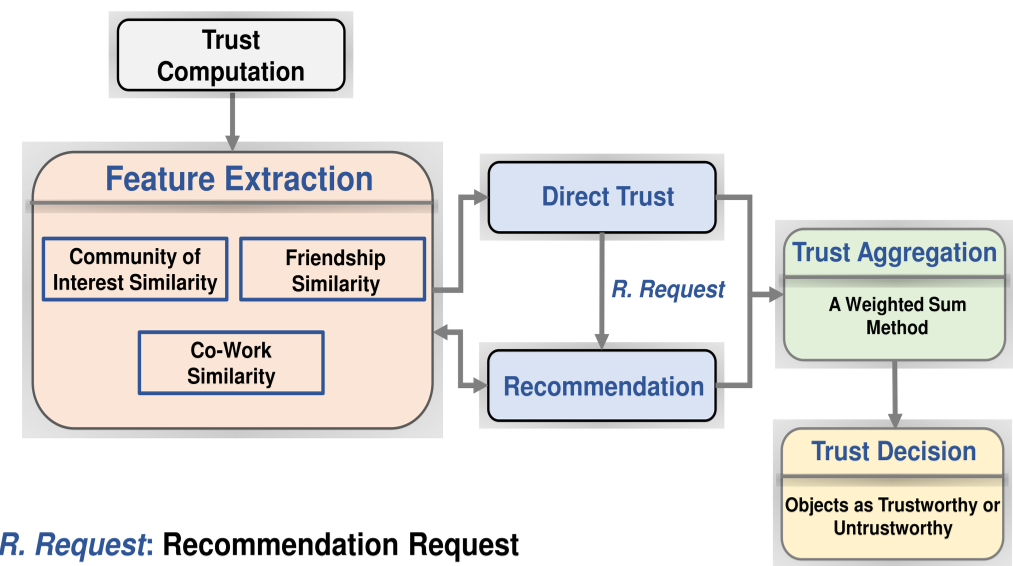 Fig 1: Schematic diagram of the similarity-based trust model.
Experiments & Results: Watching Trust Evolve
Using the Sigcomm 2009 dataset, which tracks 76 nodes and over 18,000 interactions, the researchers simulated trust evolution over 24 hours.
Key Findings:
- Temporal Dynamics: Trust scores for nodes like "Node 6" showed a sharp rise (from 0.5 to 0.7) between the 4-hour and 12-hour marks, coinciding with an increase in weighted interaction quality.
- Classification Accuracy: By setting a threshold (), the model effectively separated reliable partners from potential threats.
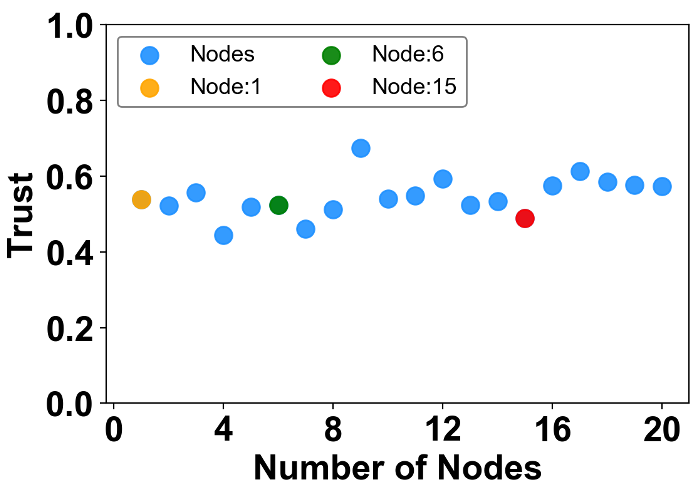 Fig 2: Visualization of how node trust scores change over 24 hours based on interaction dynamics.
Critical Analysis & Conclusion
Takeaway
The paper successfully demonstrates that similarity is a proxy for trust. By quantifying social ties (Friendship, Co-work, Community), the SIoT can reach a consensus on reliability that is far more robust than simple identity-based security.
Limitations & Future Work
While the model excels at classification, it assumes that "successful packet transmission" is a sufficient measure of interaction quality. The authors acknowledge that future work must involve:
- Attack Modeling: Testing against sophisticated "Sybil" or "Zig-zag" attacks where nodes behave well only temporarily.
- Historical Experience: Incorporating a deeper "memory" module to record long-term trustee behavior beyond the immediate time window.
Ultimately, this work provides a solid mathematical foundation for the "Social" aspect of IoT, moving us closer to a secure, self-organizing machine ecosystem.