
Deciphering the Pulse of Online Forums: The Hidden Laws of Human Temporal Behavior
Understanding the time characteristic of user behavior on online forums
This paper presents a quantitative empirical analysis of the temporal characteristics of user behaviors (posting and replying) across four major Chinese online forums: Sina, NetEase, HuBeiDongHu, and LiXiang. By analyzing inter-event time distributions, the study identifies that online forum activities follow heavy-tailed distributions characterized by high burstiness and low memory, deviating significantly from Poisson processes.
TL;DR
By analyzing millions of interactions across four major Chinese forums, researchers have found that human posting behavior is far from random. Instead, it follows a "heavy-tailed" distribution characterized by intense bursts of activity and long periods of silence. This study quantifies these patterns using burstiness and memory metrics, offering a new blueprint for identifying spammers who break these natural human rhythms.
Background: Beyond the Poisson Process
In classical statistics, human actions were often modeled as a Poisson process, implying that the time between two actions (inter-event time) follows an exponential distribution. However, this suggests a level of regularity that doesn't exist in reality. This paper joins the ranks of computational social science by proving that forum users exhibit Temporal Heterogeneity—we are creatures of extremes, either replying to ten threads in five minutes or staying silent for months.
Methodology: Measuring the "Burst"
The authors collected data from Sina, NetEase, HuBeiDongHu, and LiXiang, covering hundreds of thousands of posts and replies. To quantify the "pulse" of these forums, they utilized two core metrics:
- Burstiness (): Measures how intermittent a signal is.
- Memory (): Measures if the length of a current interval influences the next one.
 The fundamental unit of analysis: the time interval () between consecutive user actions.
Key Insights from Empirical Analysis
1. The Heavy-Tail Phenomenon
The distribution of intervals for both posting and replying showed a clear heavy tail. On a log-log scale, this appears as a straight line, signifying a power-law distribution.
- The "Up-fluctuation": The researchers noted a spike at the 24-hour mark ( seconds), which corresponds to the circadian rhythm of human life. We tend to return to the forum at the same time the next day.
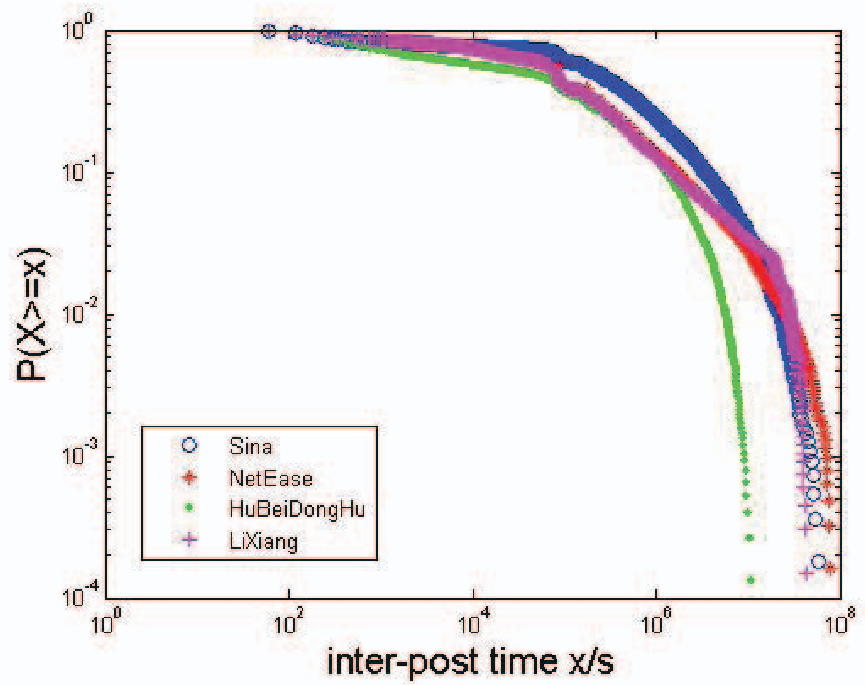 Note the heavy tail in (a) and the linear trend in the cumulative distribution (b), indicative of non-random, bursty behavior.
2. High Burstiness, Low Memory
The study found that forums generally have high burstiness () but memory () values near zero.
- Interpretation: While users act in concentrated bursts, their timing is largely independent of their previous actions. This "low memory" makes human behavior on forums particularly difficult to predict using simple linear models.
- Reply vs. Post: Interestingly, "reply" behaviors showed slightly higher memory than "post" behaviors, likely because replies are reactions to ongoing discussions (external stimuli).
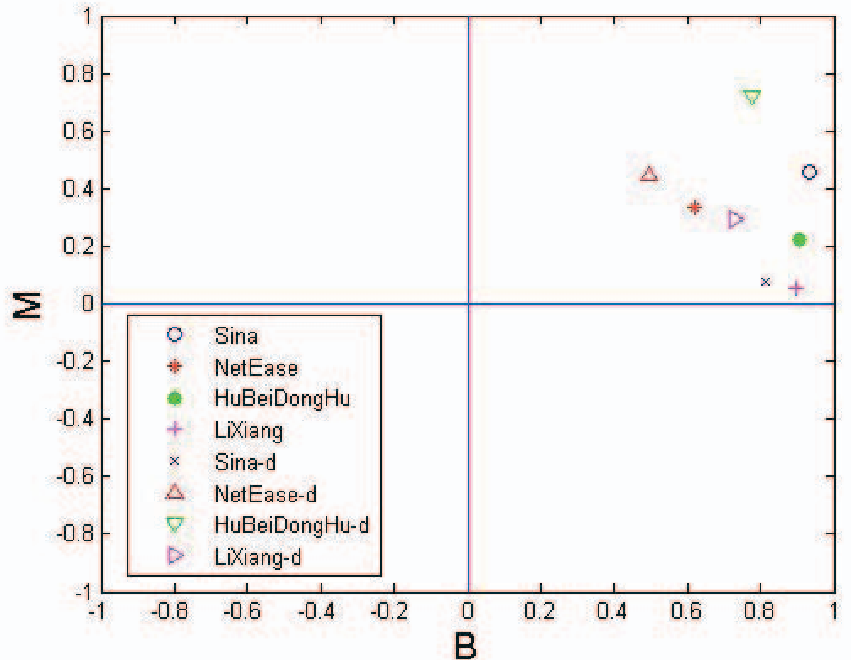 The cluster in the high-burst, low-memory quadrant highlights the universal characteristic of forum interactions.
3. Identifying the "Digital Ghost": Spam Detection
One of the paper's most practical contributions is identifying deviations from normal patterns.
- NetEase Anomaly: In NetEase, the researchers found reply intervals as short as 1 second. Since a human requires time to read and type, these "low-head" distributions are smoking guns for automated spam scripts.
- Midnight Activity: While normal users sleep (5 AM being the lowest activity point), certain accounts maintain high frequency after midnight, providing a temporal signature for spammers.
Critical Analysis & Conclusion
This research confirms that Heavy-Tailed Distributions are a ubiquitous feature of online social interaction. The study’s value lies in its comparison across different types of forums (comprehensive vs. financial), proving that while the topic changes, the temporal math of human engagement remains consistent.
Limitations: The study primarily focuses on the "when" rather than the "what." Integrating Sentiment Analysis or NLP with these temporal features would likely create an even more robust spam detection system.
Takeaway: If you want to find a bot, don't just look at what they say—look at when they say it. Humans have a rhythm; machines have a clock.