
Time-Critical MSN: Using Predictable Human Routines for Guaranteed Content Delivery
Time Critical Content Delivery Using Predictable Patterns in Mobile Social Networks
The paper introduces a routing framework for Mobile Social Networks (MSN) that leverages predictable human mobility patterns to ensure time-critical content delivery. By analyzing routine social encounters, the authors propose algorithms for backbone formation and next-hop selection that optimize message delivery based on specific timing constraints.
TL;DR
Researchers have developed a routing framework for Mobile Social Networks (MSN) that treats human mobility not as a random walk, but as a predictable schedule. By incorporating the exact time and duration of encounters into routing logic, the system provides time-assurance for critical messages while significantly reducing network overhead.
Problem & Motivation: The "Blind Encounter" Flaw
Most existing Mobile Ad-hoc Network (MANET) protocols assume constant connectivity—a luxury rarely found in real-world mobile scenarios. Conversely, Delay-Tolerant Network (DTN) protocols often rely on "blind encounters," forwarding data to any node with a high statistical probability of meeting the destination.
The Critical Gap: These methods ignore when the encounter happens. If a message is time-critical (e.g., an urgent "Event Alert" or a "limited-time ticket"), knowing that User A usually meets User B is not enough. We need to know if they will meet before the message expires and if the meeting lasts long enough to transfer the file.
Methodology: Building a Backbone from Human Habits
The authors argue that human life is repetitive. Using the MIT Reality Mining dataset (100 users over 9 months), they proved that encounters follow consistent daily patterns.
1. The Backbone MSN
The system identifies "Active Social Actors"—users who are well-connected and have generic interest profiles. These users form a Backbone MSN. A link in this graph isn't just a binary "connected" or "not," but a tuple of:
- : Time left until the next encounter.
- : Expected duration of the upcoming encounter.
- : Probability of that encounter occurring.
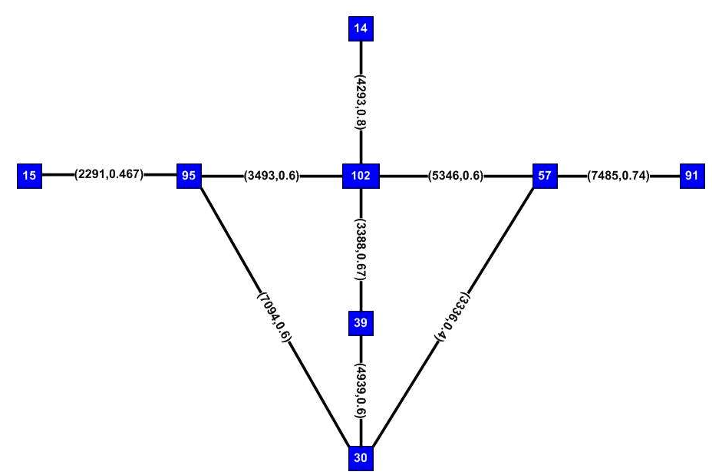 In this aggregated backbone graph, links are weighted by encounter probability and duration, allowing for calculated path selection.
2. Next Hop Selection
The routing algorithm (Algorithm 2 in the paper) functions on a simple but powerful heuristic. A node passes message to neighbor only if:
- The neighbor's interest profile matches the message.
- The time to encounter is less than the message's timeout.
- The encounter duration is sufficient to transfer the message size .
Experiments: Real-World Traces & Simulations
The authors validated their approach using the Virtual Social Simulated Environment (VSSE), a platform that allows real human participants (via avatars) to interact with automated mobility models.
Key Insights from Results:
- Reduced Flooding: Unlike epidemic routing which sprays messages everywhere, this pattern-aware approach selects specific carriers. As the network matures and more messages are exchanged, the system becomes more efficient at finding "short-cuts," leading to a decrease in the number of carrier changes (hops).
- Latency Mastery: Latency was found to be inversely proportional to the number of messages in the system, suggesting that as social patterns become better mapped, delivery becomes faster.
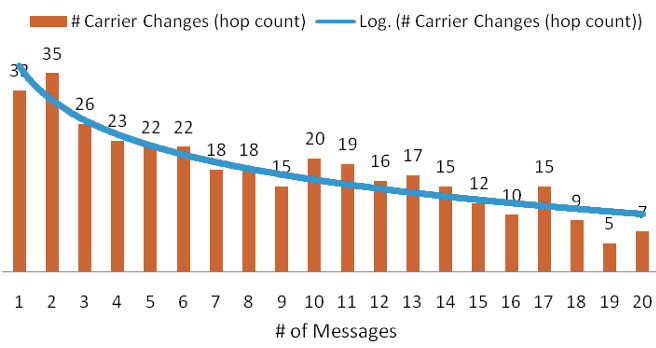 The decrease in hop counts (message carrier changes) demonstrates that the algorithm identifies more efficient routes as predictable patterns are established.
Critical Analysis & Conclusion
Takeaway
The genius of this work lies in transforming "social context" from a vague sociological concept into a concrete networking metric ( and ). By doing so, the authors move MSN routing from "best-effort" to "time-assured."
Limitations
- Privacy: Building detailed neighbor tables requires logging users' daily routines, raising significant privacy concerns.
- Anomalies: The model assumes users follow strict routines (Monday-Friday). It may struggle with sudden behavioral changes or special events that deviate from historical data.
Future Outlook
As 5G/6G and edge computing evolve, these "Predictable Pattern" algorithms could be integrated into local device-to-device (D2D) communication layers, allowing our phones to intelligently offload traffic through the "social backbone" without ever touching the congested cellular core.