
Beyond the Frame: Unlocking Environmental Audio with Matrix Factorization
Time–Frequency Matrix Feature Extraction and Classification of Environmental Audio Signals
This paper introduces a novel long-term audio feature extraction framework using Matching Pursuit Time-Frequency Distribution (MP-TFD) and Non-negative Matrix Factorization (NMF). The method decomposes a Time-Frequency Matrix (TFM) into spectral and temporal components to achieve an 85.5% classification accuracy across 10 diverse environmental audio classes, significantly outperforming traditional MFCC-based approaches.
TL;DR
Researchers have developed a "segment-free" feature extraction method that treats audio signals as high-dimensional images (Time-Frequency Matrices). By combining adaptive Matching Pursuit with Non-negative Matrix Factorization (NMF), they’ve achieved a 10%+ performance boost over standard MFCCs, specifically excelling in classifying complex sounds like helicopters, animals, and musical instruments.
The "Short-Term" Fallacy
Most audio processing pipelines rely on Short-Term Analysis. We chop a signal into 20ms frames, assume it's stationary, and calculate features like MFCCs. While this works for speech (where the vocal tract moves slowly), it fails miserably for environmental audio. Sounds like an aircraft engine or a bird's chirp contain abrupt transients and long-term structures that a 20ms window simply cannot "see."
The authors argue that human perception needs at least 0.5 to 1 second to understand an audio context. Why shouldn't our machine learning models do the same?
Methodology: The TFM Decomposition Pipeline
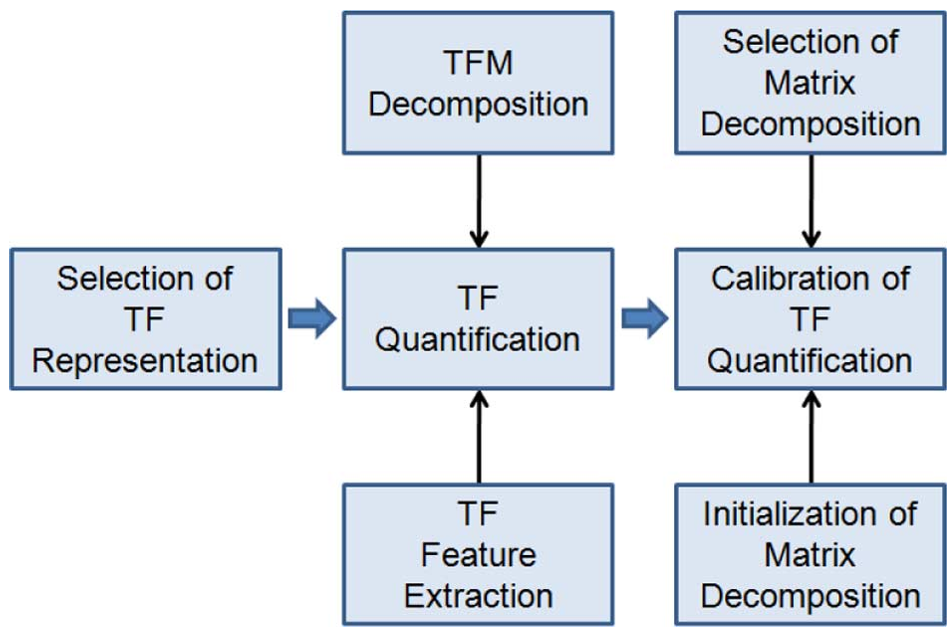
The paper proposes a three-stage workflow that shifts the focus from local frames to global matrices.
1. MP-TFD: The Adaptive Canvas
Instead of a standard Spectrogram (which has a fixed resolution tradeoff), the authors use Matching Pursuit Time-Frequency Distribution (MP-TFD).
- Adaptive: It uses a redundant dictionary of Gabor atoms to model the signal.
- Resolution: It provides high resolution in both time and frequency.
- Purity: It is cross-term free and naturally ignores incoherent noise (denoising).
2. From Matrix to Components (NMF)
The resulting TFD is treated as a Time-Frequency Matrix (TFM). To reduce its massive dimensionality, the authors apply NMF. This mathematical "scalpel" decomposes the matrix into (frequency basis) and (temporal activation), effectively separating the "what" from the "when."
3. The Novel Feature Set
The authors don't just use the raw NMF vectors. They extract seven high-level descriptors:
- Joint TF Moments: Capturing the spread of energy.
- Sparsity: Distinguishing between continuous hums and transient pops.
- Discontinuity: Measuring abrupt changes in the temporal envelope.
- MP Coherence: A unique metric based on how quickly the Balancing Pursuit algorithm converges.
Experimental Showdown: TFM vs. MFCC
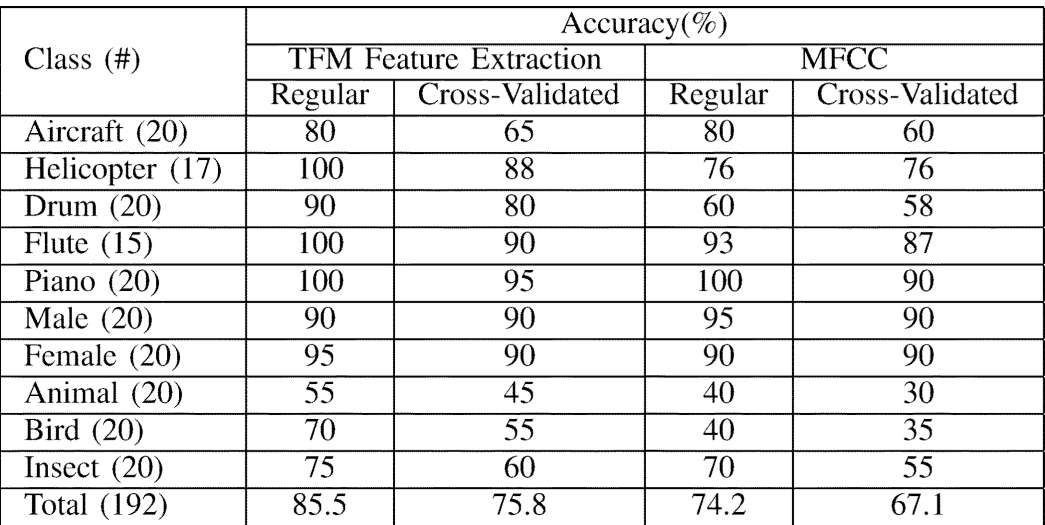
The model was put to the test against 10 diverse classes, including aircraft, helicopters, insects, and human speech.
| Method | Accuracy (Regular) | Accuracy (Cross-Validated) |
|---|---|---|
| Proposed TFM | 85.5% | 75.8% |
| Standard MFCC | 74.2% | 67.1% |
The results (shown in the table above) highlight a massive leap in performance. Notably, groups like "Helicopter" and "Piano" achieved 100% accuracy using the TFM features.
Robustness to Noise
One of the most impressive findings is the system's resilience. Because MP-TFD focuses on "coherent" structures, it acts as an automatic filter. The system remained stable at 10dB SNR, while Spectrogram-based features required a near-silent 50dB SNR to function effectively.
Critical Insight & Conclusion
This paper serves as a vital reminder that signal representation is often more important than the classifier itself. By moving away from rigid windowing and embracing the matrix-like nature of audio, the authors provide a robust way to quantify non-stationarity.
Future Outlook: While NMF is powerful, it is computationally intensive. The next logical step for this research would be integrating these TFM-derived features into Convolutional Neural Networks (CNNs) or Transformers, which are naturally designed to find patterns in 2D matrix representations.
For practitioners in multimedia retrieval or environmental monitoring, the takeaway is clear: stop looking at frames, and start looking at the matrix.