
Beyond the Static: Why Time is the Missing Variable in Music Emotion Recognition
The Role of Time in Music Emotion Recognition: Modeling Musical Emotions from Time-Varying Music Features
This paper examines the critical role of temporal dynamics in Music Emotion Recognition (MER). It critiques traditional static machine learning approaches and advocates for modeling musical emotions as time-varying processes driven by the temporal evolution of acoustic features rather than static averages.
TL;DR
Music isn't a snapshot; it's a journey. Yet, for years, Music Emotion Recognition (MER) has treated songs like static images, averaging out their features and losing the soul of the performance. This paper argues that the "secret sauce" of musical emotion lies not in the features themselves, but in how they change over time. By moving from static classifiers to dynamic time-series models, we can finally bridge the "semantic gap" between raw audio and human feeling.
The "Bag of Features" Problem: Why Static Models Fail
Historically, MER systems have followed a rigid pipeline: extract features (MFCCs, Spectral Centroid, etc.) from short frames, average them across a whole track, and map that single vector to an emotion like "Happy" or "Sad."
The authors point out a glaring flaw: Musical experience is inherently temporal. A sudden shift from soft to loud (a sforzando) creates a visceral emotional spike that a static average completely erases. This traditional approach ignores the cognitive mechanisms—memory and expectation—that actually regulate our emotional responses to music.
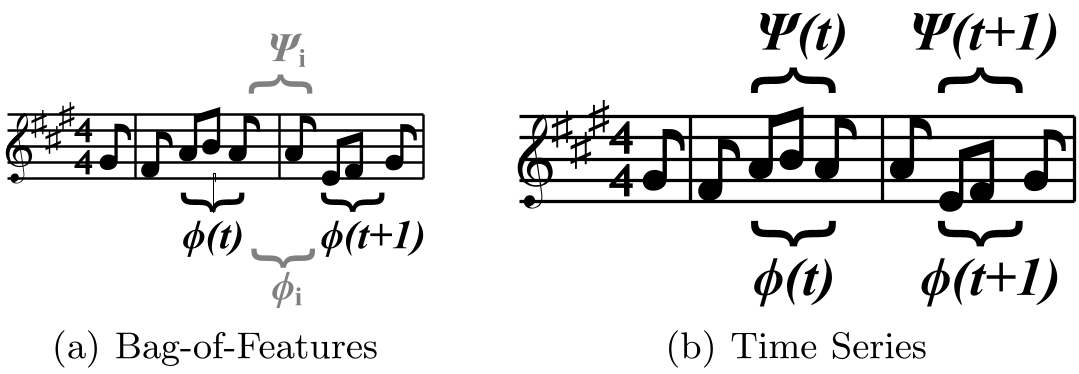 Fig 1: (a) Traditional approach averaging features vs. (b) Time-varying approach tracking features and emotions over time.
The Core Insight: Correlation is Not Causation
The paper argues that simple feature values (e.g., "high tempo") aren't the direct cause of emotion. Instead, it is the rate of change and the violation of expectations.
- Loudness variations build tension.
- Rhythmic entrainment creates stability.
- Melodic surprises trigger dopamine through the resolution of uncertainty.
To capture this, we need a mathematical shift. Instead of , where is a static emotion and is a feature vector, we must use models where: This accounts for the "inertia" of human emotion—we don't instantly switch from depressed to ecstatic; our feelings have a temporal profile.
Methodology: Mapping the Emotional Trajectory
The authors review several advanced frameworks for modeling these dynamics:
- Linear Dynamical Systems (Kalman Filters): Treating emotions as hidden states that we estimate through noisy audio "measurements."
- Autoregressive Models (ARX): Using past values of both features and emotions to predict the next emotional state.
- Recurrent Neural Networks (Elman Networks): Utilizing "context units" as short-term memory to detect spatio-temporal patterns in sound.
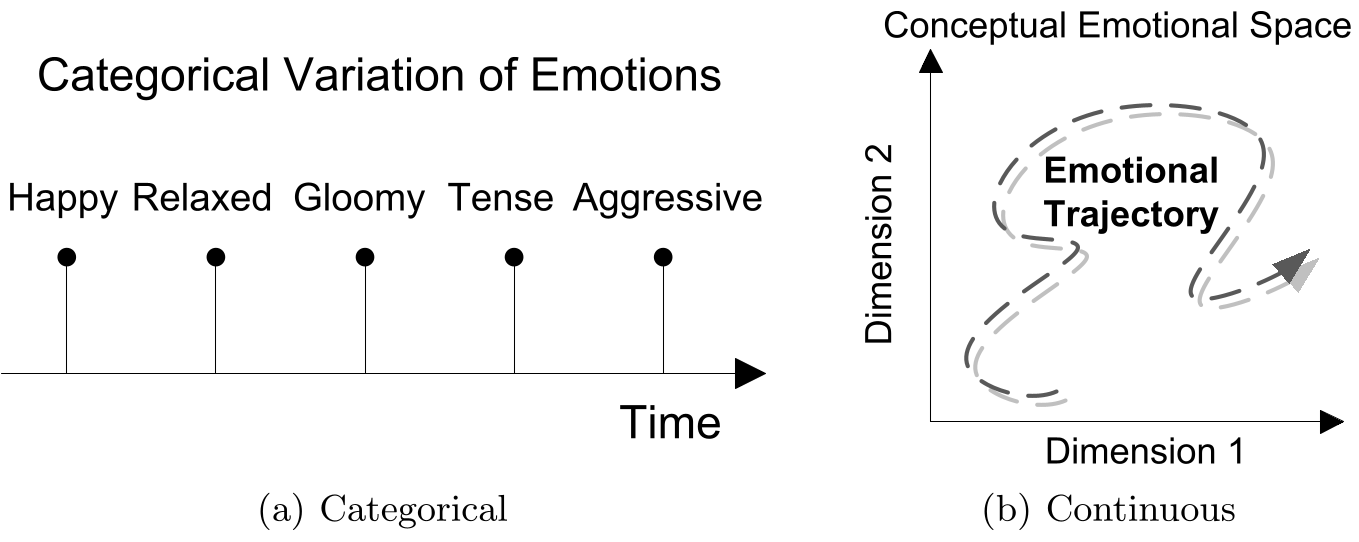 Fig 2: Visualizing how emotion moves through the Valence-Arousal plane (CMA) as a trajectory over time.
Results & Key Findings
The meta-analysis of these methods yields fascinating insights:
- Arousal is easier to predict than Valence: Models like ARX achieve ~78% accuracy for Arousal but struggle with the subjective nuances of Valence (~22%).
- Feature Synergy: Loudness and tempo are workhorses for Arousal, while Spectral Centroid (brightness) often correlates with positive Valence.
- Short-term Memory Matters: Recurrent networks outperform feed-forward ones because they "remember" the previous musical context, allowing them to sense the tension built by a rising melodic line.
Deep Insight: Clock Time vs. Musical Time
Perhaps the most profound contribution of this work is the discussion on Subjective Time. The authors argue that MER shouldn't just look at seconds on a clock.
- Boring music (low information) feels long while happening but is remembered as short.
- Complex, novel music (high information) feels fast-paced but is remembered as a long, significant event.
Future MER systems should measure the Flow of Information (novelty vs. redundancy). When the information flow is high, tension increases. This "flow" is a much stronger predictor of emotion than the raw MFCC values.
Conclusion: The Path Forward
The "glass ceiling" in MER—where performance has stayed stagnant for years—is a direct result of ignoring time. To advance, the field must:
- Adopt Continuous Annotation (sampling emotions every second).
- Integrate Cognitive Models of memory and expectation.
- Shift focus to Interactions between features (e.g., how tempo affects the perception of loudness).
As the authors eloquently state, music creates its own time. If our AI models can't perceive that time, they will never truly understand why a symphony makes us cry.