
Mining the Pulse: Extracting Time-Sensitive Arabic Multiword Expressions from the Social Stream
Time-sensitive Arabic multiword expressions extraction from social networks
This paper presents a statistical framework for extracting and relating Arabic Multiword Expressions (MWE) from social media, specifically Twitter. Using 15 million tweets, the authors introduce a "Confidence Ratio" (CR) metric and a graph-based similarity approach to capture time-sensitive linguistic structures that are often missing from traditional lexical resources.
TL;DR
Researchers have developed a highly effective statistical pipeline to extract Arabic Multiword Expressions (MWE) from Twitter, bypassing the limitations of traditional linguistic parsers. By introducing a Confidence Ratio based on the diversity of posters rather than just raw frequency, the system achieved a 92.6% validity rate for high-frequency terms and successfully identified emerging linguistic trends before they reached formal knowledge bases like Wikipedia.
The Challenge: Why Arabic MWEs in Social Media are "A Pain in the Neck"
In Natural Language Processing, Multiword Expressions (e.g., "vicious clashes" or "creative chaos") are units that carry a specific semantic meaning as a whole. In Arabic, this is complicated by:
- Morphological Richness: Prefixes and suffixes attach directly to words, creating billions of surface variations.
- Dynamic Nature: Social media is the birthplace of new terminology ("Time-sensitive MWEs") that traditional dictionaries don't cover.
- Noise: Spam, retweets, and telegraphic (fragmented) grammar break standard dependency parsers.
The authors argue that we need a system that doesn't just ask "How many times was this said?" but rather "How many different people said this in different contexts?"
Methodology: Beyond Simple Counting
The proposed architecture (shown below) moves from raw data collection to a structured semantic graph.
1. The Confidence Ratio (CR)
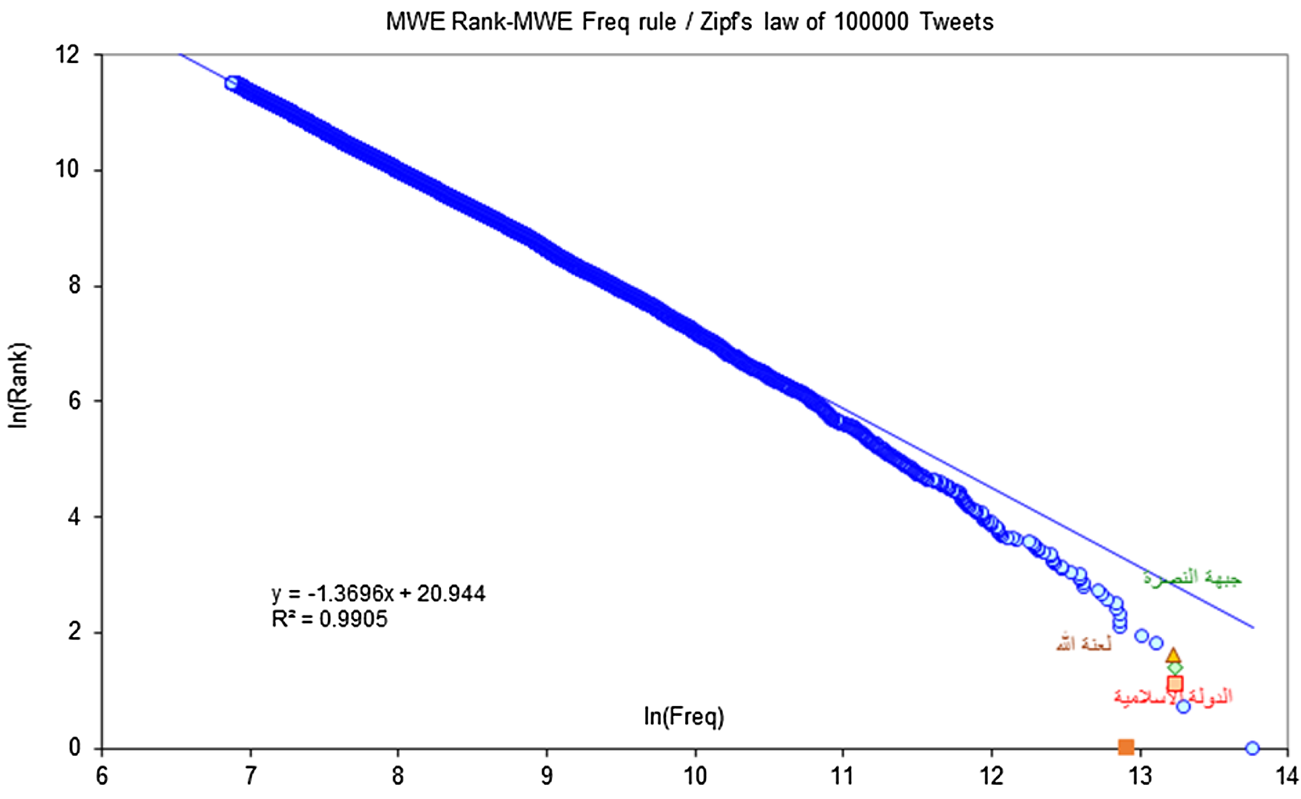
One of the paper's core insights is that raw frequency is a trap. A spam bot can tweet a phrase 10,000 times, but it remains a single "Distinct Tweet" (DT). The authors propose: If a phrase has a high frequency but a low CR, it’s likely noise. If it appears across many distinct users and conversations, it’s a valid MWE.
2. Time-Convergence to Hashtags
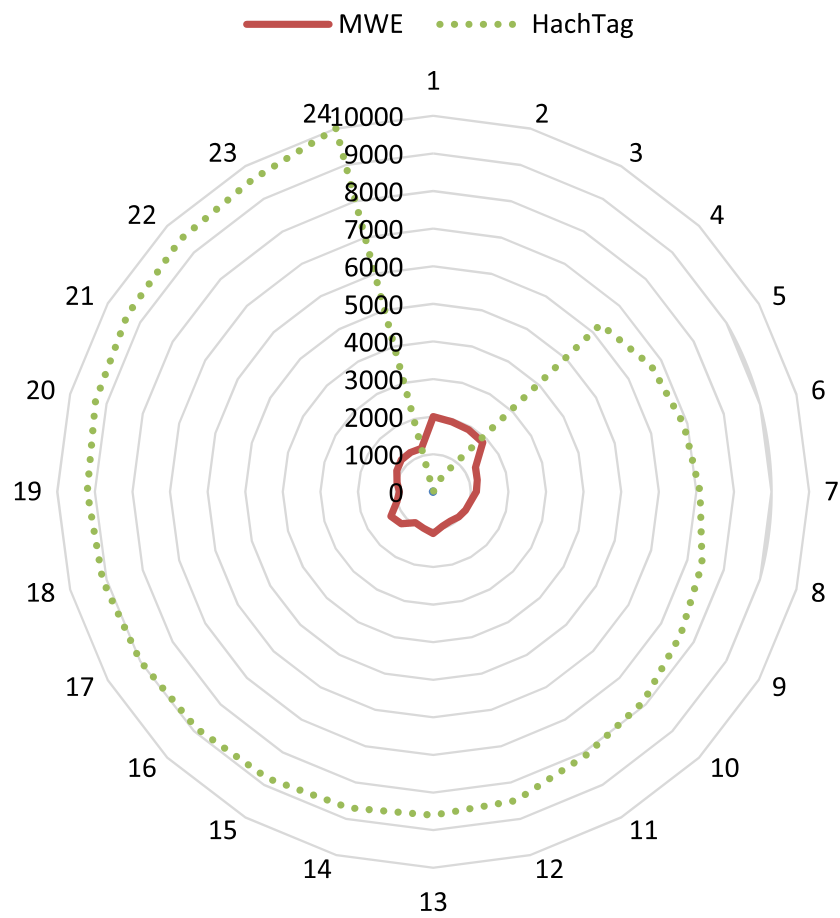
The study observed a fascinating lifecycle of MWEs. As an event trends, a specific MWE (e.g., "burning of a Sunni young man") gains traction as a multiword phrase before eventually converging into a single Hashtag as the topic matures.
Experiments and Results: Beating the Knowledge Bases
The researchers tested their "MWEsG" (Generated Graph) against "MWEsSG" (Semantic Graph from DBPedia/Wikipedia).
- Precision: 86%
- Compatibility: 84% (F-measure)
- The "Wikipedia Gap": Interestingly, 70% of the terms the system found that didn't match DBPedia were actually valid emerging topics. This proves that social media monitoring can act as an "early warning system" for linguistic and social shifts that static encyclopedias have not yet indexed.
Critical Insight: The "Why"
Why does this work better than a parser? Because in the chaotic environment of Twitter, Statistical Habit outweighs Grammatical Syntax. By treating a search result subset as a single document and applying TF-IDF style ranking, the authors successfully isolated contextually relevant terms (like linking "Messi" to "Luis Suarez") without needing a deep understanding of Arabic verb-subject agreement.
Conclusion & Future Outlook
This work provides a massive contribution to Arabic NLP by generating over 360,000 valid lexical units. For developers and researchers, the Confidence Ratio is a simple yet powerful tool for cleaning social media data. Future work could potentially integrate these statistical MWEs into real-time translation and sentiment analysis tools to handle the "Arabic Spring" of new dialects and expressions constantly emerging online.