
Deciphering the Decay: Why Most Social Media Trends Die Young
Modeling time-sensitive information diffusion in online social networks
This paper introduces a continuous-time model for information diffusion in Online Social Networks (OSNs) using a time-varying infection rate . The core contribution is a theoretical "time-rescaling" framework that maps this complex time-varying process to a standard SI (Susceptible-Infected) model, achieving a state-of-the-art balance between analytical tractability and realistic modeling of user behavior.
TL;DR
Why do some hashtags set the world on fire while others vanish in minutes? This paper argues it isn't just about who follows whom, but how fast our collective interest rots. By introducing a time-varying infection rate into the classical SI model, the authors provide a mathematical "time-machine" (time-rescaling) that explains why most information fails to go pandemic despite the massive connectivity of social networks.
The "Boredom" Gap in Social Modeling
Most classical epidemic models treat information like a virus—if you are exposed, there is a fixed probability you catch it. However, social media users are fickle. A news story "fresh" at 9 AM is "stale" by 9 PM. Prior works either ignored this temporal decay or simplified the network so much (using tree structures) that they lost the "social" in social networks.
The authors' core Insight: The spread of information is a race between the network's connectivity and the user's decaying enthusiasm.
Methodology: The Magic of Time-Rescaling
The authors model the diffusion as a time-inhomogeneous Markov Chain. The transition rate is modulated by , a function representing the aging of the information.
The Unified Mapping Theorem
The mathematical breakthrough here is Theorem 1. It proves that if you have a complex time-varying process , you can map it to a "Standard" SI model (where rate = 1) simply by transforming the time axis: This means researchers don't need to reinvent the wheel; they can "import" decades of research on standard SI models and simply rescale the time to fit the real-world decay of a specific story.
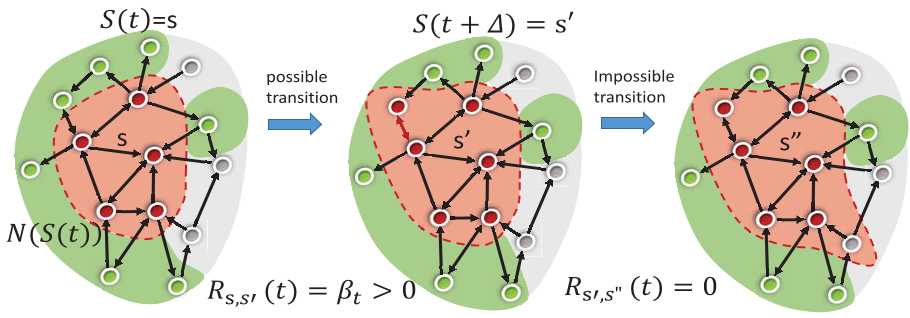 Fig 1: The diffusion process where green nodes represent the immediate frontier of exposure.
Why Information "Stops"
The paper provides a rigorous answer to the "0.1% problem"—why most posts reach so few people.
- Integrable Boredom: If decays fast enough (mathematically, if the integral is finite), the information is "killed" by time.
- The Threshold: If the decay follows a power law , information only goes pandemic if . If , the average time to reach the next node becomes infinite, effectively freezing the cascade.
Evidence from Digg
Using data from the news aggregator Digg, the researchers extracted the real for popular stories.
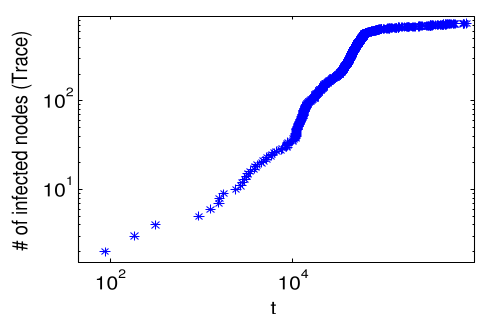 Fig 2: Comparison between Digg traces (a) and the standard model (b), bridged by the derived scaling function m(t) (c).
The data revealed a Piecewise Power-Law:
- Phase 1 (Active): In the first ~10 hours, interest decays slowly ().
- Phase 2 (Dormant): After 10 hours, interest plummets (). Because 1.77 is significantly greater than 1, the math dictates that the story must stop spreading, regardless of how many followers the remaining users have.
Critical Analysis & Future Work
This framework is a powerful bridge between theoretical physics and social science. It elegantly separates where information goes (topology) from when it gets there (temporal decay).
Limitations:
- The model currently assumes the decay rate is the same for all users. In reality, some "super-spreaders" might maintain interest longer.
- It uses an SI model, meaning it doesn't account for users "un-sharing" or deleting posts (SIR model).
Closing Thought: For marketers and platform designers, this research suggests that the first 10 hours are the "Golden Window." After that, the power-law decay becomes so steep that even the most connected influencer cannot revive a dying trend.