
Shape DTW & Cloud Models: Bridging Qualitative Intuition with Quantitative Time Series Mining
Research on time series data mining based on linguistic concept tree technique
This paper proposes a novel similarity measure for time series data mining called Shape Dynamic Time Warping (SDTW), which integrates Cloud Models Theory and Linguistic Concept Trees. By using Cloud Models to represent the slope features of piecewise linear representations, it achieves a robust, multi-granularity alignment that outperforms traditional Euclidean and DTW methods.
TL;DR
Current time series mining often struggles with noise and scale sensitivity. This paper introduces a Shape Dynamic Time Warping (SDTW) approach that replaces raw data points with Linguistic Variables derived from Cloud Models. By mapping slopes to a "Concept Tree," the method achieves robust alignment and multi-granularity analysis, proving more accurate than Euclidean measures in identifying complex control chart trends.
Breaking the Brittleness of Euclidean Distance
In the realm of Time Series Data Mining (TSDM), the "Distance Measure" is the heart of the system. For years, the Euclidean Distance was the default. However, it is notoriously brittle: if two identical shapes are shifted by a single time step, Euclidean distance treats them as completely different.
While Dynamic Time Warping (DTW) was introduced to fix this by "warping" the time axis, it introduced its own pathology—it often tries to explain Y-axis noise by over-warping the X-axis. The authors of this paper argue that humans don't compare series point-by-point; we compare "shapes" like steep rise, steady plateau, or gradual decline.
The Core Innovation: Cloud Models & Concept Trees
The genius of this paper lies in how it quantifies these "fuzzy" human concepts. The authors employ Cloud Models, which represent a linguistic atom (like "High Slope") through three parameters:
- Expected Value (Ex): The mathematical center of the concept.
- Entropy (En): The "fuzziness" or the range of values the concept covers.
- Hyper-Entropy (He): The "randomness" or thickness of the cloud, representing the uncertainty of the membership degree.
Architecture: From Raw Data to Linguistic Labels
The workflow consists of three distinct phases:
- Pre-processing: Using Linear Boundary Reduction (LBR) to simplify the series into straight lines, effectively filtering noise.
- Feature Extraction: Calculating the derivative (slope) at each segment.
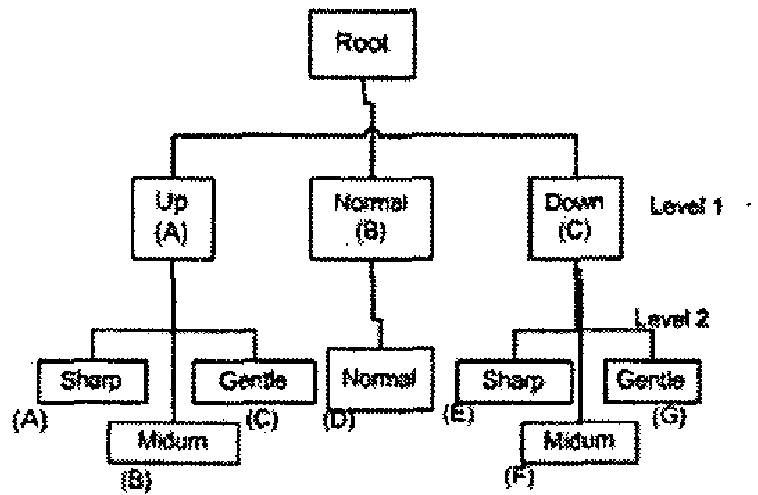
- Linguistic Mapping: Mapping these slopes onto a Shape Concept Tree. This tree allows the system to analyze data at different "granularities"—from a simple "Up/Down" level to a more nuanced 7-atom description.
Experiments: Why Qualitative is Better
The authors tested their method against the UCI Synthetic Control Chart dataset. The results (see the dendrogram comparisons) show a clear victory for SDTW.
- Logic vs. Raw Numbers: Euclidean measures failed to group "Upward Shift" and "Downward Shift" correctly because it was distracted by the absolute values.
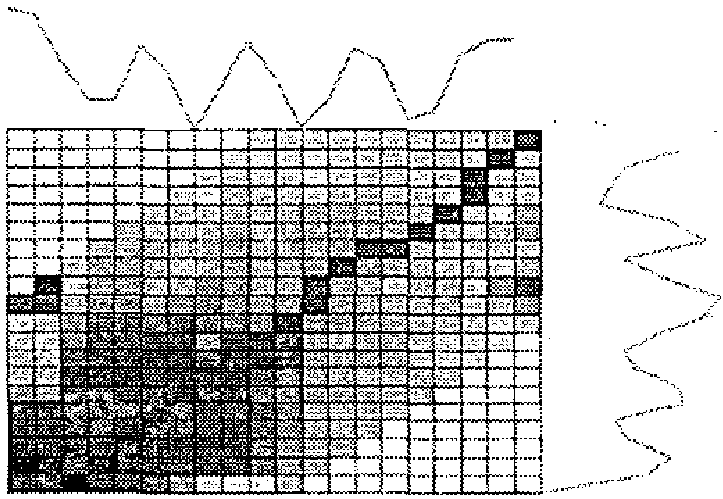
- Efficiency: As shown in the alignment grid, by using linguistic symbols, the SDTW algorithm reduces the Cartesian grid markers, meaning the "path" through the dissimilarity matrix is found much faster.
Critical Analysis
The paper presents a compelling bridge between Fuzzy Set Theory and Data Mining. By integrating "Cloud Models," it acknowledges that uncertainty isn't just a membership value (as in classic Fuzzy Logic) but involves a degree of randomness.
Limitations:
- Preprocessing Dependency: The performance is heavily reliant on the Linear Boundary Reduction (LBR) step. If the LBR threshold is too high, critical small-scale features might be lost.
- Univariate Focus: The current model focuses on single-variable series. In modern contexts like IoT or HVAC monitoring, extending this to Multidimensional Cloud Models is essential.
Conclusion
"Research on Time Series Data Mining Based on Linguistic Concept Tree Technique" reminds us that sometimes, looking at the "big picture" (qualitative shape) is more effective than squinting at the pixels (raw data). It strikes a sophisticated balance between the randomness of probability and the vagueness of human language, offering a robust roadmap for future TSDM research.