
SNIR: Beyond Global Trust — Why Your Friend's Taste in Art Isn't Their Taste in Sports
Producing timely recommendations from social networks through targeted search
The paper introduces SNIR (Social Network-based Item Recommendation), a targeted referral system for social networks like Flickr. It utilizes agent-based learning to provide timely recommendations by analyzing user comments and specialized "item-level" trust across different interest categories.
TL;DR
Social networks are drowning in information. This paper proposes SNIR (Social Network-based Item Recommendation), a system that learns to recommend items from your friends based on your historical interaction with them across different categories. By using tags for probabilistic categorization and comments as implicit "likes," the system provides timely, high-precision updates that far exceed standard content-based filters.
The "One-Size-Fits-All" Trust Problem
In 2009, social networks like Flickr and Facebook were exploding. The "Information Overload" problem was becoming critical. The authors identified a key human intuition that algorithms missed: Trust is local and topical.
In daily life, if you have a friend who is a professional photographer, you trust their "Nature" shots but might ignore their "Politics" posts. Most 2009-era systems assigned a single "similarity" value to a contact. SNIR challenges this, arguing that my preference for a friend's content is a function of both the person and the category.
Methodology: Tags, Categories, and Bayes
The SNIR framework operates on a three-tier logic:
- Implicit Preference Learning: Instead of asking for 1-5 star ratings (which users rarely give), the system monitors comments. If you comment, you are interested.
- Probabilistic Categorization: Digital media is messy. A photo of a "Mountain" might be
Travel,Nature, orArt. SNIR uses a dictionary of tags to calculate the probability , giving more weight to tags appearing earlier in the tag list. - The Bayesian Heart: The system predicts the likelihood of a user liking an item posted by a specific friend by calculating the posterior probability based on past interactions with that friend in that specific category.
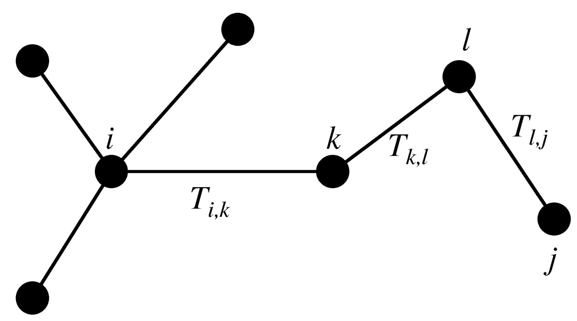 Figure 1: A conceptual trust network where agents assign multi-faceted trust values.
Experiments: Real-World Flickr Data
The authors analyzed 4,025 users and over 120,000 photos. They verified two key hypotheses:
- Hypothesis 4.1: Higher activity More interest. A friend posting 100 photos might get fewer comments than a friend posting 5 high-quality ones.
- Hypothesis 4.2: Interest is topic-specific. A user’s preference for friend A over friend B flips when the topic changes from "Nature" to "People."
Performance Metrics
When compared against random sampling (current industry trend at the time) and pure Content-Based systems, SNIR dominated:
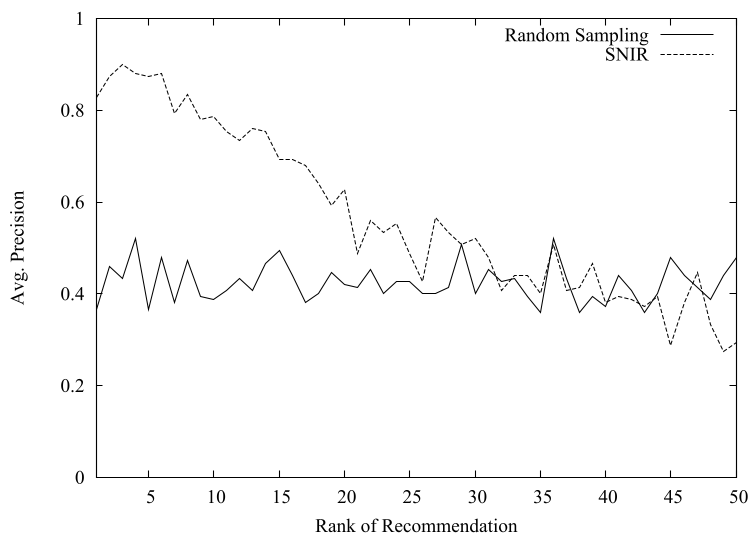 Figure 2: Precision values for recommended items. SNIR (top line) maintains high precision for top-ranked items.
As seen in the results, SNIR nearly doubled the precision of the baseline. While a Content-Based system (recommending items similar to what you liked before) helped, it lacked the "Social Signal"—the inherent trust we have in specific people.
Critical Insight & Future Outlook
The genius of SNIR lies in its simplicity and timeliness. Traditional Collaborative Filtering forces you to wait for a crowd to rate an item (latency). SNIR allows for instant recommendation the moment your trusted friend uploads a photo, provided you have a historical "topic-friend" trust score.
Limitations
The study assumes that comments are generally positive. In the modern "troll" era, sentiment analysis would be required to distinguish a "like" comment from a "dislike" comment. Furthermore, the system is limited to immediate friends; extending this to "friends-of-friends" (Transitive Trust) is the next logical step.
Conclusion
SNIR proves that in social recommendation, who mentioned it is just as important as what they mentioned. By breaking down trust into categories, we can build agents that truly understand our unique relationship with our digital social circle.