
Pop-Forecast: Mastering the Art of Timely Video Virality Prediction
Timely video popularity forecasting based on social networks
This paper introduces Pop-Forecast, an online learning framework for predicting video popularity in social networks. By leveraging a systematic multi-stage sequential decision process and contextual bandit learning, it optimizes for both prediction accuracy and timeliness without requiring any prior training datasets.
TL;DR
In the fast-paced world of social media, knowing if a video will go viral after it’s already trending is a lost opportunity. Pop-Forecast is a revolutionary online algorithm that predicts video popularity by analyzing how users interact within a social network. Unlike old-school tools that just look at view counts, Pop-Forecast balances accuracy with timeliness, learning on-the-fly to issue forecasts exactly when they are most valuable—all while outperforming existing benchmarks by over 30%.
The "Passive Viewer" Fallacy
For years, popularity prediction was treated as a simple time-series problem: if a video got 100 views in an hour, it might get 10,000 in a day. This worked for YouTube-style platforms where users were passive consumers.
However, in modern social networks like Facebook, X (Twitter), or RenRen, users are proactive spreaders. A video’s success depends less on its content and more on who shares it and how fast their friends re-share it. Existing models (like SH or PAG) fail here because:
- They require massive offline training sets that become outdated overnight.
- They don't account for the "Wait vs. Act" dilemma (the cost of waiting for more data vs. the risk of an early, wrong guess).
Methodology: Adaptive Contextual Learning
Pop-Forecast treats every video as a multi-stage decision task. At each "age" (time interval), the system looks at the Context Information () and decides: Should I predict the final popularity now, or wait for more data?
The Secret Sauce: Social Context
The authors identify two critical metrics that act as "biological markers" for virality:
- Branching Factor (BrF): How many followers directly view the initiator's post. High BrF usually indicates a "celebrity" or "influencer" spark.
- Share Rate (ShR): The probability that a viewer becomes a spreader. This measures the "infectiousness" of the content.
Adaptive Partitioning
To handle the infinite variety of video behaviors, the algorithm uses Adaptive Partitioning. It starts with a broad view of the world and "zooms in" (subdivides the mathematical space) as it sees more video arrivals. This allows it to learn specific rules for different "niches" of videos without needing a pre-labeled training set.
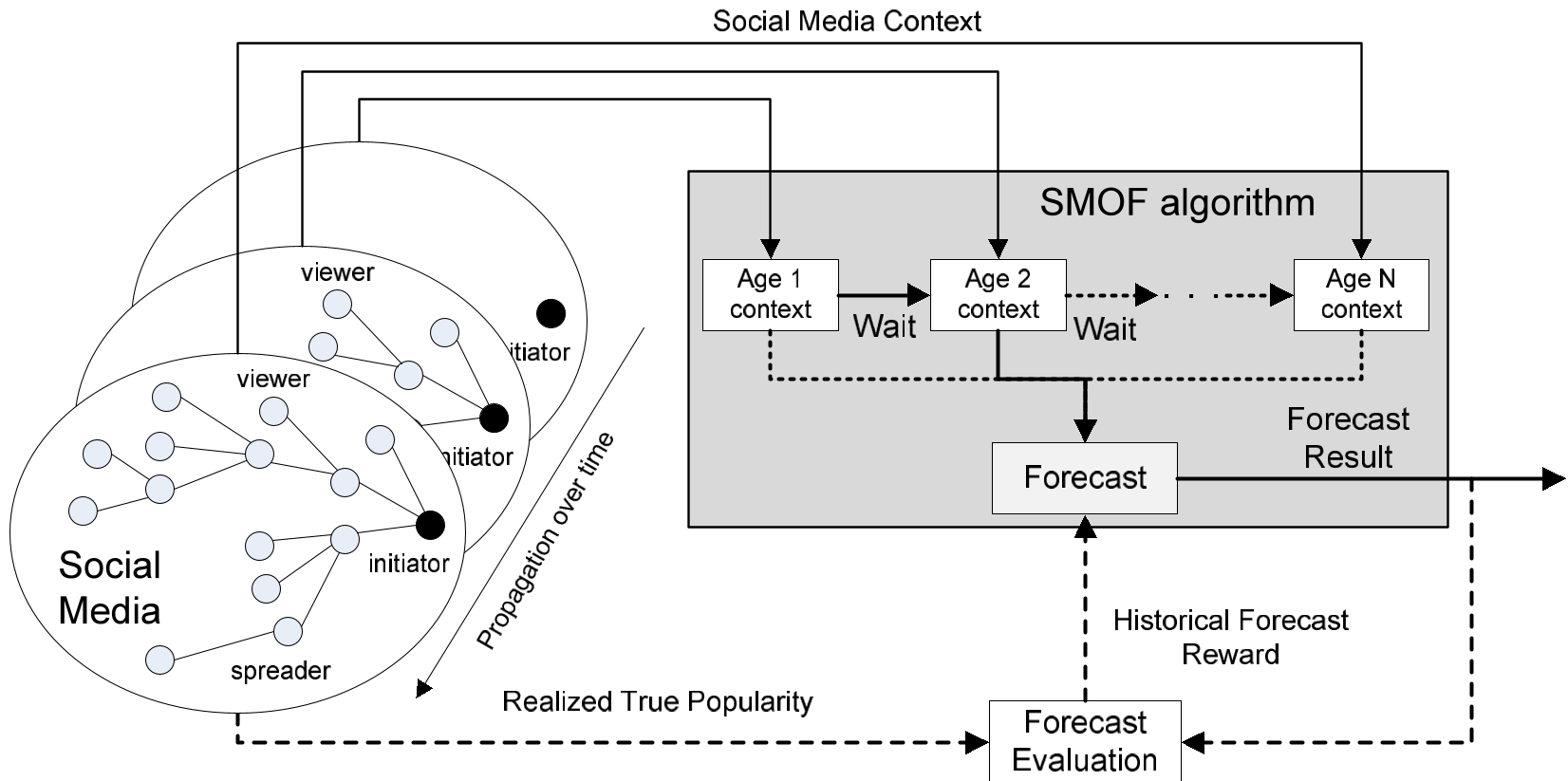 Fig 1: The flow from social propagation to decision-making.
Proving Efficiency: The Regret Bound
One of the most impressive parts of this work is the mathematical proof. The authors prove that the "Regret"—the difference between Pop-Forecast and an "Omniscient Oracle" who knows the future—is sublinear. In plain English: the more videos the system sees, the closer it gets to perfection.
Experimental Results: RenRen Data Analysis
Using data from RenRen (China’s answer to Facebook), the team tested Pop-Forecast against 5,000 video links.
Why Social Context Matters
The research highlighted that even if two videos have the same initial views, the one with a higher Share Rate is far more likely to explode later. Traditional models ignore this, but Pop-Forecast catches it.
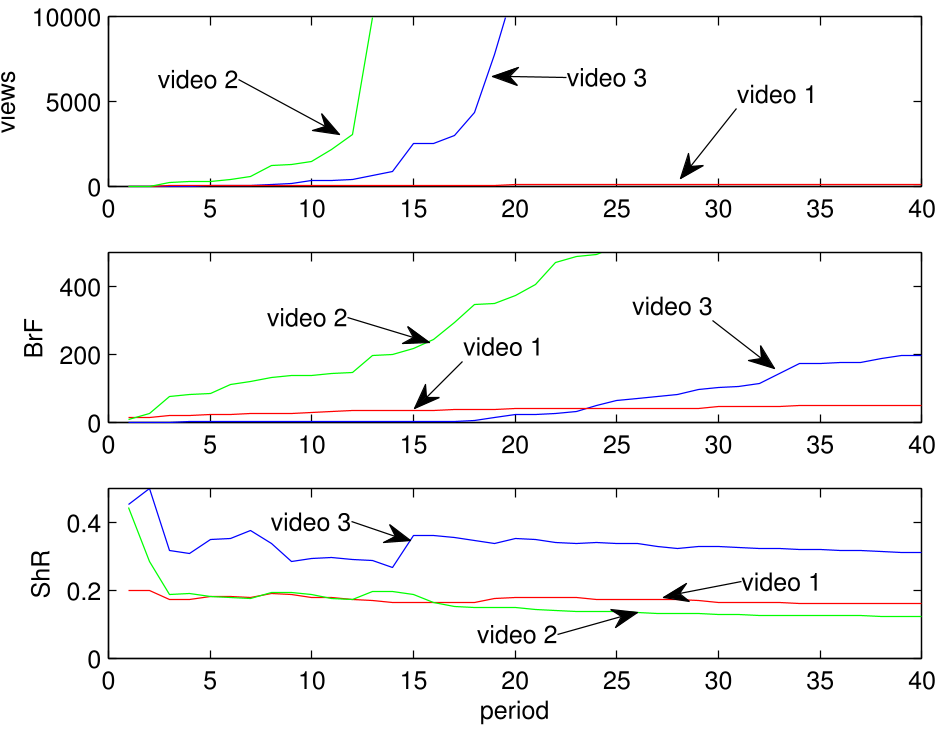 Fig 2: Evolution of views, Branching Factor (BrF), and Share Rate (ShR) for popular vs. unpopular videos.
The Performance Edge
Pop-Forecast achieved a 0.92-0.94 reward score, whereas the best benchmark (PAG15) only hit 0.85 despite waiting much longer to make its prediction.
| Method | Prediction Accuracy (at λ=0.01) | Prediction Reward |
|---|---|---|
| SH10 | 83% | 0.80 |
| PAG10 | 81% | 0.79 |
| Pop-Forecast | 94% | 0.92 |
Critical Insight: The Value of Timeliness
The brilliance of this model is the parameter . It allows platform owners to tune the system:
- High : Predict very early (great for catching "trending" topics for high-speed ad bidding).
- Low : Wait for more certainty (useful for long-term server resource planning).
Conclusion
Pop-Forecast shifts the paradigm from "What did the views look like?" to "How is the network reacting?" By combining social topology with online bandit learning, it provides a roadmap for the next generation of real-time digital marketing and cloud resource management. While the current model focus on BrF and ShR, the framework is flexible enough to plug in deep-learning embeddings or sentiment analysis in the future.