
TPS: Balancing Social Media Push Notifications and Wireless Efficiency
Timer-Based Push Scheme for Online Social Networking Services in Wireless Networks
This paper introduces the Timer-Based Push Scheme (TPS) for Online Social Networking Services (SNS), designed to optimize data delivery in wireless networks. By using a pre-defined timer to bundle multiple articles, TPS significantly reduces connection setup costs compared to individual push operations while maintaining lower access delays than the existing Push-N Scheme (PNS).
TL;DR
The Timer-Based Push Scheme (TPS) is a novel protocol for Online Social Networking Services (SNS) that optimizes how articles are delivered to mobile users. By batching articles based on a specific time interval rather than a fixed count , it provides a robust, mathematically optimal way to reduce connection overhead and battery drain in wireless networks.
Background & Positioning
In the era of Facebook and Twitter (now X), the volume of social media updates can overwhelm wireless signaling channels. This paper sits at the intersection of Mobile Computing and Queueing Theory, providing a bridge between theoretical optimization and practical SNS implementation. It improves upon the previously known Push-N Scheme (PNS) by introducing temporal stability.
The Core Conflict: Push vs. Pull
Existing delivery methods face a dilemma:
- Pull (Client-led): Saves server signaling but increases access delay and user device energy consumption because the device must wake up and check for updates.
- Push (Server-led): Zero delay for the user, but if every "Like" or "Post" triggers a separate push, the connection setup cost explodes, draining the network's signaling resources.
The authors argue that current solutions like PNS (waiting for articles before pushing) are too brittle. If users post irregularly, the wait for articles might be too long, or the optimal might change constantly, making it a nightmare to implement in a real-world SAS (SNS Application Server).
Methodology: The Power of the Timer
The Timer-Based Push Scheme (TPS) introduces a simple yet elegant mechanism: a timer .
- A user posts an article; the server starts a timer .
- Any subsequent articles during are buffered.
- When expires, all articles are pushed in a single connection.
- If the user manually "Pulls" before the timer ends, the buffer is cleared.
Theoretical Framework
The authors define a weighted total cost function: where represents the importance of signaling efficiency vs. user delay. Using the Newton-Raphson method, they prove that an optimal exists and can be calculated based on user access rates () and post rates ().
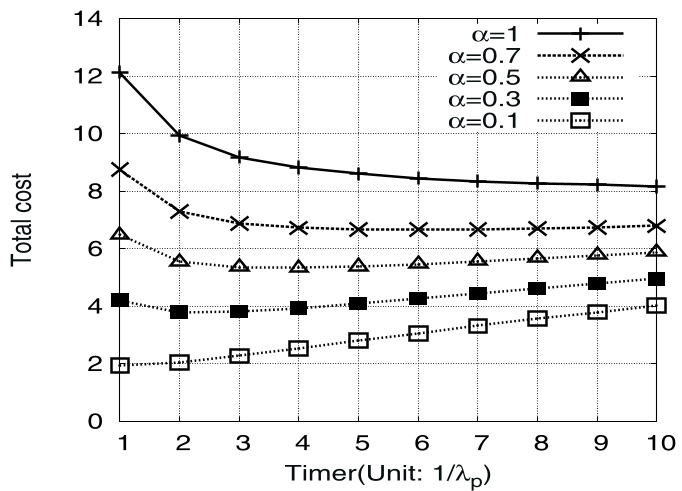 Figure: The effect of and weight on total cost. As increases (pushing becomes more expensive), the optimal moves to the right.
Why is TPS Better than PNS? (The Variance Insight)
The most striking finding is the Robustness to Irregularity. In PNS, the optimal threshold changes drastically if the article posting pattern has high variance (). If jumps from 1 to 100, the optimal might jump from 4 to 7.
In contrast, TPS is indifferent to variance. The mathematical derivation shows the optimal is independent of . This means a network engineer can set a timer and it will remain optimal even if a user goes from posting once an hour to "burst-posting" ten times in a minute.
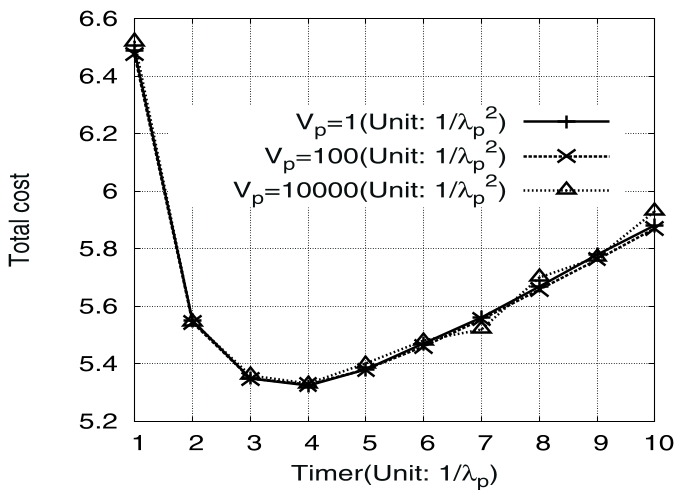 Figure: TPS Cost vs Variance. Regardless of how irregular the posting becomes, the cost curve remains stable.
Experimental Validation
Using an event-driven simulator in C++, the authors compared TPS and PNS:
- Cost Comparison: PNS is slightly more efficient (by ~1-4%) if and only if you can perfectly guess the optimal .
- Implementation: TPS is significantly easier to implement because its optimal parameters are easier to find numerically and don't require constant re-adjustment for different traffic types.
| Case | |||
|---|---|---|---|
| of TPS | 3.78 | 5.31 | 6.63 |
| of PNS | 3.63 | 5.17 | 6.58 |
| Difference (%) | 3.96% | 2.63% | 0.75% |
| The small efficiency gap is a worthy trade-off for the massive gain in system stability. |
Depth Analysis & Conclusion
The Timer-Based Push Scheme represents a pragmatic shift in network protocol design. By prioritizing Robustness over Theoretical Peak Efficiency, the authors provide a solution that is ready for the "messy" reality of human behavior on social media.
Takeaway for Engineers:
If your system handles bursty, unpredictable user traffic, Timer-based batching is almost always superior to Count-based batching. It simplifies your control logic and protects your signaling plane from high-variance traffic spikes without significant cost penalties.
Limitations:
The model assumes an exponential distribution for user access times (). In reality, social media access often follows "heavy-tailed" distributions (users checking very frequently or not at all for days), which might require further tuning of the weighted cost model.