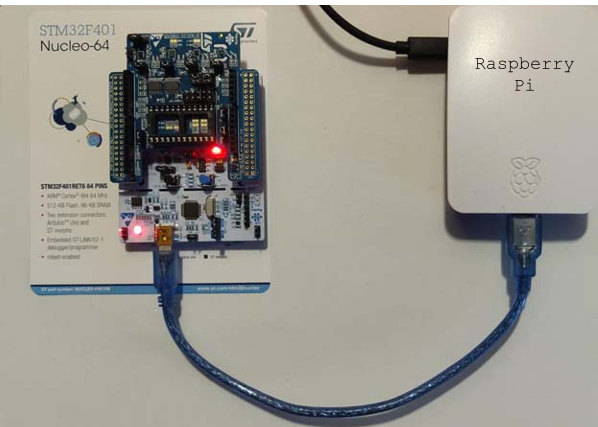
Tiny Neural Networks: Democratizing Weather Prediction at the Edge
Tiny Neural Networks for Environmental Predictions: An Integrated Approach with Miosix
This paper introduces a specialized framework for local weather forecasting using Deep Tiny Neural Networks (DTNN) deployed on resource-constrained microcontrollers. The authors utilize an LSTM-based architecture integrated with the Miosix RTOS and X-CUBE-AI toolchain to achieve real-time atmospheric pressure prediction directly at the edge.
TL;DR
Researchers have developed a way to migrate complex weather forecasting from energy-hungry supercomputers to tiny STM32 microcontrollers. By utilizing Deep Tiny Neural Networks (DTNN) and a Real-Time Operating System (Miosix), they achieved accurate atmospheric pressure forecasting using only 480 Bytes of RAM, effectively moving intelligence from the cloud to the sensor.
Background: The Bottleneck of Centralized Forecasting
Weather prediction is traditionally a high-stakes game played by supercomputers. Numerical Weather Prediction (NWP) models solve partial differential equations that are computationally expensive and power-hungry. As we push for higher spatial resolution (local forecasting), these centralized models hit a scalability bottleneck.
The authors argue for a shift toward Edge Computing, where decentralized units process data locally. This not only saves bandwidth by avoiding raw data transmission but also allows for site-specific predictions that global models might miss.
Methodology: Engineering the "Tiny" in DTNN
The core challenge is fitting a "Deep" model into a "Tiny" space. The authors followed a rigorous workflow:
- Architecture Selection: They compared four families—LSTM, GRU, CNN-LSTM, and CNN-GRU.
- Hardware-Aware Optimization: Using STMicroelectronics' X-CUBE-AI, they converted high-level Keras models into optimized C-code.
- RTOS Integration: They used Miosix, a lightweight RTOS, to manage concurrent tasks: querying the I2C sensors and running the neural network inference in separate threads.
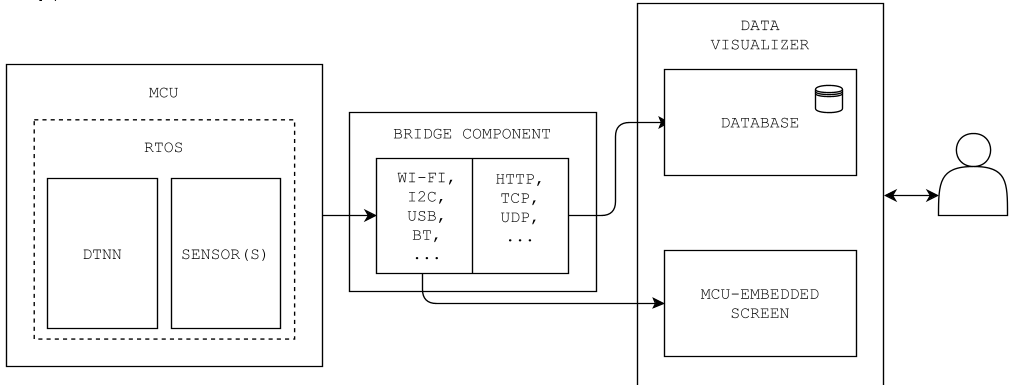
The design utilizes a synchronized queue where a "Producer" thread collects sensor data and calculates sea-level pressure, while a "Consumer" thread triggers the LSTM inference every 8 hours.
Design Space Exploration
One of the paper's highlights is the Ablation-style analysis of model complexity. They systematically reduced the number of units in LSTM and GRU cells to find the "sweet spot" where accuracy remains high but memory footprint plummets.
| Model (LSTM) | FLASH (KB) | RAM (B) | NRMSE |
|---|---|---|---|
| 70 Units | 234.89 | 1116 | 0.0255 |
| 30 Units | 44.42 | 480 | 0.0255 |
| 10 Units | 5.43 | 160 | 0.0262 |
Surprisingly, reducing units from 70 to 30 had virtually no impact on the Normalized Root Mean Square Error (NRMSE), yet it cut FLASH usage by nearly 80%.
Experimental Results & Real-World Validation
The system was deployed for 30 days in March 2020. Despite being trained on data from a different location (50km away), the system maintained a high degree of fidelity.
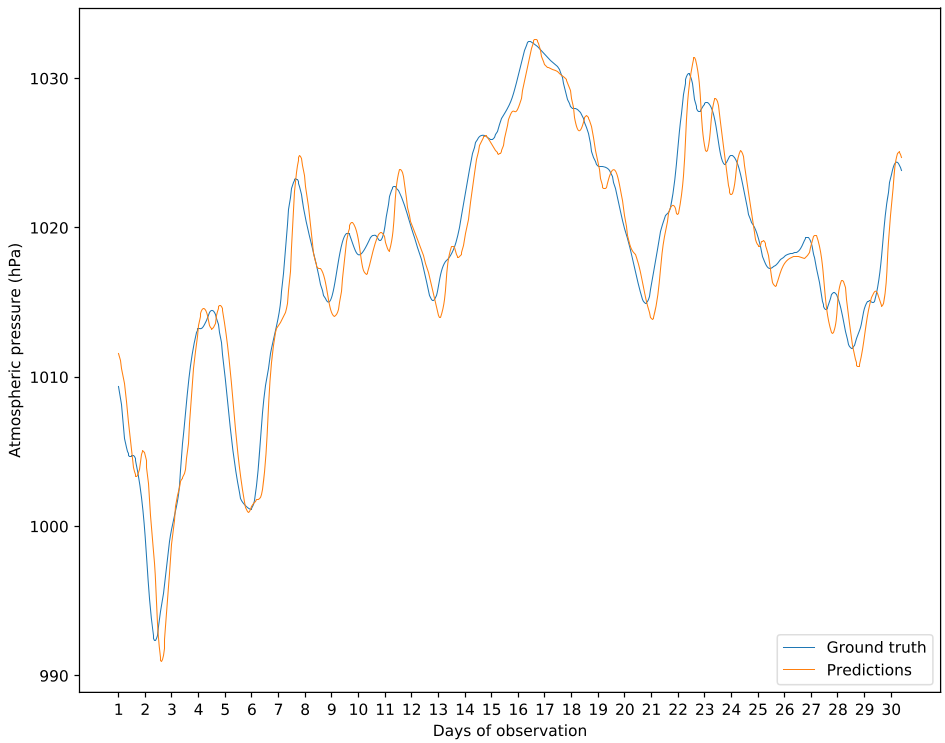
The blue line (Real) and green line (Predicted) in the chart above show a remarkable correlation, with an actual RMSE of 2.10 hPa. The slight error increase compared to the training set reflects the local nature of atmospheric pressure, proving the need for distributed units that can learn local nuances.
Critical Insight: Why This Matters
The significance of this work isn't just "forecasting on a chip"—it's the Scalability through RTOS. By integrating Miosix, the authors demonstrate that TinyML isn't just about a single model running in a loop; it's about a multi-tasking system that can handle sensor interrupts, data pre-processing, and inference simultaneously without wasting clock cycles.
Conclusion
This integrated approach—combining DTNNs, automated toolchains (X-CUBE-AI), and professional RTOS (Miosix)—sets a new standard for industrial Edge AI. Future work involving multi-sensor fusion (humidity, temperature, wind) and "swarms" of these units could revolutionize precision agriculture and disaster prevention.