
To Be or Not to Be Friends: How Social Ties Command the Future of Venture Capital
To be or Not to be Friends: Exploiting Social Ties for Venture Investments
The paper introduces CoRec (Connected Recommendation), a novel investment prediction model that utilizes a Social-Adjusted Probabilistic Matrix Factorization (PMF) framework. It bridges financial data from Crunchbase with social network data from About.me to predict venture capital deals based on directed interpersonal connections between VC members and startup founders.
TL;DR
Is venture capital just about financial statements and market size? This paper argues it’s actually about who knows whom. By introducing CoRec, a Social-Adjusted Probabilistic Matrix Factorization model, the researchers prove that social connections between VC members and startup founders aren't just "noise"—they are the strongest predictors of whether a deal gets signed. Utilizing data from Crunchbase and About.me, they demonstrate that the "social interest" generated by a Twitter follow or a Facebook friendship can boost investment probability by nearly 900%.
Problem & Motivation: The Information Gap in VC
In the high-stakes world of Venture Capital (VC), the "team" is often more important than the "product." However, analyzing team quality is notoriously difficult. Prior research was often limited to small-scale surveys or vague "organizational ties."
The authors identified a gap: nobody was looking at the individual-level, directed social ties between the person giving the money and the person receiving it. If a Senior Partner at a VC firm follows a Startup Founder on Twitter, that "directed link" signifies a level of proactive interest and trust that standard financial models completely ignore.
Methodology: The CoRec Framework
The core of the paper is the Social-Adjusted PMF. Unlike standard Recommendation Systems that treat users and items as independent entities, CoRec treats the interaction as a function of personal relationships.
1. The Social-Adjusted Prior
Instead of a standard Gaussian distribution for latent factors, the model adjusts the "interest" level using a social factor : This means if there's a strong social tie (), the predicted likelihood of investment shifts significantly.
2. Deep Feature Extraction
The model doesn't just treat a "friendship" as a binary 0 or 1. It decomposes the relationship into:
- Job Titles (): Does a connection between two CEOs matter more than a connection between two junior associates?
- Connection Labels (): Is a "LinkedIn connection" as valuable as a "Twitter follower" relationship?
- Directional Strength: Does the VC follow the startup (proactive) or vice versa (passive)?
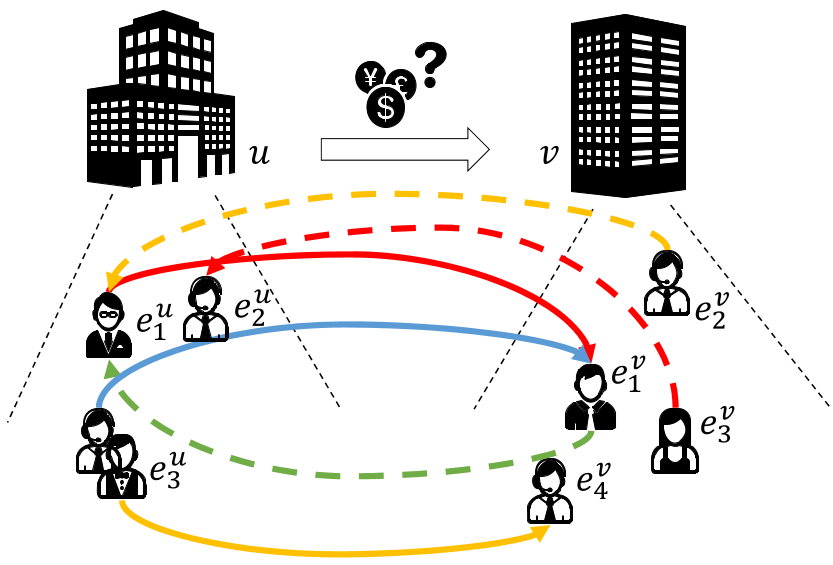 Figure 1: The architecture showing how individual member ties (bottom) influence the VC-to-Startup investment decision (top).
Experiments & Results: The Power of Social Proof
The researchers combined Crunchbase (deal data) with About.me (social data). The statistics were startling:
- Baseline investment rate: ~0.3%
- Rate for members with extended ties: ~1.0%
- Rate for members with direct ties: 2.7%
Comparative Performance
In head-to-head tests against standard Collaborative Filtering (CF) and standard PMF, CoRec consistently achieved lower RMSE and MAE while maintaining a higher Mean Average Precision (MAP).
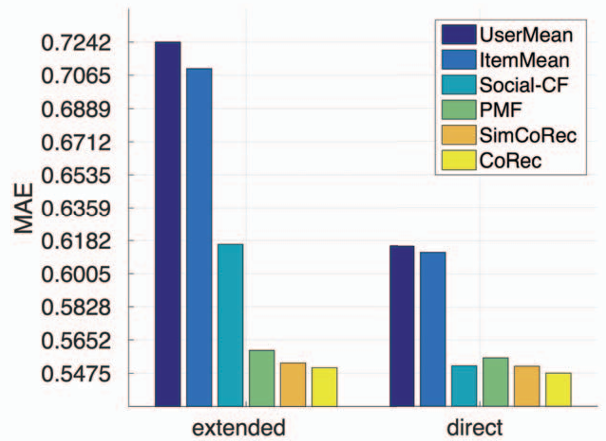 Figure 2: Performance metrics showing CoRec (red line) consistently outperforming baselines like UserMean and vanilla PMF.
Key Insights from Role Analysis
The model's learned parameters revealed that:
- Founder/CEO and Managing Director ties are the most "predictive" of a deal.
- Twitter emerged as a dominant platform for professional signal-catching in the VC ecosystem compared to other social hubs.
Critical Analysis & Conclusion
Takeaway
The paper successfully quantifies the "Trust Factor." By moving from "VC-invests-in-Startup" to "Person A-knows-Person B," the model captures the reality of the business world: investment is a social contract.
Limitations & Future Work
While the model is robust, it relies on the availability of linked social profiles (About.me), which only covered a fraction of the Crunchbase database (1.3K individuals). Future research could explore:
- Temporal Dynamics: How does the duration of a friendship affect the deal size?
- Alumni Networks: Does graduating from the same university provide a similar "Social-Adjustment" as a Twitter follow?
In conclusion, CoRec provides a blueprint for the next generation of financial "matchmaking" tools, proving that in the world of high-growth ventures, your social graph is indeed your net worth.