
TIP: Decoding the "Confident but Wrong" Blind Spot in LLM Distillation
TIP: Token Importance in On-Policy Distillation
The paper introduces TIP (Token Importance in on-Policy distillation), a novel selection mechanism for On-Policy Distillation (OPD). By identifying informative tokens through a two-axis taxonomy of student entropy and teacher-student divergence, the authors achieve state-of-the-art results on mathematical reasoning and agentic planning while reducing training memory by up to 58%.
TL;DR
Not all tokens are created equal. While standard On-Policy Distillation (OPD) trains on everything a student model generates, the TIP (Token Importance in On-Policy distillation) framework proves that 90% of the learning signal lives in just 10% of the tokens. By targeting "overconfident" errors—where the student is certain but wrong—TIP achieves higher accuracy than full-training while cutting memory usage in half.
Background Positioning
This work moves beyond simple entropy-based selection (which only looks at student uncertainty) to a multidimensional view of "informativeness." It represents a significant step in efficient LLM training, shifting the focus from data volume to gradient quality.
The "Overconfidence" Problem: Why Entropy Isn't Enough
Most efficient training methods use Student Entropy as a proxy for difficulty: if the model is "confused" (high entropy), it needs to learn.
However, the authors of TIP identified a critical structural blind spot. LLMs often experience overconfident errors:
- The student is highly certain (Low Entropy).
- The student is wrong (High Divergence from Teacher).
An entropy-only filter deletes these tokens, effectively ignoring the most critical "teachable moments" where the teacher needs to break the student's systematic biases.
Methodology: The TIP Taxonomy
The authors categorize every token into four quadrants based on Student Entropy () and Teacher-Student Divergence ():
| Quadrant | Student Entropy | Teacher Disagreement | Role |
|---|---|---|---|
| Q1 | High | High | Correcting fragile knowledge |
| Q2 | High | Low | Stabilizing underconfident guesses |
| Q3 (The Blind Spot) | Low | High | Breaking overconfident bias |
| Q4 | Low | Low | Redundant "solved" tokens |
The Soft-OR Mechanism
To capture these, the authors use a parameter-free Soft-OR score: This score ensures that if either the student is uncertain or the teacher disagrees, the token is retained for training.
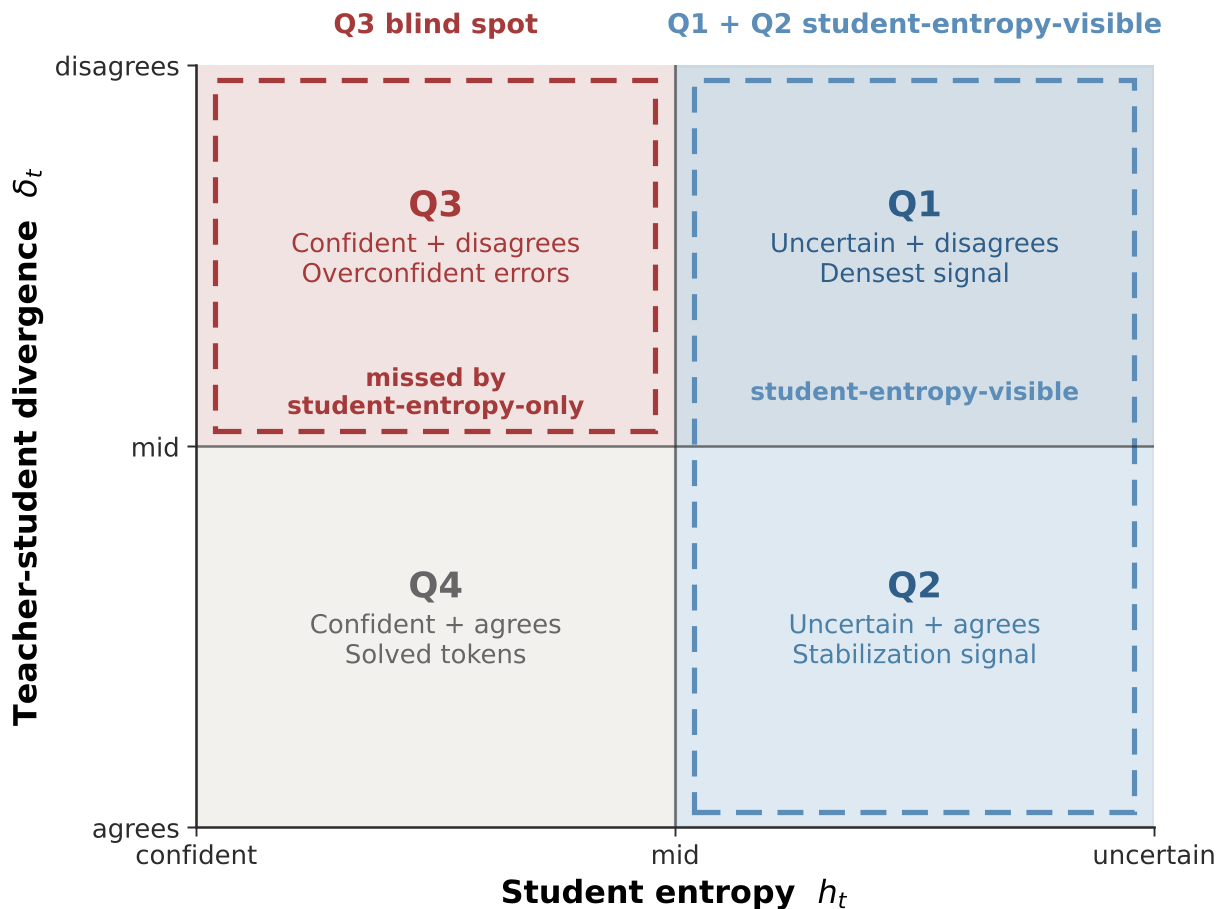 Figure 1: The TIP Taxonomy. Q3 represents the critical region that standard uncertainty-based methods miss.
Experimental Proof: Less is More
The results across Qwen3, Llama, and Qwen2.5 model families are startling.
1. Mathematical Reasoning (MATH-500)
By training on only 50% of tokens selected by the Soft-OR score, the student model actually outperformed the 100% all-token baseline. This suggests that the remaining 50% of tokens (Q4) were essentially "noise" that diluted the gradient signal.
2. Agentic Planning (DeepPlanning)
In complex planning tasks—where one confident mistake (like booking a closed venue) ruins the whole plan—the effect was even more pronounced. Training on just 20% of Q3 overconfident tokens surpassed the full-token baseline (12.6 vs 11.7 accuracy).
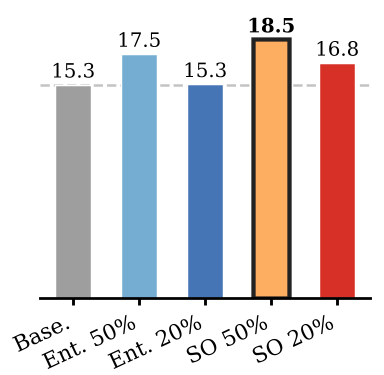 Figure 2: Performance comparison. Soft-OR consistently recovers the performance lost by entropy-only methods at low retention ratios.
Qualitative Insight: What does an Overconfident Error look like?
The paper provides a vivid example:
- Student (99.8% certainty): Repeated a generic variable
kfrom the prompt. - Teacher: Pointed out that at this step, the student should have substituted the concrete value
2. - Result: This is a Q3 token. The student was "sure" it was doing the right thing, but it was hallucinating a pattern. TIP ensures this specific error is corrected.
Critical Analysis & Takeaways
Summary
TIP proves that the "Confident and Wrong" quadrant (Q3) carries the densest corrective signal in LLM distillation.
Limitations
- Detection Cost: Q3 detection requires the teacher's full probability distribution (though this is calculated anyway in OPD loss).
- Sensitivity: The current min-max normalization might be sensitive to outliers in smaller batches.
Future Outlook
This "type-aware" selection isn't just for distillation. It has massive implications for RLHF and Process Reward Fine-Tuning, where identifying which step in a reasoning chain actually "broke" the logic is the holy grail of model improvement. The future of LLM training is not more data, but better-selected data.