
Engineering Patience: The Mathematical Observation of Tolerance in Social Networks
The observation of tolerance in a social network model
This paper introduces a formal mathematical model for "tolerance" within multi-agent dynamic social networks using the Highest Weighted Reward (HWR) rule. It defines tolerance as an agent's willingness to maintain unstable, suboptimal connections over time, successfully predicting the duration of these relationships before disconnection occurs.
TL;DR
Why do we stay in unproductive relationships? In the world of multi-agent systems, this is called Tolerance. This paper moves beyond static graph theory to provide a rigorous mathematical model for tolerance in dynamic social networks. By utilizing the Highest Weighted Reward (HWR) rule, the authors can predict exactly how long an agent will "put up with" a bad neighbor before cutting ties.
Background: Beyond Static Graphs
Most classical network models like Small-World or Scale-Free graphs are "static"—once the edges are drawn, they stay there. However, real-world social networks (like high school friendships or scientific citations) are inherently dynamic. Agents constantly evaluate their peers: Is this connection still beneficial?
Previous work introduced the HWR rule to allow agents to update their neighborhood. Interestingly, researchers noticed that agents didn't always disconnect immediately when a neighbor's performance dropped. This "lag" is what we call Tolerance.
The Pain Point: The Missing Definition of "Liking"
While sociologists and primatologists have talked about tolerance for decades, computer science lacked a predictive model. If an agent receives a bad reward today, will it leave tomorrow? Or in ten days? Without a mathematical definition, we cannot engineer systems that simulate realistic human behavior or stable social conventions.
Methodology: The HWR Rule and the Tolerance Formula
The core of this research lies in the Highest Weighted Reward (HWR) rule. Unlike simple averaging, HWR uses a time-discount factor () to prioritize recent interactions.
1. The Decision Logic
An agent maintains a relationship only if the Average Reward (AR) from that specific neighbor is greater than a threshold () multiplied by the Average Total Reward (ATR) from all neighbors.
2. Deriving N-Tolerance
The authors define n-tolerance as the number of turns () an agent maintains an unstable connection. By treating the rewards as a geometric series, they derived a formula to solve for :
Physical Intuition: This formula balances three things:
- Investment: How much good history do we have ( turns)?
- Current Pain: How bad is the current reward ()?
- Expectation: What is our threshold () for happiness?
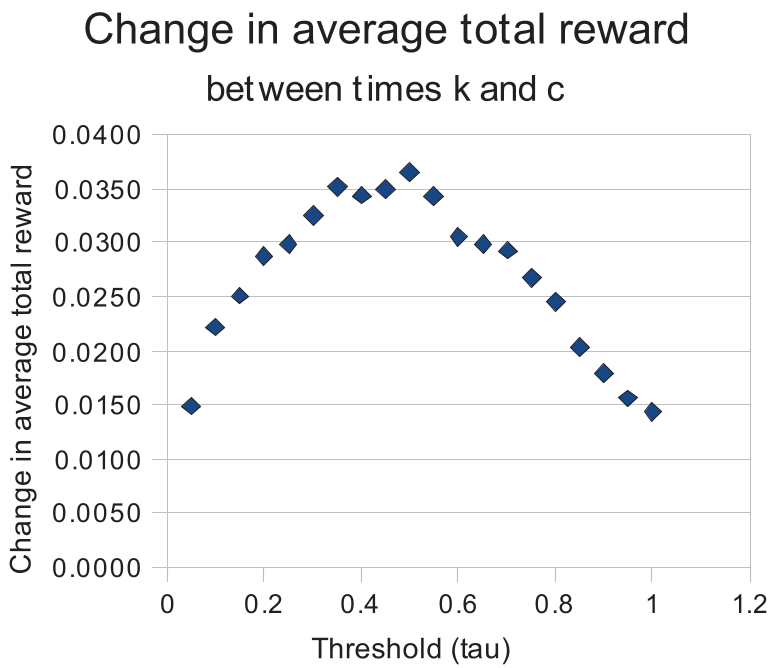 Figure: The relationship between the threshold and the change in total reward, highlighting the stability of the system.
Experiments and Insights
The researchers tested their model using a Pure Coordination Game with 300 agents. In this game, agents get rewards only when they choose the same strategy (Cooperate/Cooperate or Defect/Defect) as their neighbors.
Key Findings:
- The 7% Error: The model is highly accurate. The small error arises because the "Average Total Reward" of an agent isn't perfectly static—it fluctuates as other neighbors change their behavior.
- Threshold vs. Weight: Raising the threshold () makes agents "impatient," rapidly decreasing tolerance. Increasing the history weight () makes agents more "sentimental," increasing tolerance as they value the past more.
- Neighborhood Size Paradox: Interestingly, larger neighborhoods lead to higher average tolerance. This happens because a larger pool of neighbors "dilutes" the impact of one bad actor on the Average Total Reward, making the agent less likely to notice/react to the decline immediately.
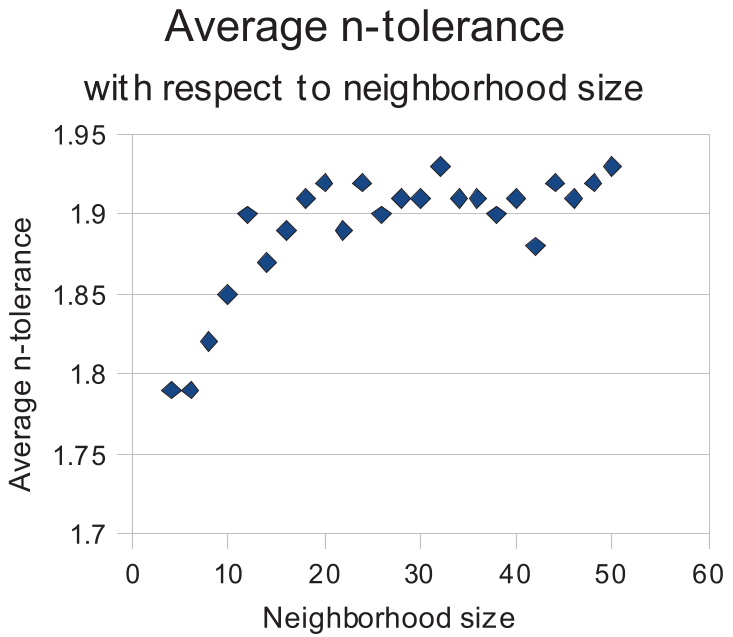 Figure: Average N-Tolerance increases as agents have more connections, demonstrating a "dilution" effect.
Critical Analysis & Conclusion
Takeaway
This paper successfully bridges the gap between social psychology and multi-agent systems. By quantifying tolerance, we can now design AI agents that don't just optimize for immediate gain but exhibit "stability-seeking" behaviors that mirror human social structures.
Limitations
The model assumes all agents share the same threshold () and weight (). In reality, tolerance is a diverse trait. Furthermore, the assumption that the average total reward remains constant during the period of "tolerance" is a simplification that leads to the aforementioned 7% error.
Future Outlook
The next step is Optimal Tolerance. Can a network reach consensus faster if agents are slightly more tolerant? Too much tolerance leads to "deadwood" (useless connections), but too little leads to "network fracturing." Finding the "Goldilocks zone" of tolerance will be the key to building the next generation of cooperative AI.