
TFP Query: Integrating Social Context into Spatial Search in LBSNs
Retrieving Top-k Famous Places in Location-Based Social Networks
The paper introduces the Top-k Famous Places (TFP) query for Location-Based Social Networks (LBSNs), which ranks Points of Interest (POIs) based on both spatial proximity and social popularity among a user's local network. It proposes three query processing frameworks—Social-First, Spatial-First, and a specialized Hybrid approach—achieving significant performance gains in large-scale geo-social data environments.
TL;DR
When you are looking for a pub in a new city, you don't just want the closest one; you want the one your friends or colleagues actually visit. This paper formalizes this as the Top-k Famous Places (TFP) query. It proposes a novel Hybrid approach using a specialized FCR-Tree index that outperforms traditional sequential filtering by up to 400%, effectively blending geographical distance with social relevance.
Problem & Motivation
Current Location-Based Social Networks (LBSNs) like Foursquare or Facebook Places handle billions of check-ins. However, retrieving a list of places ranked by both distance and "friend popularity" is computationally expensive.
Existing systems typically perform late fusion: either they find all nearby places and then check social counts, or they find all friends' check-ins and then filter by distance. Both approaches fail as the search radius or the number of friends grows. The authors identified that there is no specialized index that prunes both the spatial and social dimensions simultaneously.
Methodology: The Hybrid Approach
The core innovation is the Hybrid Approach and its associated index, the Friends Check-ins R-Tree (FCR-Tree).
1. The FCR-Tree
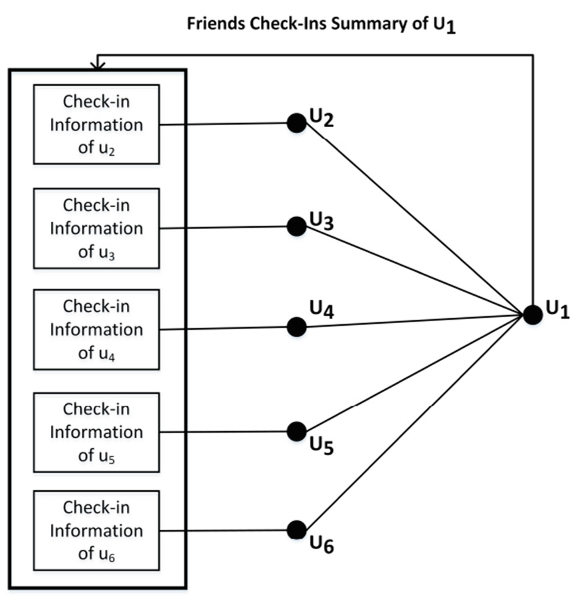
Instead of just indexing places, the FCR-Tree indexes the summaries of check-ins for a user's social circle. For each user, the system pre-computes an R-Tree where leaves represent the spatial bounds of their friends' activity.
2. Scoring Function
The TFP query uses a weighted sum (controlled by ): where is the proportion of a user's friends who have visited place .
3. Joint Pruning with Grid Partitioning
The Hybrid algorithm divides the search range into a grid. For each cell, it calculates an upper bound score based on the spatial proximity of the cell and the maximum possible social score (derived from the FCR-Tree's overlap count).
If a cell’s upper bound score is lower than the current -th best score, the entire cell (and all POIs within it) is discarded without ever touching the individual check-in records.
Experiments & Results
The authors tested their methods on the Gowalla dataset (approx. 196k users and 6.4M check-ins).
- Range Efficiency: As the search range increases from 10km to 400km, the Spatial-First approach explodes in cost because it retrieves too many POIs. The Hybrid approach stays stable because its pruning power increases with the density of data.
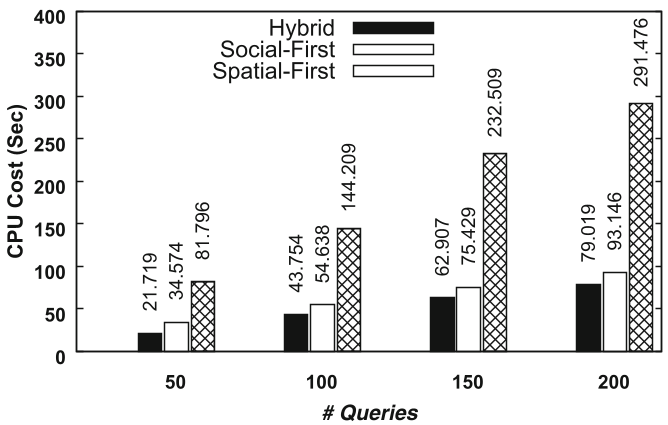
- Throughput: In a concurrent query environment (50-200 simultaneous queries), the Hybrid method maintains a significantly lower CPU footprint.
Critical Analysis & Conclusion
Takeaway
The TFP query fills a critical gap in personalized geo-services. By moving the "social relevance" check into the indexing layer rather than treating it as a post-processing filter, the researchers achieved SOTA performance for group-specific POI retrieval.
Limitations
- Pre-computation Cost: Building an FCR-Tree for every user might be storage-intensive for networks with millions of active users.
- Update Frequency: The paper notes that FCR-Trees are bulk-updated, meaning real-time "trending" places might not be reflected instantly.
Future Work
The next step for this technology is likely Dynamic TFP, where the "social relevance" isn't just a static friend list but includes real-time social signals (e.g., people currently checked in) or higher-order social connections (friends of friends).