
The Power of the Vote: Rethinking Influence Maximization in Mobile Social Networks
Mining Mechanism of Top-k Influential Nodes Based on Voting Algorithm in Mobile Social Networks
This paper proposes a novel Voting-based Mechanism to identify the Top-k influential nodes in mobile social networks (MSNs). By constructing an undirected weighted social relationship graph from real-world SMS/MMS data and employing an election mechanism combined with heap sorting, the method achieves superior influence spread and computational efficiency compared to traditional greedy algorithms.
TL;DR
Researchers have developed a "Voting Algorithm" that identifies the most influential users in a mobile network by simulating an election process. By moving away from computationally expensive greedy algorithms and focusing on "Intimacy" and "Activity" degrees derived from SMS/MMS data, this method is both faster and more effective at spreading information (or stopping malware) than previous industry standards.
Contextual Positioning
In the era of big data, identifying "super-spreaders" in social networks is critical for viral marketing and cybersecurity. While traditional research focuses on Greedy Algorithms that are mathematically rigorous but computationally "heavy" (NP-hard), this work is a heuristic-driven breakthrough that leverages the physical intuition of human social behavior to solve complex network problems.
The Core Problem: The Complexity Wall
Why is finding the top-k influential nodes hard? In a network with millions of users, trying every possible combination of "seed" nodes to see which spreads the most influence is a combinatorial nightmare. Existing solutions like the Climbing-up Greedy Algorithm try to solve this by adding one node at a time, but they still require repeated, expensive simulations (often Monte Carlo) to estimate influence spread.
Furthermore, these models often treat connections as simple links, ignoring the nuance of intimacy. A person you text daily is more likely to be influenced by you than a random acquaintance on a contact list.
Methodology: Social Elections
The authors suggest that influence isn't just about how many friends you have; it's about how much they trust and interact with you.
1. Building the Social Relationship Graph
Using message records, the authors build a directed weighted graph. They smartly convert this into an undirected graph where the weight is the minimum of the messages sent between two people. This ensures that only mutual, high-frequency relationships are valued.
2. The Voting & Activity Engine
Instead of a global search, the algorithm performs a local election:
- Intimacy Degree (ID): Nodes calculate how close they are to neighbors.
- Election: Each node gives its single "vote" to its most intimate friend.
- Activity Degree (AD): When two nodes have the same number of votes, the one who is more "active" (sends more messages and has more friends) wins.
 Table: Results of the voting process, showing the Number of Votes and Activity Degree (AD) for various nodes.
Experiments: Real-World Performance
The researchers tested their model on a massive dataset from a Chinese telecom provider (400,000 users; 20 million messages).
Efficiency vs. Effectiveness
The complexity of the Voting Algorithm is significantly lower than its predecessors:
- Climbing-up Greedy:
- Voting Algorithm:
Crucially, this speed doesn't come at the cost of performance. As shown in the comparison below, the Voting Algorithm actually reaches more nodes (Influence Spread) than the greedy alternatives over time.
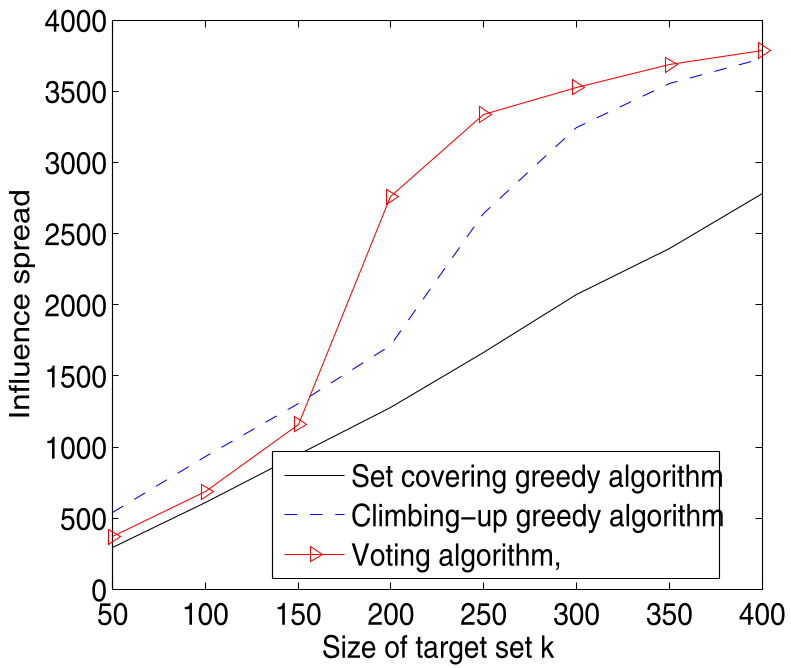 Figure: Comparison of influence spread across various 'k' values. The Voting Algorithm consistently outperforms prior greedy methods.
Critical Insights & Future Outlook
The brilliance of this work lies in its Inductive Bias: it assumes that human influence is a product of localized trust (votes) and global participation (activity).
Takeaways:
- Local is Better: Global optimization is often overkill for social networks. Local heuristics can capture the "Physics" of the network more efficiently.
- Intimacy Matters: Weighting edges by the minimum mutual interaction is a clever way to filter out spam or one-way noise in communication data.
Limitations:
The model assumes static relationships over a three-week window. In reality, social influence is highly dynamic and topic-dependent. Future work integrating Semi-Markov processes (as mentioned by the authors) will be necessary to model how influence "decays" or shifts as users change behaviors or encounter malware.
Conclusion
By treating mobile users as "voters" rather than just "nodes," this mechanism provides a scalable, high-performance blueprint for managing influence in the next generation of mobile social networks.