
Group Activity Planning: Balancing Proximity and Social Fitness in Geo-Social Networks
Finding Top- $$k$$ Places for Group Social Activities
The paper introduces the Group-based Geo-social Top-k Places (GkP) query, a novel recommendation task that suggests Points of Interest (POIs) for user groups. It combines spatial proximity (user distance) and social fitness (POI popularity for specific group sizes) into a unified scoring function.
TL;DR
Planning a meetup for a group of friends is a classic logistical headache. It’s not just about who lives closest to which restaurant; it’s about whether that restaurant is actually good for a group of your size. This paper formalizes the Group-based Geo-social Top-k Places (GkP) query, a recommendation framework that optimizes for both travel distance and the historical suitability of a venue for specific group sizes.
The Problem: Why "Nearest" Isn't Always "Best"
When four friends want to meet for dinner, a standard map search might suggest the point that minimizes the total travel distance. However, in reality, that "optimal" spot might be a tiny espresso bar that rarely accommodates groups, leading to a poor social experience.
The authors identify two major gaps in existing research:
- Lack of Group Context: Most POI systems are designed for individuals.
- Static Suitability: Systems often ignore the "social fitness" of a place—how frequently it hosts groups of size m.
Methodology: Quantifying "Social Fitness"
The core contribution of this work is the mathematical modeling of a POI's fitness for a group.
1. Social Fitness and Relevance Vectors
The authors borrow from Information Retrieval (IR) theory. Just as a document is relevant to a query term, a POI is relevant to a group size. They define a Relevance Vector that captures the visiting frequency of various group sizes at a specific location, smoothed to handle data sparsity.
2. Synthetic Relevance: The "Size Tolerance" Insight
A critical insight here is that social suitability is not a binary. If a restaurant is popular for groups of 4, it is likely suitable for groups of 3 or 5. The authors use a Synthetic Relevance formula to incorporate the popularity of neighboring group sizes, ensuring the model is robust to slight variations in group numbers.
 The ranking function: A weighted linear combination of Spatial Proximity (D) and Social Fitness (R).
Algorithmic Baselines
The paper proposes two ways to solve the GkP query:
- Distance-Driven Solution (DDS): Starts with the spatially nearest locations (using ANN queries) and then evaluates their social fitness, pruning the search space when the distance becomes too great to overcome the fitness score.
- Relevance-Driven Solution (RDS): Sorts POIs by their pre-computed social fitness and evaluates distances incrementally.
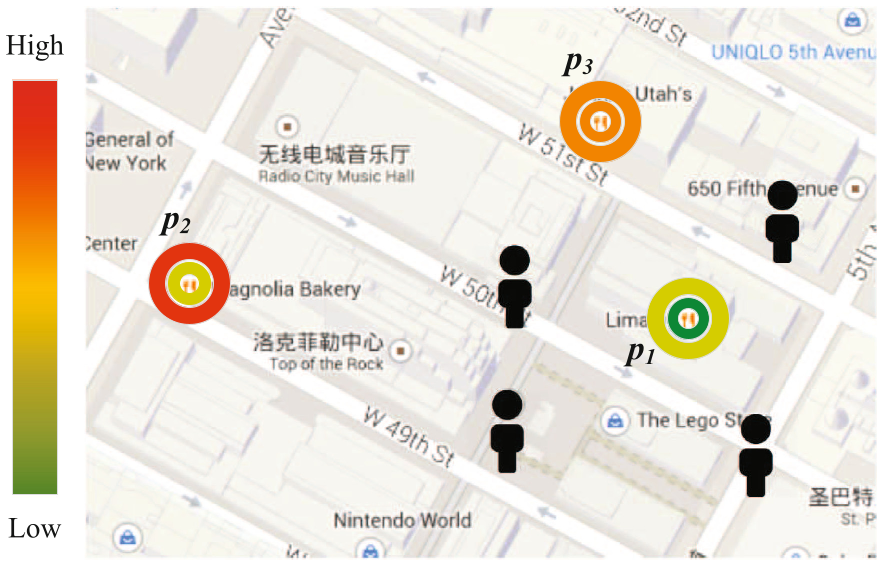 In this example, while p1 is closest, p3 is the better choice because it has a significantly higher frequency for groups of four.
Experiments: Performance and Scalability
Using real-world check-in data from BrightKite and Gowalla, the authors found that:
- RDS is the clear winner for real-time use: Because social fitness can be pre-computed, searching by relevance is significantly faster than iteratively computing aggregate distances.
- Sensitivity to Weights (): If the user cares mostly about distance ( is low), DDS performs reasonably. However, if social fitness is the priority, DDS becomes computationally expensive, sometimes taking over 2 hours, whereas RDS remains efficient.
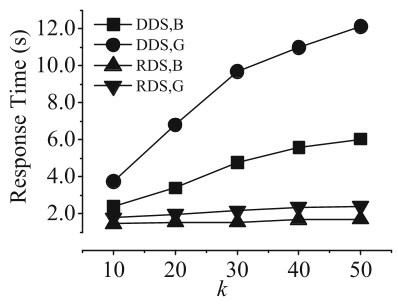 Performance comparison across different k values and weighting factors.
Critical Insight & Conclusion
The significance of this work lies in its bridging of Spatial Databases and Information Retrieval. By treating group sizes as "query terms" and POI histories as "documents," the authors provide a scalable way to solve a complex social coordination problem.
Future Outlook: While the current algorithms are index-free, the next step in this research involves creating specialized spatial-social indices that could unify these two dimensions, potentially allowing for even faster sub-millisecond responses on massive global datasets.