
On Top-k Social Web Search: Bridging Content and Connection
On top-k social web search
This paper introduces "Social Web Search," a retrieval paradigm that combines traditional Textual Relevance (TR) using TF-IDF with Social Influence (SI) based on user affinity in a social network. The authors propose and evaluate two search strategies, TR-based and SI-based, to efficiently compute top-k results in environments where a user's social connections impact document importance.
TL;DR
The emergence of the social web means that who said it is often as important as what was said. This paper explores Social Web Search, a framework that integrates Textual Relevance (TR) with Social Influence (SI). By proposing two distinct strategies—TR-based and SI-based—the authors tackle the efficiency bottlenecks of ranking documents based on their proximity to the user in a social graph.
Background & Motivation: Why TR is Not Enough
Standard search engines use metrics like TF-IDF to find the best textual match. However, in a social context, a mediocre document from a trusted friend is often more valuable than a perfect match from a stranger.
The technical challenge lies in the independence of the two factors:
- Textual Relevance (TR): Content-driven, usually indexed via inverted files.
- Social Influence (SI): Context-driven, requiring graph traversals to calculate the "closeness" (shortest path) between the searcher and the publisher.
Combining these in real-time for top-k results (where is small, e.g., top 10 results) is computationally expensive because calculating SI for every potential document candidate can crash performance.
Methodology: The Two Paths to Efficiency
The authors propose a unified scoring function to rank documents:
To find the top-k results without exhaustive computation, they propose two strategies:
1. TR-Based Search (The "Content-First" Approach)
This method starts with what we know best: keywords. It fetches documents in descending order of TR.
- The Problem: For every document found, we must look up the publisher and calculate their SI to the query user—this triggers massive social graph traversals.
- The Fix: The authors implemented an SI Cache to store distances of visited nodes, significantly reducing redundant graph walks.
2. SI-Based Search (The "Trust-First" Approach)
This strategy flips the script. It explores the social network starting from the query user (outward expansion).
- The Logic: It finds documents from your inner circle first, then moves to friends-of-friends.
- The Advantage: It naturally prioritizes those with the highest SI scores, which is often the more "expensive" variable to compute.
 Figure 1: Conceptual overview of social network distribution and document publishing.
Performance Benchmarks
The researchers tested their methods against varying network sizes () and query lengths ().
- Scalability: As the social network grows to 100,000 users, SI computation overhead increases significantly, eventually causing the two methods to converge in performance (Figure 4).
- Keyword Sensitivity: SI-based search is remarkably stable. Whether you search for 1 keyword or 5, the "expansion" cost of the social graph remains the constant bottleneck, whereas TR-based search slows down as more documents match the expanded keyword set.
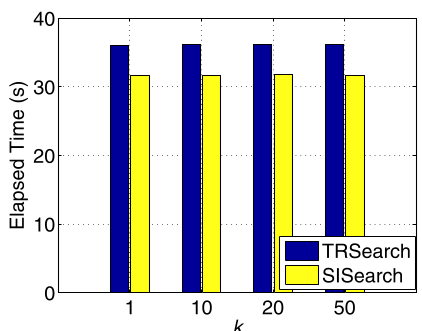 Figure 2: Impact of Social Network Size (|U|) on Elapsed Time. Note the exponential increase in latency as the user base expands.
Critical Analysis & Conclusion
Takeaway
SI-based search is generally superior for small-to-mid-sized communities or queries where the social tie is the primary filter. The inclusion of an SI Cache is a mandatory optimization for any TR-based system.
Limitations
- Metric Simplicity: The paper uses distance-based SI (shortest path). Modern social networks might require more complex metrics like PageRank or interaction frequency.
- Lack of Early Exit: The current algorithms examine a large portion of the candidate space. A more advanced "Threshold Algorithm" (TA) approach could allow the search to terminate early if the maximum possible score of unexamined documents falls below the current top-k.
Future Outlook
As we move toward decentralized social media and personalized AI agents, "Social Web Search" will likely evolve into Graph-RAG (Retrieval-Augmented Generation), where the "Social Influence" acts as a weight for which nodes in a knowledge graph the LLM should trust most.