
TKSTQ: Beyond Keywords—Bridging Geography and Semantics in Social Media Retrieval
Top-K Spatio-Topic Query on Social Media Data
The paper introduces Top-K Spatio-Topic Query (TKSTQ), a novel retrieval framework for social media data that combines spatial proximity with semantic topic modeling. By utilizing MetaLDA and a customized Quad-tree index, it moves beyond rigid keyword matching to find users based on the underlying themes of their geo-tagged short texts.
TL;DR
The paper "Top-K Spatio-Topic Query on Social Media Data" tackles the limitations of traditional geo-search. Instead of just looking for exact words near a location, the authors propose TKSTQ, a system that understands what people are talking about (topics) rather than just the words they use. By combining MetaLDA (a short-text topic model) with a Quad-tree spatial index, they've created a search mechanism that is both semantically "smart" and geographically "aware."
The Problem: The "Keyword Rigidity" Trap
Imagine you are a basketball fan in a new city. You search social media for "Michael Jordan" to find local enthusiasts. If nobody uses that exact name, traditional systems return zero results—even if a hundred people nearby are tweeting about "NBA," "Championships," or "Bulls."
Current Spatial Keyword Queries (SKQ) suffer from two main flaws:
- Semantic Blindness: They can't see the link between "retail" and "customer service" or "music" and "concert."
- Short-Text Sparsity: Standard topic models (like LDA) fail on tweets because 140 characters don't provide enough context for the model to "learn" associations effectively.
Methodology: High-Dimensional Topics meets 2D Maps
1. Strengthening Short-Text Understanding
To solve the sparsity problem, the authors use MetaLDA. Unlike standard LDA, MetaLDA leverages external "knowledge" (Word Embeddings from Wikipedia). This allows the model to know that "Jordan" and "Basketball" are related even if they never appear together in a single tweet.
2. The Spatio-Topic Index
Efficiency is key when dealing with millions of tweets. The authors propose a modified Quad-tree.
- Spatial Partitioning: The map is recursively divided into four quadrants (quads) until a threshold (max tweets per node) is reached.
- Topic Lists: Each leaf node doesn't just store a list of tweets; it stores tweets organized by their dominant topic.
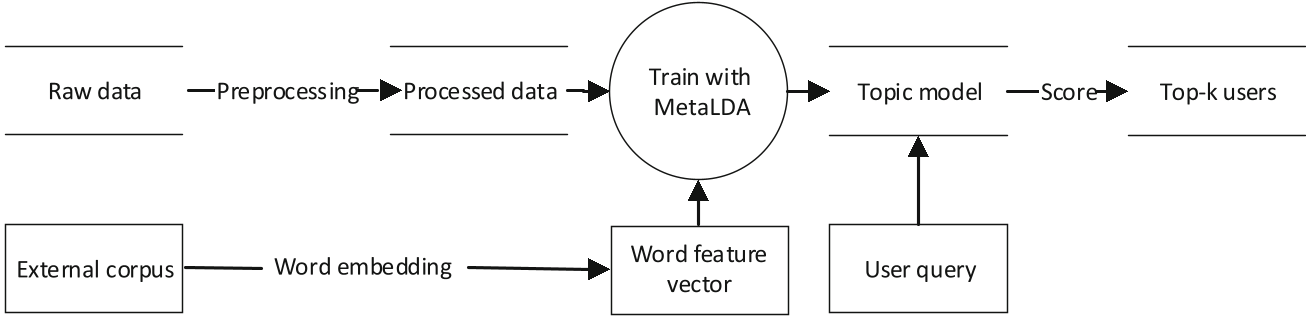 Figure 1: The TKSTQ System Architecture, illustrating the pipeline from raw tweets to indexed topics.
3. The Hybrid Score Function
To rank users, the system uses a dual-weighted score:
- Distance: Uses a Sigmoid function to ensure that if someone is "close enough" (e.g., within 5km), the focus shifts almost entirely to how relevant their topic is.
- Topic: Uses Cosine Similarity between the query's inferred topic vector and the tweet's vector.
Experiments & Results
The authors tested their approach on 1 million geo-tagged tweets.
Efficiency vs. Precision
The study found that while MetaLDA takes slightly longer for initial inference due to the complexity of the embeddings, the query execution is faster than keyword-based searches when the search radius () is large. This is because the number of topics (e.g., 200) is much smaller than the vocabulary of unique keywords (thousands).
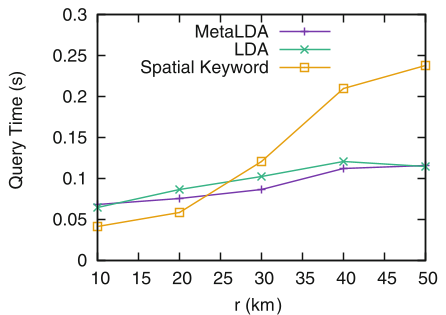 Figure 2: Performance comparison showing that Spatio-Topic indexing maintains lower query times as search radius increases compared to keyword methods.
The "Semantic Win"
The real triumph was in Precision. As shown in the table below, TKSTQ found highly relevant results that keyword search would have ignored:
| Query Words | Related Results Found by TKSTQ |
|---|---|
| Music | band, chorus, concert, dance |
| Police | officer, gunpoint, shooting |
| Bitcoin | btc, eth |
Critical Insight & Future Outlook
The core value of this paper lies in its Inductive Bias: it assumes that if you are interested in a keyword, you are actually interested in the concept behind it.
Limitations:
- Training Overhead: Training MetaLDA on massive datasets is computationally expensive.
- Temporal Decay: Social media topics change fast (breaking news). This model focuses on static topic distributions and might need an additional temporal "weight" to stay current.
Conclusion: TKSTQ is a significant step toward "Human-Centric" search in the geo-social era. It moves us away from being librarians searching for strings and toward being assistants searching for meaning.