
Topic-aware Social Influence Minimization: Blocking Rumors with Semantic Intelligence
Topic-aware Social Influence Minimization
This paper introduces a topic-aware approach to Social Influence Minimization (SIM), aiming to limit the spread of negative information (rumors, infections) by blocking a subset of nodes. It combines the Topic-aware Independent Cascade (TIC) model with HDP-LDA and KL divergence to identify and block nodes that are both structurally pivotal and content-susceptible.
TL;DR
When a rumor strikes a social network, who should you "isolate" to stop the spread? This paper argues that blocking the most "connected" people isn't enough. By integrating HDP-LDA topic modeling with the Topic-aware Independent Cascade (TIC) model, the authors propose blocking strategies that account for both network structure and the specific topic of the rumor. Their methods, Topic-aware Betweenness and Out-degree, significantly outperform traditional structural metrics.
Problem & Motivation: The Blindness of Topology
Most existing strategies for influence minimization treat every piece of information like a generic virus. They assume that if Node A is connected to Node B, the infection will pass with a fixed probability.
However, in reality, social influence is topic-sensitive. You might be easily influenced by a friend's recommendation on "AI tools" but completely ignore their "health advice." Prior work (SOTA at the time) relied on structural centralities (Degree, Betweenness), which are "content-blind." The researchers' core insight is that to minimize influence effectively, we must block nodes that are not just bridges in the graph, but are also semantically susceptible to the specific rumor being spread.
Methodology: Fusing Content with Structure
The authors redefine the Social Influence Minimization (SIM) problem through a topic-oriented lens.
1. Topic Distribution & Susceptibility
Using HDP-LDA (Hierarchical Dirichlet Process - Latent Dirichlet Allocation), the model learns a distribution over topics for every user and every item (rumor). The "distance" between a user and a piece of information is calculated using KL Divergence . A smaller divergence means the user is more likely to "buy into" that specific topic.
2. The Heuristics
The authors propose two primary scoring mechanisms to select which nodes to block:
- Topic-aware Betweenness (TB):
- Topic-aware Out-degree (TO):
By dividing the structural centrality ( or ) by the topic distance , they ensure that a node only gets a high "block priority" if it is both a major hub in the network and highly interested in the rumor's topic.

Experiments & Results: Precision Matters
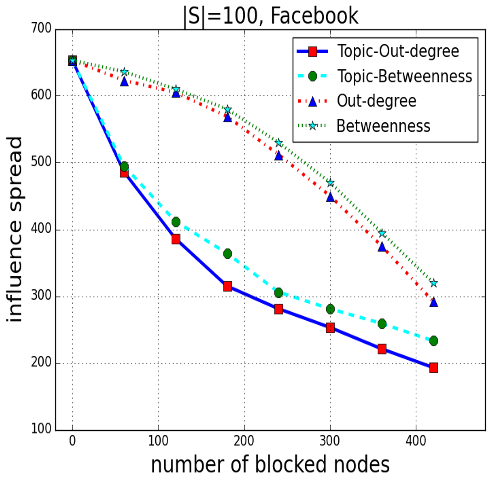
The framework was tested on two major datasets: Sina Weibo (2,000 nodes) and Facebook (4,039 nodes).
SOTA Comparison
The results demonstrated a clear "gap" between topic-aware methods and traditional ones.
- On the Sina Weibo dataset, with an initial infected set of 50 nodes, the proposed TO and TB heuristics minimized the spread to ~180 nodes, while standard Out-degree and Betweenness left the spread at ~320 nodes.
- The "Topic-aware Out-degree" (TO) generally performed the best, suggesting that for rumor control, neutralizing highly-active nodes sensitive to the topic is the most efficient path.
Critical Analysis & Conclusion
Takeaway
The primary value of this work lies in shifting the focus from "who is the most important node" to "who is the most important node for this specific rumor." The computational overhead remains manageable, as the topic distributions can be pre-computed.
Limitations & Future Work
While effective, the paper relies on node-blocking, which might be socially/politically difficult to implement (e.g., banning users). Future research could explore "Edge-blocking" (hiding specific posts) or "Counter-information injection" (promoting the truth) using the same topic-aware logic. Furthermore, the 2015-era datasets are small by today's standards; scaling these heuristics to billion-node graphs would require more efficient approximation algorithms like IMM (Influence Maximization via Martingales).
In conclusion, this paper serves as a foundational bridge between Natural Language Processing (Topic Models) and Graph Theory (Influence Propagation), proving that context is king even in the math of social networks.