
Beyond Topic-Blindness: Decoding Content-Driven Social Influence with AIR
Topic-aware social influence propagation models
This paper introduces topic-aware social influence propagation models (TIC, TLT, and AIR) that integrate latent topic modeling with classical diffusion frameworks. The core contribution is the AIR (Authoritativeness-Interest-Relevance) model, which significantly outperforms topic-blind baselines in predicting real-world information cascades.
Executive Summary
TL;DR: Most social influence research assumes that if you follow someone, they influence you equally across all subjects. This paper shatters that assumption by introducing Topic-aware Social Influence Propagation Models. By decomposing influence into user authoritativeness, interests, and item relevance, the authors provide a framework that is remarkably more accurate (up to 28% AUC improvement) and parameter-efficient than classical models.
In the academic coordinate system, this work serves as a bridge between Probabilistic Topic Modeling (NLP) and Information Diffusion (Network Science), moving away from "black-box" edge weights toward interpretable semantic influence.
Problem & Motivation: The "Blind" Influencer
Classic models like Independent Cascade (IC) and Linear Threshold (LT) have long been the gold standard for viral marketing. However, they possess a fatal flaw: they are topic-blind.
- The Overfitting Trap: Assigning a unique probability to every edge in a network like Facebook results in billions of parameters, leads to massive overfitting, and fails to handle new items (cold-start).
- Context Vacuum: An expert in "Quantum Physics" likely has zero influence when they post about "Baking," yet traditional models treat their influence as a static property of the social arc.
The authors' insight is simple yet profound: Influence is a triadic relationship between who is talking, what they are talking about, and who is listening.
Methodology: The AIR Model
While the authors provide topic-aware extensions for IC and LT (TIC and TLT), their most significant contribution is the AIR (Authoritativeness-Interest-Relevance) model.
The Three Pillars of AIR:
- Authoritativeness (): Does user carry weight in topic ? This can even be negative (distrust).
- Interest (): How interested is user in topic ?
- Relevance (): How relevant is item to topic ?
Instead of modeling edges, AIR models parameters. This drastic reduction makes the model scalable and less prone to the "one-hit wonder" influencer bias found in sparse data.
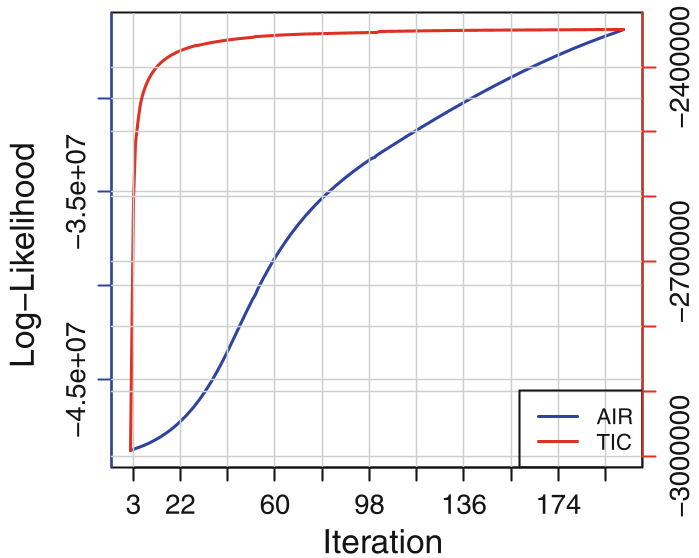 The figure shows the convergence of the GEM procedure for AIR compared to TIC. While AIR takes longer to converge, it captures a much more nuanced view of the propagation dynamics.
Experiments & Results: Precision in Prediction
The authors validated their models on Digg and Flixster datasets. The results were categorized into general activation (binary) and activation time (regression-like).
Key Performance Insights:
- Superior Accuracy: The AIR model outperformed all others, particularly in "Infection Episodes" where a user has active neighbors.
- Predicting "When": Topic-aware models were significantly better at predicting the timing of an action, proving that topic alignment accelerates the diffusion process.
- Influence Maximization: In viral marketing simulations, picking seeds based on topic-weighted authority yielded a much larger "spread" than picking seeds using topic-blind greedy algorithms.
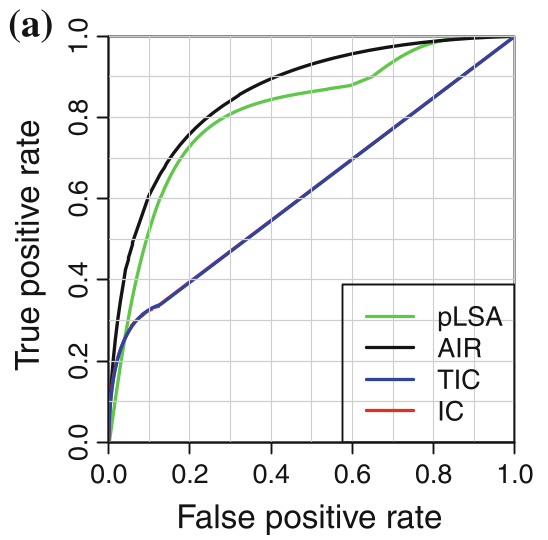 The ROC curves demonstrate that AIR (solid line) consistently maintains the highest True Positive Rate across both datasets.
Critical Analysis & Conclusion
Takeaway
The AIR model proves that content is king in social networks. By moving from a "graph-first" to a "topic-first" perspective, we can better identify the true hubs of influence that are relevant to a specific campaign.
Limitations & Future Work
- Computation: The Generalized EM (GEM) procedure for AIR is computationally expensive compared to standard IC.
- Dynamics: While topics are latent, the model assumes static interests. Future work could incorporate temporal topic evolution—tracking how a user's interests shift from "Gaming" to "Parenting" over time.
For the practitioner, this paper provides a robust blueprint for building recommendation engines and viral growth loops that don't just look at who knows who, but who influences whom on what.