
Beyond Topology: Why Topic-Awareness is the Key to Finding Rumor Sources
Topic-aware Source Locating in Social Networks
This paper introduces a topic-aware approach to source locating in social networks, moving beyond traditional structural analysis. It proposes the Topic-aware Susceptible-Infected (T-SI) model and two algorithms, TopicCenter (an approximate ML estimator) and SamplePath (a heuristic), to identify the origin of information propagation.
TL;DR
Locating the origin of a rumor or a viral "tweet" is traditionally seen as a graph theory problem. However, this paper argues that what is being said is just as important as who is saying it. By introducing the Topic-aware Susceptible-Infected (T-SI) model, the authors improve source detection accuracy by factoring in user interests and item relevance, outperforming traditional topology-only methods like Rumor Centrality.
Background: The Limits of Graph Centrality
In the hunt for "Patient Zero" in a social network, early scholars looked at the graph's shape. If you see a cluster of infected nodes, the center of that cluster is likely the source, right? Not necessarily. In reality, a sports fan is more likely to retweet a football score than a political manifesto. Traditional models (SI, SIR) treat all edges as equal, but in human networks, edges have "topic-dependent weights."
Methodology: The T-SI Model
The core contribution is the T-SI (Topic-aware Susceptible-Infected) model. In this framework, the probability of node infecting node with item is not constant. Instead, it is calculated based on:
- Topic Distribution: The latent topics within the message (as defined by LDA).
- User Interests: The historical interests of the receiver.
- Time Sensitivity: The "freshness" of the information.
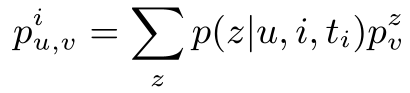 The infection probability is a weighted sum over topic distributions.
The Estimators
The authors propose two ways to find the source:
- TopicCenter: An approximate Maximum Likelihood (ML) estimator. It calculates the "Rumor Center" but weights the paths based on topic-similarity probabilities.
- SamplePath: A practical heuristic where infected IDs are "re-propagated" through the network to see which node could most likely have reached all currently infected users.
Experiments & Results
The researchers tested their approach against two datasets: a synthetic 3,000-node graph generated by the MMSB model and a real-world "Author Collaboration" network.
The performance metric used was the distance between the predicted source and the actual source. The results were clear: explicitly modeling topics reduces the error distance significantly compared to the standard rumor-center approach.
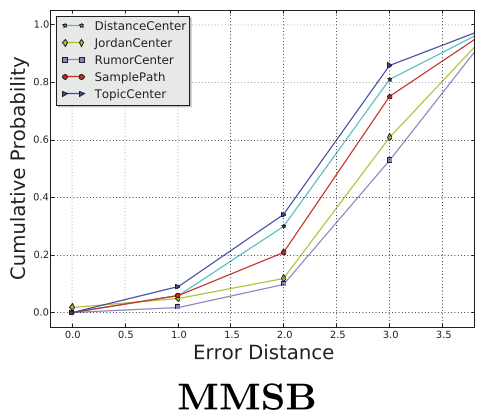 (Note: Fig 1 illustrates the cumulative probability of distance; higher curves toward the left indicate better accuracy.)
Critical Insight: The Value of Semantic Context
The "Topic-aware" approach acknowledges a fundamental truth of social media: networks are heterogeneous. By using LDA (Latent Dirichlet Allocation) to process text and mapping it to a modified SI model, this work bridges the gap between Natural Language Processing (NLP) and Graph Theory.
Limitations & Future Work
While the T-SI model is a major step forward, it assumes that user interests are static. In dynamic social environments, interests shift. Furthermore, the model relies on having access to the content of the messages; if the data is encrypted or limited to metadata, TopicCenter becomes harder to implement. Future research could explore "Blind Topic-Awareness," where topic distributions are inferred from propagation patterns alone without reading the actual text.
Conclusion
This paper serves as a reminder that in the era of big data, "the medium is the message," but the message defines the path through the medium. For rumor control and information forensics, topic-awareness is no longer optional—it is a requirement.