
TCB: Bridging the Gap Between Links and Interests via Joint NMF
A Topic Community-Based Method for Friend Recommendation in Online Social Networks via Joint Nonnegative Matrix Factorization
This paper introduces TCB (Topic Community-Based friend recommendation), a hybrid approach that integrates user link structures and textual content using Joint Nonnegative Matrix Factorization (Joint NMF). By mining latent topic communities from both social graphs and user-generated content, it achieves superior friend recommendation performance on real-world datasets like LinkedIn and Weibo.
Executive Summary
TL;DR: The "Topic Community-Based" (TCB) method solves the limitations of single-source friend recommendations in Online Social Networks (OSN) by fusing link topology and content features. Using Joint Nonnegative Matrix Factorization (Joint NMF), it identifies latent communities where users share both social ties and common interests, leading to significantly more accurate "People You May Know" services.
In the landscape of recommender systems, this work represents a transition from simple heuristic-based models to low-rank matrix approximation techniques that treat social structure and semantic content as two sides of the same coin.
Problem & Motivation: The "Single Information" Trap
Why do current friend recommendations often fail? The authors identify a fundamental flaw in using either social links or content in isolation:
- Link-based (e.g., FoF): Just because you share a mutual friend doesn't mean you share interests. You might be recommended a stranger whose only connection to you is a random acquaintance.
- Content-based: Shared tags (e.g., "Big Data") are great, but without a social bridge (common friends), the recommendation feels cold and is less likely to be accepted.
The Insight: Human social behavior follows Homophily—the principle that people with similar attributes are more likely to form links. Therefore, a recommendation engine should look for "Topic Communities" where these two signals overlap.
Methodology: The Core Architecture
The heartbeat of this method is the Joint NMF model. Instead of factorizing one matrix, it factorizes two:
- Matrix X: User-to-user links (Social Graph).
- Matrix Y: User-to-content features (TF-IDF values from posts/tags).
By forcing both factorizations to share the same Community Indicator Matrix , the model aligns the social structure with the topical content.
Mathematically Balancing the World
The objective function uses a hyper-parameter to tune the importance:
- : Shows which community a user belongs to.
- : Shows the internal strength of a community.
- : Shows which words define a community.
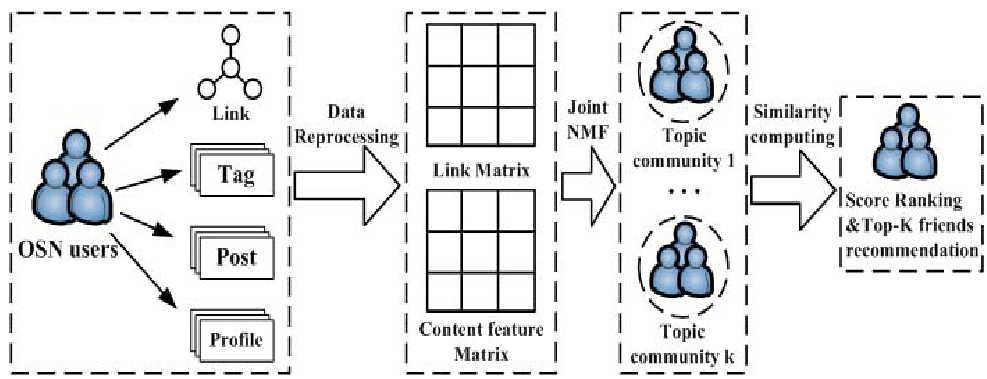
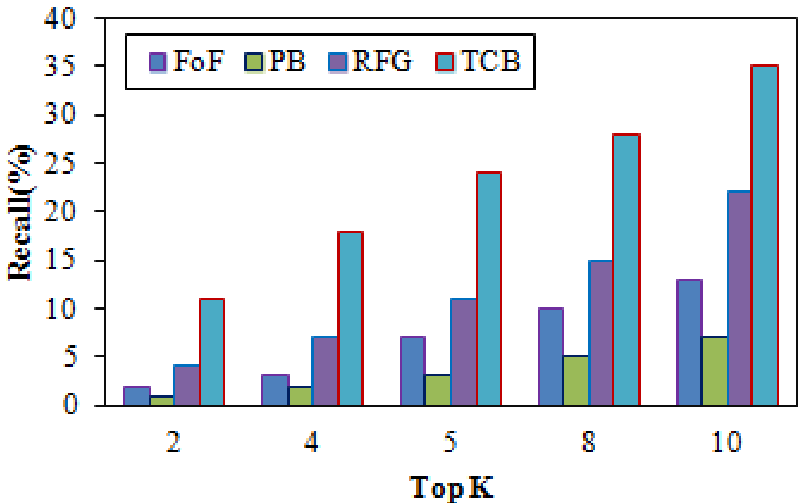
Experiments & Results: SOTA Performance
The authors tested TCB on LinkedIn and Weibo datasets. Compared to the Ranking Factor Graph (RFG) and traditional baselines, TCB achieved higher accuracy.
Why does TCB win?
The primary reason is Sparsity Management. Social link matrices are notoriously sparse (99.9%+ empty). Traditional models struggle with this, but TCB projects the data into a low-rank feature space (), where the "density" of information is much higher, allowing for more precise similarity calculations.
The "Six Degrees" Theory in Practice
One of the most unique aspects of this paper is the theoretical modeling of . The authors derive an initial based on the Six Degrees of Separation theory, suggesting a balance between social proximity and interest similarity is the natural starting point for human connection.
Critical Analysis & Conclusion
Takeaway
TCB proves that mining "Topic Communities" is a superior way to handle the noise of large-scale social networks. It doesn't just look at who you follow; it looks at why you are part of a specific circle.
Limitations & Future Work
- Dynamic Nature: OSNs change by the second. The current NMF approach is relatively static. The authors propose moving towards MapReduce frameworks to handle larger, faster-changing data.
- Direct vs. Indirect Links: Matrix currently only counts direct neighbors. The authors suggest that incorporating "degrees of separation" (e.g., weighting a 2nd-degree friend as 1/2) could further boost precision.
Final Thought: As AI moves toward more holistic user modeling, TCB's approach of fusing diverse data sources into a unified latent space remains a cornerstone of robust system design.