
TDTEO: Mastering the Art of News Evolution via Event Ontology
Topic Detection and Tracking Based on Event Ontology
The paper introduces TDTEO, a Topic Detection and Tracking (TDT) framework that leverages domain-specific Event Ontology. By integrating hierarchical event classes and evolution scenarios, it achieves SOTA performance in news organization, reaching a macro-F1 of 85.25% in detection and a low normalized cost of 0.1028 in tracking.
TL;DR
Building a system that understands the news isn't just about keywords; it's about understanding logic. This paper presents TDTEO, a framework that uses Event Ontology to solve the long-standing "Semantic Drift" problem in Topic Detection and Tracking (TDT). By mapping news to a structured hierarchy and predicting "what happens next" through scenario models, it achieves an 85.25% macro-F1 while being 3x faster than traditional clustering.
The "Moving Target" Problem in TDT
Why is news tracking so hard? Because topics are live organisms.
- Sparsity: Initial reports on a scandal are often vague.
- Granularity: Is a news piece about "Sports" or specifically "NBA Playoff Injuries"?
- Drift: A topic starting as "Scientific Discovery" might evolve into "Academic Fraud." Traditional models like LDA or K-means often lose the scent when the vocabulary shifts during this evolution.
Methodology: The Power of Prior Knowledge
The authors argue that we shouldn't approach news as a blank slate. Instead, they use a Domain Event Ontology, which treats events as structured units (Actions, Objects, Place, Time).
1. Hierarchical Detection
Instead of flat clusters, TDTEO uses an inheritance tree. If a news report doesn't perfectly match a "Plagiarism" leaf node, the system checks the "Academic Misconduct" parent node. This prevents "Missed Detections" caused by specific keyword mismatches.
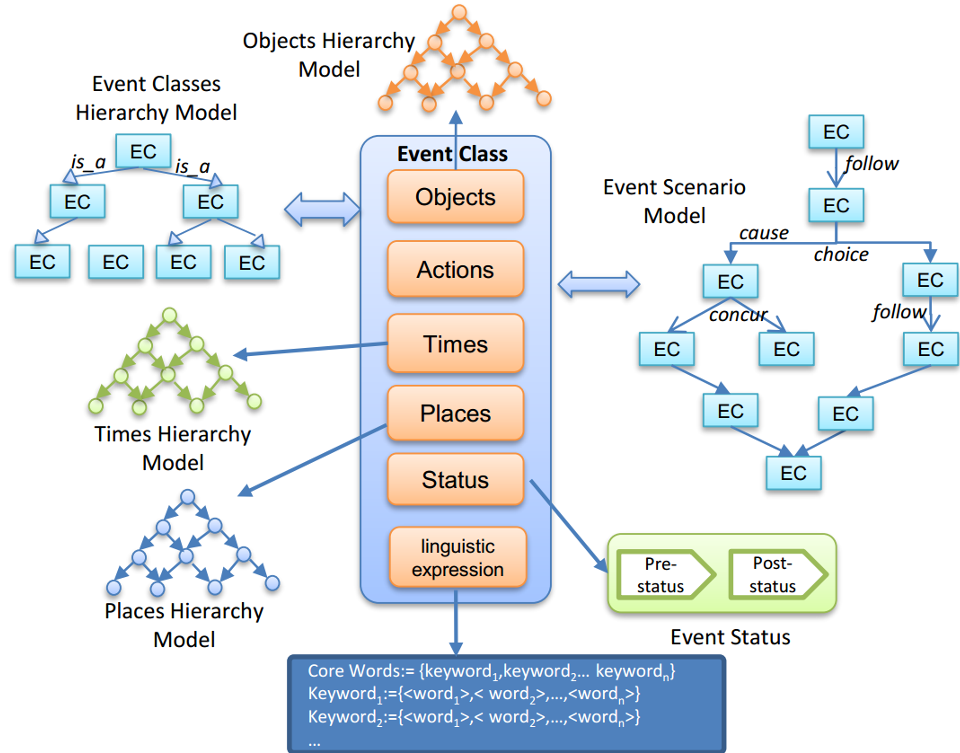 Figure 1: The dual-layer structure of the Event Ontology, combining hierarchy with evolutionary scenarios.
2. Scenario-Driven Tracking
This is the "Secret Sauce." The ontology contains Scenario Models—causal and sequential links between event classes. When a "Seed Event" is detected, the system proactively shifts its attention to potential "Subsequent Events" defined in the ontology.
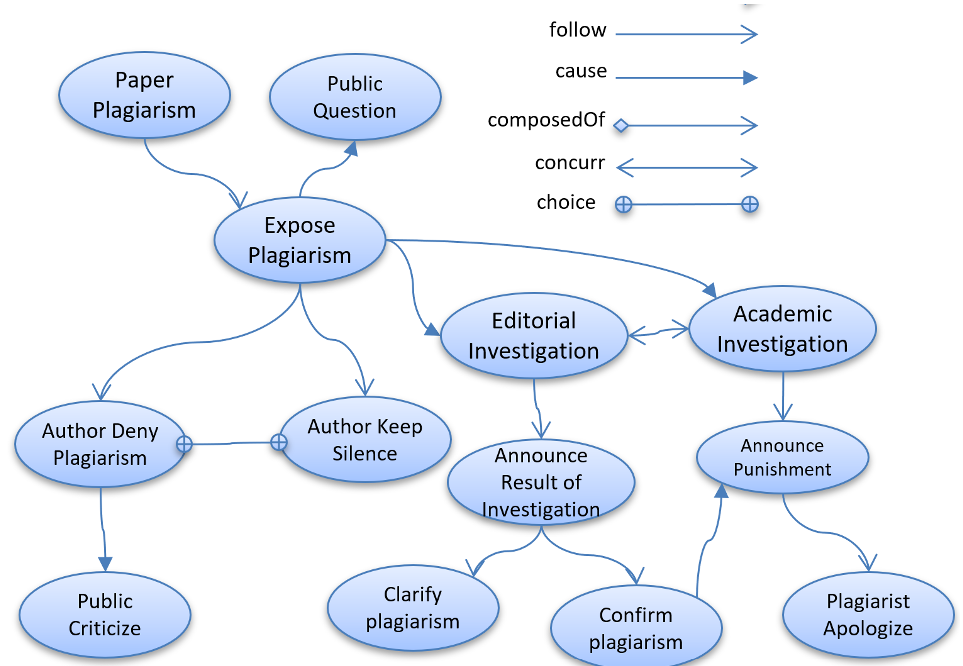 Figure 2: A scenario model for "Expose Paper Plagiarism" showing the logical flow from exposure to investigation and punishment.
Performance: Efficiency Meets Accuracy
The experiments conducted on the Sogou news corpus and real-world datasets (like the Zhaitianlin plagiarism scandal) reveal two major wins:
- Speed: By eliminating the need for iterative cluster center searching (common in K-means), TDTEO runs in time. It achieved 90.67% accuracy in roughly 1/4th the time of K-means.
- Precision in Tracking: In the Zhaitianlin case study, using a "Tracking Distance" of 1 (predicting the immediate next step in the ontology) resulted in the lowest error cost.
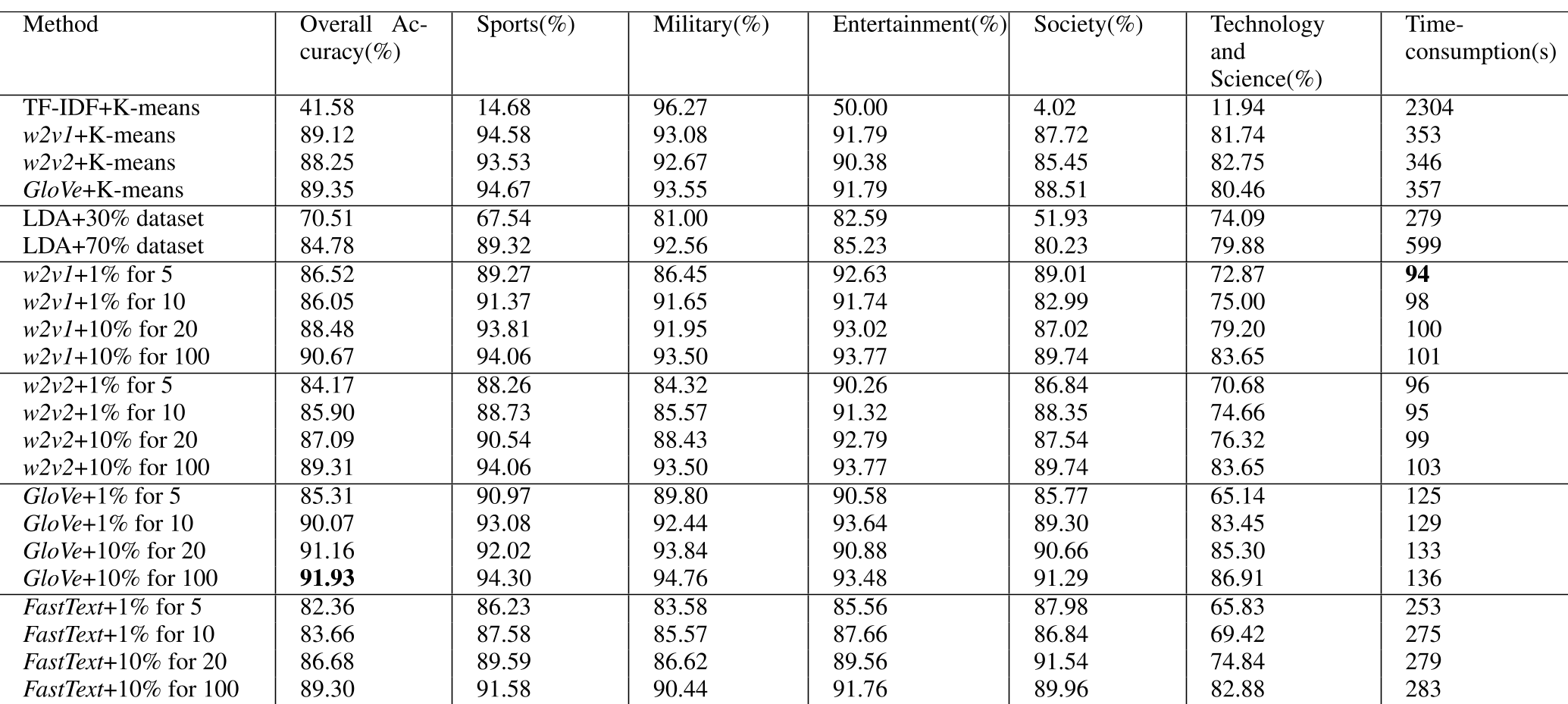 Table 1: Performance comparison across major news categories. TDTEO consistently outperforms baseline models.
Critical Insight: Why This Matters
The core achievement of TDTEO is moving TDT from Statistical Matching to Logical Reasoning. While modern LLMs are great at embeddings, they often struggle with long-term consistency and "hallucinating" topic shifts. Integrating an Event Ontology provides a "Hard Rail" that keeps the AI focused on the real-world logic of how events unfold.
Conclusion & Future Look
TDTEO proves that "Common Sense" (in the form of Ontology) is the best remedy for data sparsity. While building these ontologies requires initial manual effort, they are reusable assets. The next frontier? Automated Ontology Induction, where the AI learns these scenario patterns themselves from historical data, combining the flexibility of Deep Learning with the rigor of Symbolic Logic.