
Happy Entertainment but Angry Finance: Decoding the DNA of Weibo Topics
Topic Dynamics in Weibo: Happy Entertainment Dominates but Angry Finance is More Periodic
This paper presents a comprehensive investigation into topic dynamics on Weibo using an incremental Bayesian learning framework to classify 238 million tweets into seven categories. The study uncovers distinctive evolving patterns across temporal, spatial, gender, sentimental, and interactive dimensions, achieving a SOTA F-measure of 84.05% for large-scale Chinese social media classification.
TL;DR
By analyzing over 200 million tweets, researchers from Beihang University have mapped the "pulse" of Weibo. The verdict? While we use social media mostly to consume entertainment and joy, our financial and military discussions are fueled by anger and follow a rigid, work-week rhythm. This work provides a rigorous framework for understanding why certain topics "stick" and how social media serves as a mirror to real-world societal pressures.
Background: Beyond the Noise
In 2013-2014, Weibo became the "central square" of Chinese public life. However, for data scientists, it was a chaotic sea of short, sparse text. This paper moves beyond simple keyword counting to provide a multi-dimensional taxonomy: Society, International, Sports, Technology, Entertainment, Finance, and Military.
The "Why": Why Some Topics Cycle and Others Spike
The authors' core insight lies in the temporal behavior of human interests. They argue that social media isn't just a stream of consciousness; it's a regulated system. Using Discrete Fourier Transform (DFT)—a tool usually reserved for physics and engineering—the researchers converted chronological tweets into frequency signals to find hidden cycles.
Methodology: The Bayesian Lens
To process 200 million tweets, the team used an Incremental Bayesian Learning Framework.
- Crowdsourced Labeling: Instead of manual tagging, they used professional news accounts as "gold standard" anchors.
- Sustainability: The incremental nature allows the model to learn new slang and emerging topics without retraining from scratch.
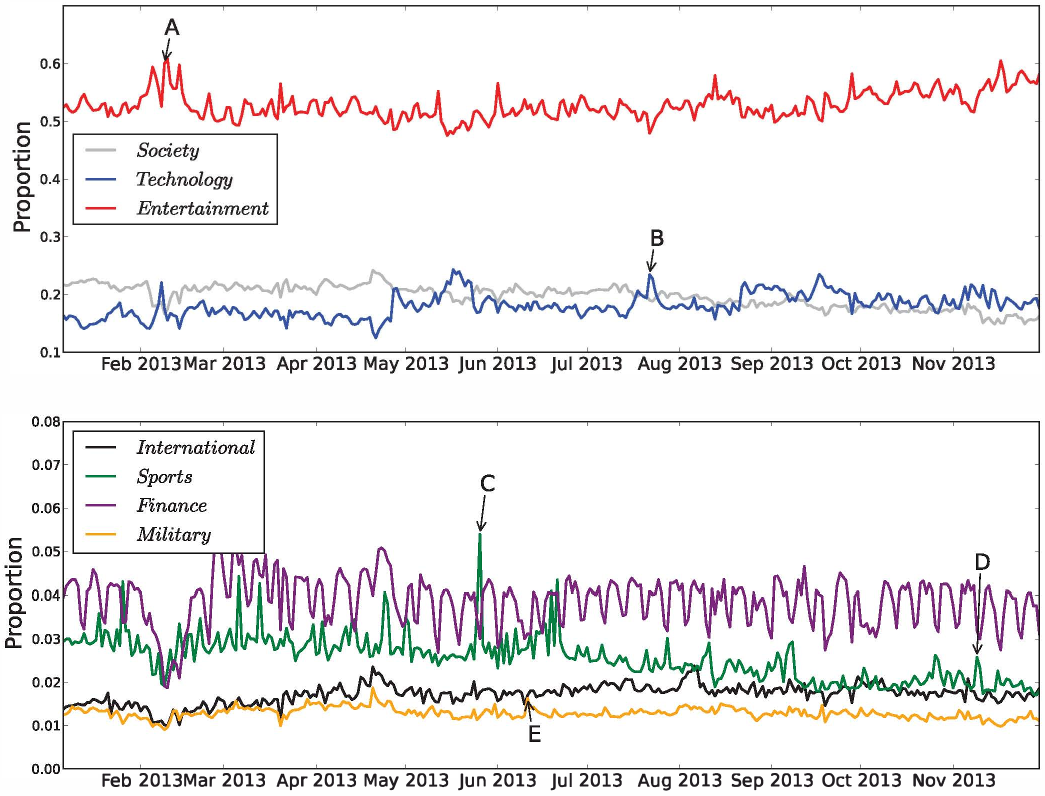 Fig 1: Spikes in topics correlate with real-world events like the breakdown of WeChat or major sports wins.
Key Findings: The "Emotional Logic" of Topics
1. The Periodicity of Finance
Finance is the most "disciplined" topic. It drops significantly on weekends and peaks during trading hours. The DFT analysis (Fig 2b) showed clear spikes at HZ 47, mathematically proving its 7-day cycle. In contrast, Entertainment is more fluid, serving as a "relief valve" during the weekends.
2. The Sentiment Map
One of the most striking findings is the correlation between topic and emotion.
- Joy dominates Technology (largely due to app advertisements and upbeat product launches).
- Anger is the primary driver of Finance and Military. This reflects public frustration over economic issues (housing prices) or nationalistic sentiments during diplomatic conflicts.
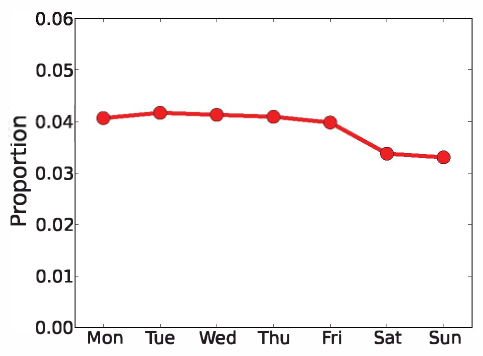 Fig 2: Finance (a, b) shows a heavy weekly cycle, whereas Society (f) is erratic and event-driven.
3. The Gender and Interaction Gap
The data confirms a digital divide: Female users dominate Entertainment, while Male users are more active in Finance and Military. Interestingly, Finance—despite having fewer total tweets—shows an incredibly high "Interactive Correlation." This suggests that people talking about money belong to highly "echo-chambered" or professional communities where everyone follows the same signals.
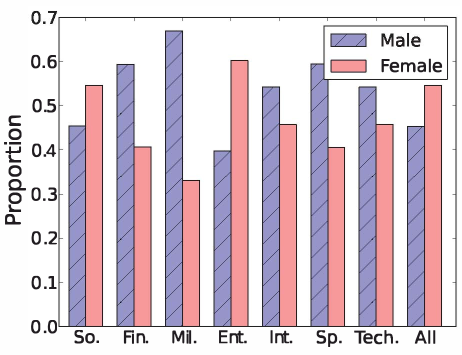 Fig 3: The emotional and demographic breakdown showing female dominance in joy-related Entertainment.
Conclusion & Insight
The research proves that Weibo is more than a news portal; it is an emotional and temporal ecosystem.
- For Marketers: The weekend is for joy/entertainment; the weekday is for professional/financial engagement.
- For Sociologists: Anger is a critical bonding agent for "technical" communities like Finance and Military.
Limitations: The study relies heavily on accounts active in 2013. In the modern era of algorithmic feeds (like TikTok/Douyin), these organic temporal patterns might be "smoothed out" by recommendation engines that force-feed content regardless of the day of the week.
Future Work: Applying this to multi-modal data (images/videos) would determine if "Happy Entertainment" still dominates when the medium changes from text to visual.