
TECM: Bridging the Gap Between Topical Relevance and Emotional Intelligence in Chatbots
Generating Topical and Emotional Responses Using Topic Attention
The paper proposes the Topical and Emotional Chatting Machine (TECM), a conversation generation model that integrates Non-negative Matrix Factorization (NMF) topic modeling and emotion category embeddings into a Seq2Seq framework. It achieves State-of-the-Art performance in the NTCIR-14 Short Text Generation subtask by generating responses that are both semantically rich and emotionally aligned.
TL;DR
The Topical and Emotional Chatting Machine (TECM) is a novel architecture designed to solve the "generic response" problem in emotional AI. By combining NMF-based topic modeling with emotion category embeddings, TECM generates responses that are not only emotionally appropriate but also rich in specific information. It shows a 10% improvement in BLEU and an 18% increase in diversity (Distinct-2) over previous baselines.
Background & Motivation
Current dialogue systems often fall into two traps: they are either informative but robotic, or emotional but generic. Early works in emotional dialogue generation, such as the Emotional Chatting Machine (ECM), paved the way for affective computing but often produced repetitive, "safe" responses like "I am happy too."
The authors of TECM argue that emotions don't exist in a vacuum—they are tied to specific topics. To generate a truly human-like response, a model must understand the contextual theme of the conversation.
Methodology: The Dual-Attention Core
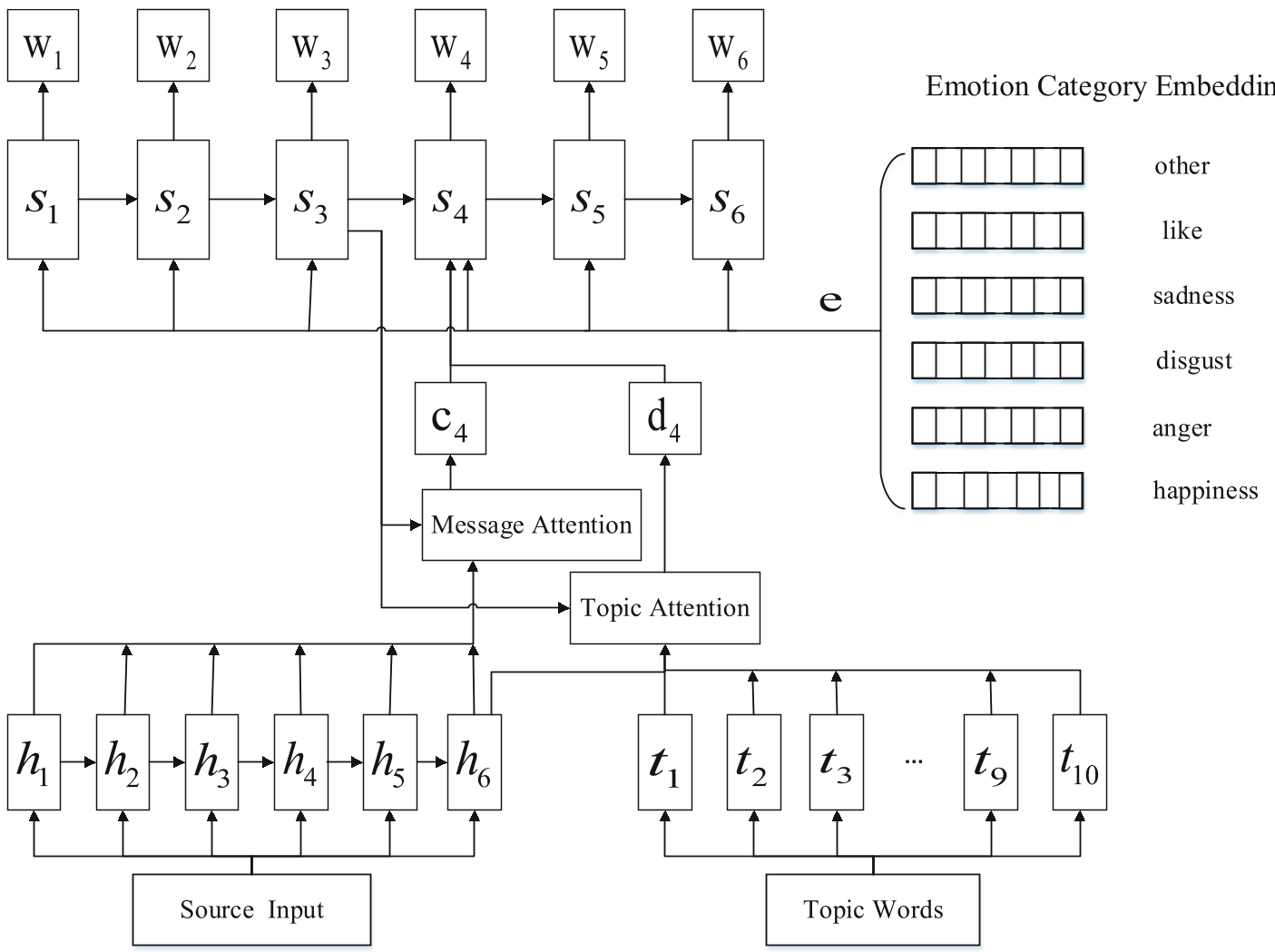
The TECM model is built upon a Seq2Seq framework using Gated Recurrent Units (GRU), enhanced by a tripartite input strategy in the decoder.
1. Topic Extraction via NMF
Instead of relying solely on the input post, TECM uses Non-negative Matrix Factorization (NMF) to extract a set of topic words. For any given post, the model identifies the most probable topic and selects the top 10 associated words (e.g., a post about "flu" might trigger topic words like "sick," "fever," "medicine").
2. The Architecture
The model employs two types of attention:
- Message Attention: Focuses on the hidden states of the input post.
- Topic Attention: Calculates a weighted sum of the NMF topic words, guided by the encoder's final hidden state.
3. Emotion Injection
A 100-dimensional Emotion Category Embedding is concatenated into the GRU input at each time step. This acts as a continuous signal that biases the language model toward specific affective vocabularies (Like, Sadness, Disgust, Anger, Happiness).
Experimental Validation
The model was trained on a massive dataset of 1.6 million Weibo dialogues, annotated by a BERT-based emotion classifier with 92.6% accuracy.
Performance Highlights:
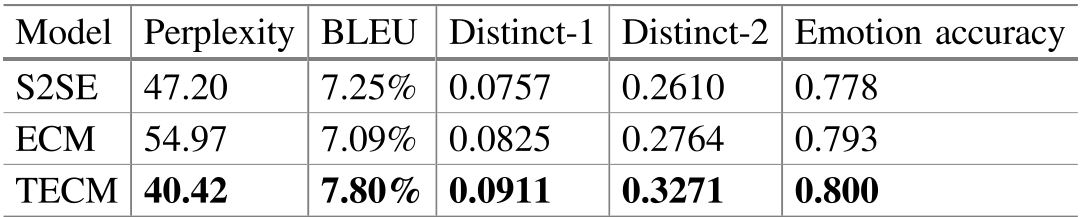
- Diversity (Distinct-1 & 2): TECM significantly outperformed the ECM baseline, proving that topic words act as "content anchors" that prevent the model from collapsing into generic phrases.
- Fluency (Perplexity): With a score of 40.42 (vs. ECM's 54.97), the model demonstrates superior language modeling capabilities.
Case Study comparison:
- Post: "My spareribs are delicious."
- ECM (Generic): "I like playing games." (Irrelevant)
- TECM (Topical/Emotional): "I like to eat spareribs." (Topically relevant and "Like" emotion)
Critical Insight & Conclusion
The success of TECM lies in its realization that dialogue quality and emotional accuracy are synergistic. By providing the model with "Topic Information" as prior knowledge, the search space for the decoder is narrowed to semantically relevant regions, which in turn makes the injected emotional signal more effective.
Limitations: The authors acknowledge that the correlation between topic words and the actual post can sometimes be weak. Future work will likely involve more advanced Neural Topic Models or Dynamic Knowledge Graphs to further refine the "Topical" aspect of the machine.
Takeaway for Practitioners: When building emotional LLMs or chatbots, don't just prompt for emotion—provide a "topic vector" or "keyword set" to keep the agent grounded and informative.