
Topic-level Social Network Search: Decoding Influence in Academic Ecosystems
Topic-level social network search
This paper presents a demonstration of "Topic-level Social Network Search," a system designed to identify top influencers and their connectivity sub-networks within specific topics. By leveraging the Author-Conference-Topic (ACT) model and Topical Affinity Propagation, the authors enable fine-grained expertise discovery and social structure visualization, integrated into the ArnetMiner platform.
TL;DR
Finding "who is important" in a social network is easy, but finding "who is important in Machine Learning vs. Databases" is a far more complex challenge. This paper introduces a system that doesn't just list names; it reconstructs the core community sub-networks of influencers for specific topics. Using a combination of the ACT (Author-Conference-Topic) model and Topical Affinity Propagation, the authors demonstrate a search engine that maps the social DNA of academic fields, resulting in an 80% improvement in user engagement over standard path-finding methods.
The Problem: The "Topic Gap" in Social Search
Most social search engines suffer from a lack of granularity. If you search for an expert in "Data Mining," you don't just want a list of people who have the keyword in their bio; you want to know:
- Context: Who are the true influencers within this specific sub-niche?
- Connectivity: How do these influencers interact? Are they part of the same lab (Advisor-Advisee) or just frequent collaborators?
Prior work often relied on simple shortest-path algorithms to connect people, which results in "spaghetti graphs" that lack structural importance. The challenge lies in quantifying influence that changes depending on the topic—a concept known as Topical Influence.
Methodology: From Matrices to Meaningful Graphs
The authors propose a rigorous framework to bridge the gap between text (topics) and structure (networks).
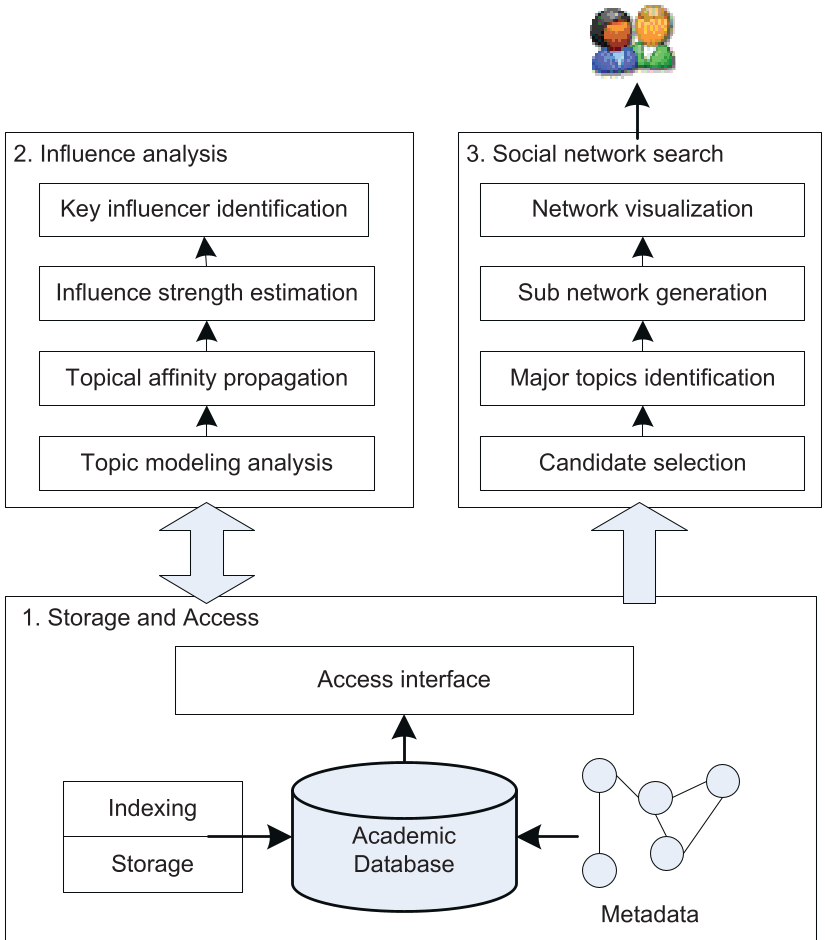
1. Topical Modeling with ACT
Instead of simple LDA, the system uses the Author-Conference-Topic (ACT) model. This heterogeneous model treats papers as links between authors and venues.
- Intuition: An author's influence isn't just about what they write, but where they publish. The ACT model estimates —the probability of a topic given an author.
2. Topical Affinity Propagation
To quantify influence, the authors use a Factor Graph where nodes represent authors and edges represent social relationships.
- The "Affinity Propagation" occurs at the topic level, meaning influence is calculated independently for every topic. This allows the system to recognize that Person A might influence Person B in "Algorithms" but not in "Human-Computer Interaction."
3. Sub-network Generation via Influence Maximization
Once influencers are identified, how do we draw the map? Connecting every pair of experts creates noise.
- The system uses Influence Maximization (specifically a degree-discount heuristic).
- The Logic: If we have already selected one influencer from a specific research group, the "marginal gain" of adding their office mate is low. This ensures the resulting sub-graph is diverse and represents the "core" of the community.
Experimental Evidence: Do Users Actually Care?
The system was deployed on ArnetMiner.org, providing a real-world "living lab."
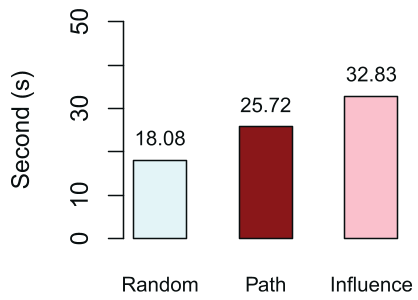
- Metric: Viewing Time: Users spent significantly more time interacting with the influence-based graphs than with random or shortest-path graphs.
- Metric: Expand/Remove Ratio: This measures how often users clicked for more details versus hiding a node. The influence algorithm nearly doubled the performance of baseline methods.
Critical Insight: The Value of Heterogeneity
The brilliance of this work lies in its acknowledgment that social networks are not homogeneous. By incorporating conferences and papers as first-class citizens in the topic model, the system captures the social context of academic production.
However, a notable limitation is the reliance on historical publication data. Influence is often a leading indicator, but publication data is a lagging indicator. Future iterations might benefit from integrating real-time signals (like social media citations or pre-print downloads) to capture "rising stars" before they dominate the citation counts.
Conclusion
This paper moves social search from "Who do I know?" to "Who moves the needle in this field?" It provides a robust blueprint for any platform—whether academic, corporate, or social—aiming to visualize the hidden hierarchies of expertise.