
Beyond Frequency: Leveraging Louvain Community Detection for Robust Topic Modeling
Topic Modeling based on Louvain method in Online Social Networks
This paper introduces a novel approach for Topic Modeling in Online Social Networks (OSNs) by leveraging the Louvain community detection method on word co-occurrence graphs. It integrates the Adaptive Distribution of Vocabulary Frequencies (ADVF) for noise reduction and achieves distinction between natural human discussions and artificial spammer-generated content.
In the era of information overload, Online Social Networks (OSNs) like Twitter and YouTube serve as a goldmine for market sentiment and competitive intelligence. However, mining these "digital goldmines" is notoriously difficult due to the brevity of posts and the overwhelming presence of coordinated spam. Traditional models like LDA (Latent Dirichlet Allocation) often stumble over the sparse nature of 140-character tweets.
This paper presents a shift from probabilistic text models to Graph-based Community Detection, utilizing the Louvain method to partition word networks into coherent topics while filtering out "artificial" trends.
The Problem: The Noise and the Bot
Traditional Text Mining techniques were designed for formal articles. In the chaotic world of OSNs:
- Noise is Constant: Slang, abbreviations, and typos break standard NLP pipelines.
- Spam Bias: Bots repeatedly post identical or similar content, which frequency-based weights (like TF-IDF) mistake for "hot topics."
The authors' core insight is that natural human language forms a sparse, organic web of connections, whereas spam bots often create unnaturally dense or isolated clusters.
Methodology: The Graph Perspective
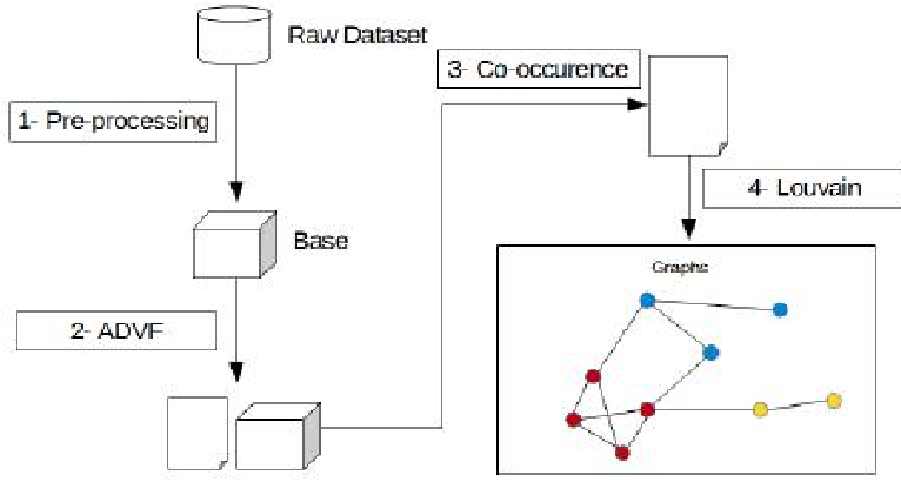
The proposed pipeline moves away from treating a document as a "bag of words" and instead treats the vocabulary as a Social Network of Terms.
1. ADVF Filtering
Before building the graph, the authors use Adaptive Distribution of Vocabulary Frequencies (ADVF). Based on Zipf’s Law, this highlights terms that deviate from expected frequency distributions, effectively stripping away grammatical noise without the heavy computational cost of lemmatization.
2. Building the Co-occurrence Graph
Terms that pass the ADVF filter become nodes. If two words appear in the same tweet, an edge is drawn between them. The more times they appear together, the heavier the edge weight.
3. Louvain Community Detection
The Louvain algorithm optimizes Modularity (Q)—a measure that compares the density of edges within a group versus edges between groups. In this context, a "Community" equals a "Topic."
Distinguishing Natural vs. Artificial Topics
One of the most compelling aspects of this research is the use of Graph Density to spot spammers.
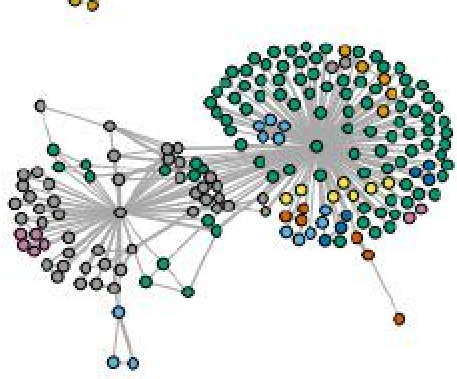
- Natural Topics: Display a "centroid" structure. For example, in the Christmas dataset, the word "Natal" acts as a hub connecting to "December" and "Party." The graph is relatively sparse (Low Density).
- Artificial Topics (Spam): Often form cliques where every node is connected to every other node (Density ≈ 1.0). This happens when bots post the same block of keywords repeatedly.
Experiments and Insights
The team tested the model on datasets like "TwitterGot" (Game of Thrones) and "TwitterNatal" (Christmas).
- vs. TF-IDF: When using TF-IDF on short tweets, the results were nonsensical (returning terms like "9000x" and "astoria"). Because tweets are so short, term frequency is almost always 1, making TF-IDF essentially a simple counter.
- Centroid Discovery: The Louvain method successfully identified "trndnl" (Trendinalia, a bot service). Although "trndnl" was highly frequent, its structural signature (High density) allowed researchers to flag it as an artificial topic.
Critical Analysis & Conclusion
By treating words as nodes in a dynamic community, this approach bypasses the "short text problem" that plagues probabilistic models. It provides a structural lens to view information flow.
Limitations: The authors acknowledge that some sophisticated bots mimic human behavior (Natural/Artificial hybrids), making density alone an imperfect metric. Future research into more complex graph metrics (like betweenness centrality or eigenvector centrality) may be required to catch "smarter" bots.
The Takeaway: For anyone building OSN monitoring tools, this paper proves that how words connect is often more important than how often they appear.