
Solving the "Instagram Noise" Problem: Using Topic Modeling for Automatic Image Annotation
Topic modelling on Instagram hashtags: An alternative way to Automatic Image Annotation?
This paper proposes using Latent Dirichlet Allocation (LDA) topic modeling on Instagram hashtags to facilitate Automatic Image Annotation (AIA). By identifying latent visual topics from noisy social media metadata, the method effectively filters descriptive tags for training AIA models.
TL;DR
Social media is a goldmine for data, but it’s incredibly messy. This paper tackles the challenge of Automatic Image Annotation (AIA) by applying Latent Dirichlet Allocation (LDA) to Instagram hashtags. By treating hashtags as a "document" and finding latent topics, the researchers can filter out the 80% of "noise" (feelings, spam, irrelevant tags) and keep the 20% that actually describes what is in the photo.
The "80/20" Problem in Social Media Metadata
The current state-of-the-art in image recognition depends on the "learning by example" paradigm. To train a model to recognize an "airplane," you need thousands of images tagged "airplane."
Instagram seems like the perfect source for this, but as the authors' prior research reveals, only 20% of hashtags describe the visual content. For a photo of a sunset, a user might tag #love, #picoftheday, or #vacation—none of which help a machine understand the concept of "sunlight" or "horizon." The challenge is: how do we automatically extract the "visual" hashtags from the "contextual" ones?
Methodology: From Chaos to Coherence
The authors propose a multi-stage pipeline that treats hashtag sets as short text documents.
1. The LDA Framework
The researchers used the MALLET implementation of LDA. Because hashtags are short and ungrammatical, they "enriched" the training corpus with Wikipedia content. This links specific hashtags (like #boeing) to broader, more meaningful topics (like "Aviation").
2. Semantic Matching with Word Embeddings
To handle unseen images, the system doesn't just look for exact matches. It uses Word Embeddings (pre-trained on Google News) to calculate a matching score between the new image's hashtags and the learned topics.
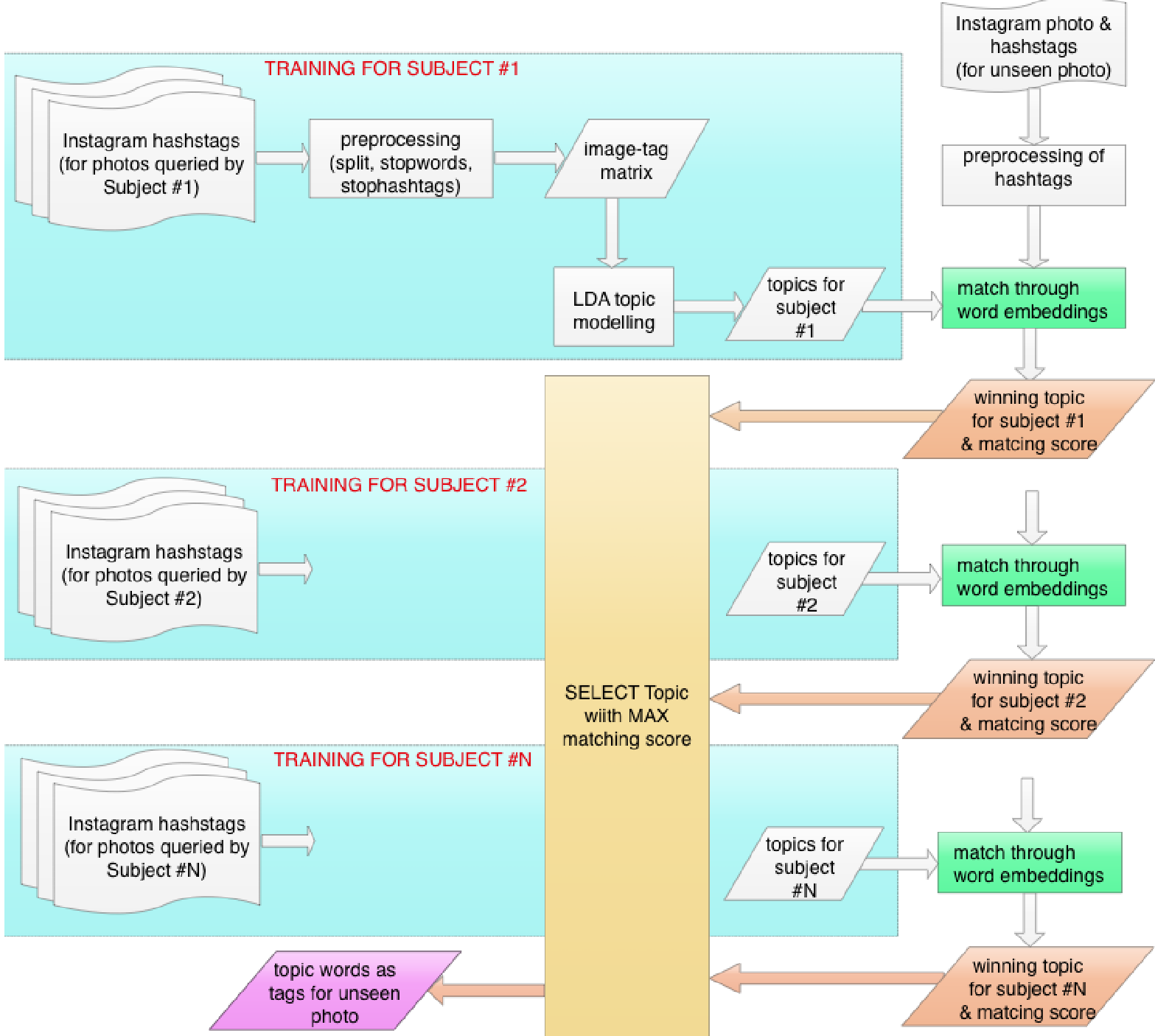 Fig 1: The proposed workflow for mining relevant tags using LDA and Word Embeddings.
3. Pre-processing is Key
Unlike standard text, hashtags require intensive cleaning:
- Splitting: Turning #picoftheday into [pic, of, the, day].
- Stop-hashtag removal: Filtering out engagement-bait tags that lack semantic value.
- Lemmatization: Grouping "flying," "flies," and "flew" under the same concept.
Experimental Insights
The study evaluated 1,000 images across 20 subjects (e.g., #airplane, #horse, #laptop).
Finding the "Sweet Spot" (Optimal Topics)
A critical part of topic modeling is choosing (the number of topics). If is too low, topics are too broad; if it's too high, they overlap. The authors used Aggregate Coherence Value (ACV) to find the optimal point where topics became most interpretable.
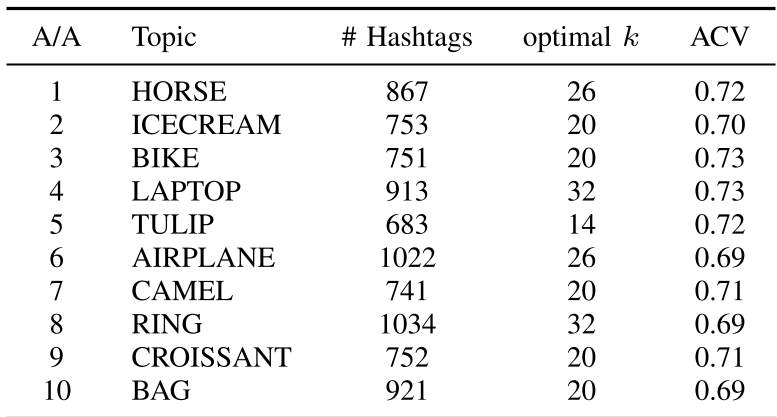 Table 1: Stability in topic coherence across different subjects like Horse, Bike, and Laptop.
Visualizing the Semantic Clusters
Using tools like pyLDAvis, the authors visualized how words cluster. For the subject #RING, the primary topic cluster contained words like "jewelry," "diamond," and "gold," effectively separating the physical object from unrelated user sentiments.
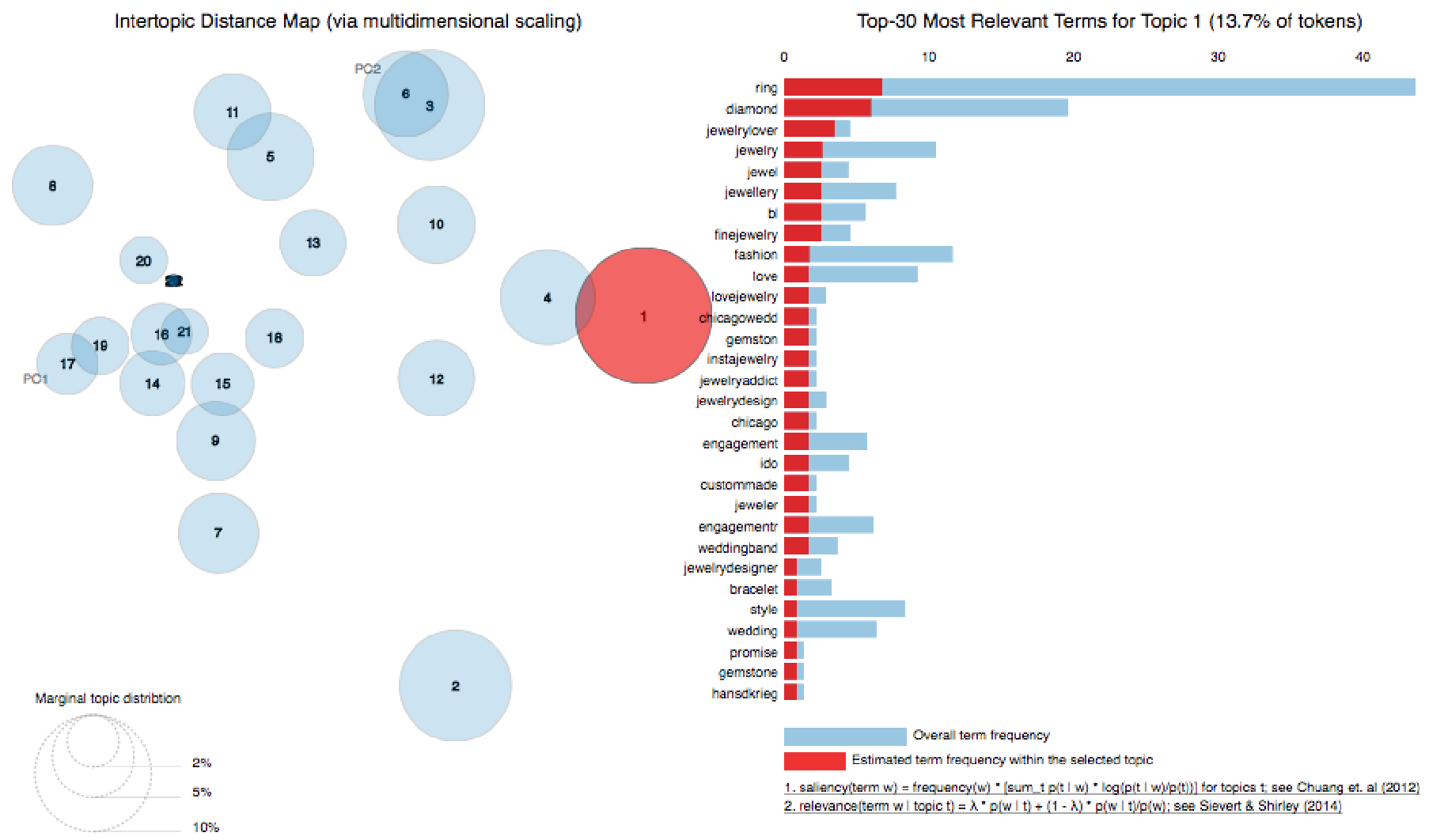 Fig 2: Visualization of the #RING topic, showing tight associations between relevant terms.
Critical Analysis & Conclusion
Takeaway
The paper successfully demonstrates that topic modeling is a viable alternate to manual image annotation. By leveraging the statistical co-occurrence of words, we can "clean" Instagram data at scale.
Limitations
- Physical vs. Abstract: The method works exceptionally well for tangible subjects (airplanes, dogs). However, it struggles with abstract concepts like "liberty" or "emotions," where hashtags are inherently subjective.
- Short Text Limitations: While Wikipedia enrichment helps, LDA natively struggles with very short documents (like a post with only 3 hashtags).
Future Work
The authors suggest moving toward crowdsourced verification to further validate the accuracy of the identified topics against human perception, potentially leading to a fully automated pipeline for generating high-fidelity AIA training sets.