
Credibility via Consensus: A Topic-Opinion Approach to Twitter Rumor Detection
Topic and Opinion Classification Based Information Credibility Analysis on Twitter
The paper introduces an automated system for assessing information credibility on Twitter by analyzing the consensus of public opinion. It combines Latent Dirichlet Allocation (LDA) for topic modeling and sentiment analysis via a semantic orientation dictionary to determine the ratio of corroborating opinions for any given tweet.
TL;DR
In the wake of the 2011 Great Eastern Japan Earthquake, Twitter became a double-edged sword: a vital tool for real-time information and a breeding ground for dangerous rumors. This paper proposes an automated system that judges the credibility of a tweet not by who sent it, but by how many other people agree with the sentiment once the topic is correctly identified. By leveraging Latent Dirichlet Allocation (LDA) and Sentiment Analysis, the system achieves "substantial agreement" with human fact-checkers.
The Core Challenge: Overabundance and Paraphrasing
Why is it so hard to spot a lie on Twitter? The researchers identify two main barriers:
- Information Overload: During a crisis, official verifications can't keep up with the millisecond-by-millisecond post rate.
- The Failure of "Keywords": Previous systems often relied on simple keyword matching (e.g., searching for the word "rumor"). However, users express the same idea in a thousand different ways—this is the paraphrasing problem.
The authors' insight was to move away from superficial metadata (like the number of retweets) and look at the underlying meaning of the conversation.
Methodology: Majority Rules in Latent Space
The system architecture is a pipeline designed to convert raw, messy tweets into a credibility score.
1. Topic Classification (The "What")
The system uses Latent Dirichlet Allocation (LDA). Instead of looking for exact words, LDA treats each tweet as a mixture of "latent topics." For example, even if two tweets don't share the exact same words, LDA can recognize that they both belong to a cluster regarding "Radiation in Food" based on word co-occurrence.
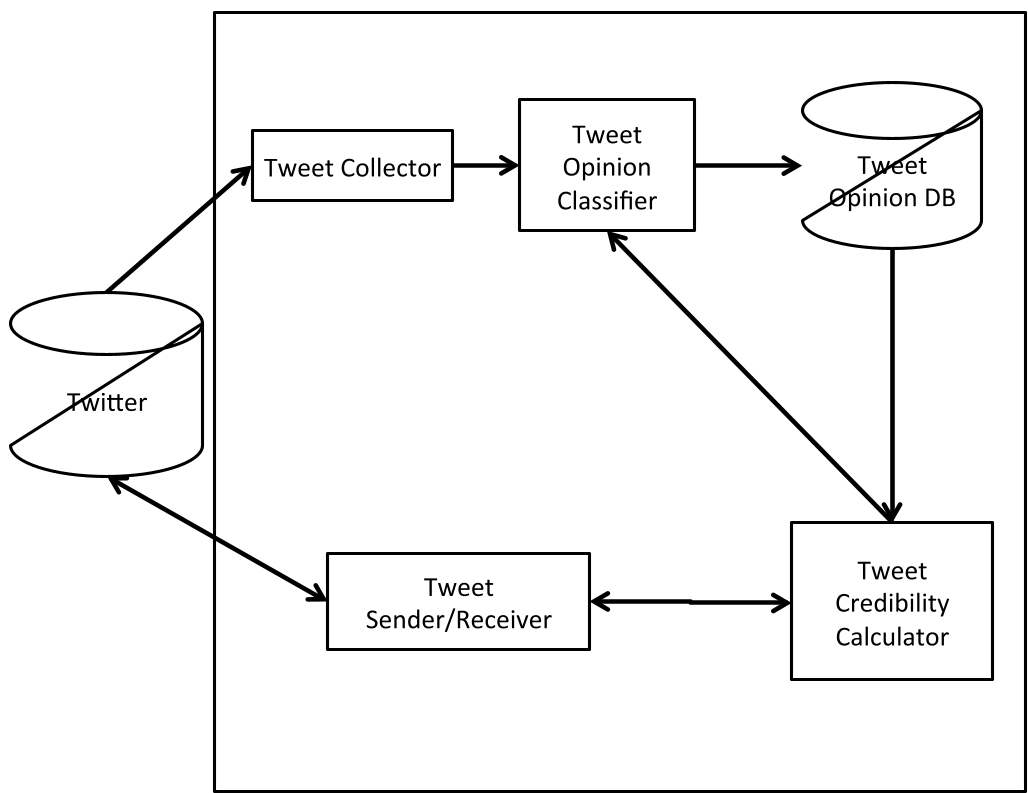 Fig 1: The 4-module architecture—from tweet collection to the final credibility calculator.
2. Opinion Classification (The "How")
Once the topic is set, the system needs to know if the tweet is asserting something "positive" (supporting a claim) or "negative" (refuting it). It uses a specialized dictionary where thousands of Japanese words are assigned a "positiveness" value.
3. The Credibility Formula
The final score is a simple yet powerful ratio: If most people discussing a specific topic reach the same conclusion, the system assigns high credibility.
Experiments: Testing Against Human Intelligence
The researchers tested the system on nearly 3,000 tweets from the 2011 disaster period. They used Kappa Statistics to measure how well the AI matched the judgment of human college students who were tasked with verifying the tweets using external sources.
Key Performance Metrics:
- Opinion Accuracy: 82.9% (The sentiment engine was highly effective).
- Topic Accuracy: 60.5% (The main bottleneck, often caused by the complexities of Japanese morphological analysis).
- Overall Credibility Agreement: 0.604 (Weighted Kappa). In academic terms, this is considered "Substantial Agreement."
 Table 1: Accuracy metrics for Topic and Opinion modules.
Critical Insights & Future Outlook
The system's greatest strength is its domain independence. Because it relies on the "Wisdom of Crowds" rather than specific website layouts, it can be applied to any anonymous web forum.
However, there is a clear Limitation: The system assumes the majority is usually right. In cases of "coordinated inauthentic behavior" (troll farms), the majority might actually be the source of the rumor.
Future Work: The authors suggest integrating Expertise Analysis. For example, a tweet about nuclear safety should carry more weight if it comes from a scientist than a random user. By weighting "who" says "what," the system could become even more resistant to the spread of misinformation.
Conclusion
This study proves that even with relatively "classical" NLP tools like LDA and dictionary-based sentiment analysis, we can build a resilient defense against misinformation by simply listening to the collective voice of the network.